Home › Guides › Banking to IT switch
Career & Salary · 2026Banking to IT Career Switch in India 2026: The 9-Month Plan, Skills Gap and Real Pay Bands
A banking to IT career switch in India usually takes 9 to 12 months of part time study and lands you in a junior data or analytics role, not a senior one. Entry data engineering roles are typically advertised between 4.5 and 8 LPA, and your banking domain knowledge is the part that gets you shortlisted.
- Your domain is the asset, not the liability. Reconciliation, regulatory returns and AML typologies are exactly the context a data team lacks. Hide your banking years and you compete as a fresher.
- Nine months at 10 to 12 hours a week is the honest figure. Not 90 days. The people who finish in six months already wrote SQL in their bank job.
- Entry bands are modest. Junior data engineering roles are commonly advertised from 4.5 to 8 LPA, and Indeed put the all India data engineer average at Rs 9,68,452 from 1.1k reported salaries as of 20 September 2026.
- The cheapest high value step is the exam, not the course. DP-700 costs about Rs 4,865 in India and DP-900 about Rs 3,696. That is the whole credential bill.
- A lateral move inside your own bank beats the open market. Internal transfers into data and technology teams skip the fresher filter that the reported fall in entry level openings has made brutal.
- Expect a flat year or a small cut. Most people move sideways on pay first and get the jump at the second move, 18 to 30 months in.
It is 11:40 PM on the last working day of the quarter. You are on your fourth reconciliation break, the fix is to retype one figure into a spreadsheet that two people will check again tomorrow, and somewhere in the same building a team of four is automating precisely this with a pipeline you are not allowed to touch. That gap, between the person who finds the break and the person who builds the thing that finds the break, is what this guide is about. It closes slower than LinkedIn suggests and faster than you probably fear.
Is a Banking to IT Career Switch Realistic for You in 2026?
Yes, with two conditions that decide almost everything: you can find 10 hours a week for nine months, and you are willing to re-enter at a junior title. If either is false, stop reading and spend the money on something else. The market is not short of people who want in. It is short of people who can write a correct SQL query and also explain what a nostro break is.
The demand side is genuinely good. Taggd's 2026 BFSI hiring outlook reports that around 61% of BFSI companies intended to increase headcount in early 2026, with the sharpest demand in AI and machine learning for credit risk models, automation engineering and model validation. Foundit listed 15,433 data engineer jobs across India on 1 October 2026. Glassdoor showed 1,088 AML roles in India in October 2026, and a growing share of those listings now ask for SQL and Python alongside the Prevention of Money Laundering Act knowledge you already have.
Here is the part the course adverts leave out. Entry level fresher openings across India are reported to be down roughly 44% year on year, so the bottom rung of the ladder is the most crowded place to stand. Your advantage is that you do not have to stand there. A 29 year old with five years in trade finance operations applying for a junior analytics engineer role at a bank's own technology arm is a different candidate from a 22 year old with a certificate, and the hiring manager knows it.
Who should not bother
If you are in a front office revenue role earning 14 LPA plus on relationship management, the arithmetic rarely works. You would re-enter technology around 8 to 12 LPA and spend three years climbing back. If you want out of banking rather than into engineering, you will quit the study plan in month three, because nothing about writing data pipelines at 11 PM is more pleasant than reconciliation unless you actually like the work. Operations, settlements, regulatory reporting, KYC, AML and MIS roles are where this move pays off most, and that is not an accident: those jobs are already half data work.
How to Switch From Banking to IT: The Skills Gap You Are Actually Closing
The gap is narrower than it looks, because most of what a data engineer does is reconciliation with better tools. What you are missing is not analytical judgement. It is the ability to express that judgement in code that runs tomorrow without you.
| What you already do in banking | What it maps to in a data role | What you actually have to learn | How interviewers test it |
|---|---|---|---|
| Reconciliation and break investigation | Data quality testing and row level validation | Writing tests in code: not_null, unique, referential checks, reconciliation counts between source and warehouse | "A table silently lost 400 rows last night. How would you have caught it before the business did?" |
| Excel pivots and daily MIS packs | Semantic modelling and BI | Star schema design, DAX measures, incremental refresh | "Model this fact table and tell me why you chose that grain." |
| Regulatory returns on a fixed deadline | SLA bound batch pipelines with audit trails | Orchestration, idempotent reruns, backfills, lineage | "The job failed at 2 AM and the return is due at 9. Walk me through it." |
| Maker checker and four eyes sign off | Code review and change control | Git, branches, pull requests, deployment pipelines | "Send me your repository." |
| Product knowledge: payments, trade finance, AML typologies | Domain modelling and metric definitions | SQL at volume: window functions, CTEs, slowly changing dimensions | "Write a query that flags accounts making repeated deposits just under the reporting threshold." |
| Nothing equivalent yet | Transformation at scale | Python, then PySpark and Delta tables | Live coding, usually 30 minutes, usually easier than you expect |
Mapping built from skills sections of data engineering and financial crime analytics listings on Foundit and Glassdoor India, read on 2 October 2026.
My opinion, and it is not the popular one: do not start with Python. Banking people are told to learn Python first because that is what the internet says, and then they spend two months on list comprehensions while the skill that gets them shortlisted goes untouched. Start with SQL and dimensional modelling, which you will half recognise, then add Python in month two once you have something to automate. The trade off is that you will feel behind in forum conversations for a while. You will be ahead in interviews, which is where it counts. SQL and Fabric pipeline work are taught hands on in 360DT's Microsoft Fabric data engineering course, and the weekend evening format means you keep the bank salary while you do it.
Also read: Data Analyst to Data Engineer in 2026, if you decide to take the two step route through an analyst title first.
The 9-Month Plan, Month by Month
Most answers to how to switch from banking to IT skip the calendar, which is where the plan actually lives or dies. This assumes 10 to 12 hours a week, which in practice means three weekday evenings and one weekend block. It also assumes you pick one cloud and stay there. Mixing Azure tutorials with AWS tutorials in month four is the single most common way people lose a quarter.
| Month | Focus | Concrete deliverable | Spend |
|---|---|---|---|
| 1 | SQL: joins, aggregation, CTEs, window functions | 50 solved query problems, pushed to a public repository | Nil |
| 2 | Python basics plus pandas, and DP-900 data fundamentals | A script that reads two CSV feeds and writes a match and break report | Nil |
| 3 | DP-900 exam, then dimensional modelling | DP-900 passed; a star schema diagram for a payments fact table | About Rs 3,696 exam fee |
| 4 | Power BI semantic models and DAX | A branch profitability dashboard with row level security by region | Nil |
| 5 | Microsoft Fabric: lakehouse, notebooks, Delta tables, PySpark | Bronze to silver to gold layers loaded from your CSV feeds | Course fee, if you take one |
| 6 | Orchestration, scheduling, failure handling | Project one shipped: a daily pipeline that reruns safely after a failure | Nil |
| 7 | DP-700 study: ingest, transform, monitor, secure | Two full practice exams above 80% | Nil |
| 8 | DP-700 exam and project two | Certification plus a second project in your own banking domain | About Rs 4,865 exam fee |
| 9 | Resume rebuild, internal transfer conversation, applications | Resume rewritten around deliverables; internal move requested in writing | Nil |
Exam fees are the India list prices for DP-900 and DP-700 published on Microsoft certification pages and confirmed in vendor guides read on 2 October 2026, exclusive of taxes. Timings assume 10 to 12 study hours a week and no prior coding.
Months one and two are where almost everyone fails, so it is worth seeing them at a finer grain.
The first 10 weeks, week by week
If you reach week 10 with a working reconciliation script, you will almost certainly finish the plan.
SELECT, WHERE, GROUP BY, and one real dataset
Load a public payments or transactions dataset into any free SQL environment. Stop when you can answer ten business questions about it without searching for syntax.
Joins and the grain problem
Learn why a join can duplicate rows and inflate a total, which is the same mistake that produces a false break in your day job. Deliverable: a query that reconciles two tables and returns only the differences.
Window functions
ROW_NUMBER, LAG, SUM OVER. These are what AML pattern questions are built from. Deliverable: flag every account with three or more deposits under a threshold inside seven days.
Python only as far as you need it
Read a file, loop, write a file, handle an exception, call pandas. Skip classes and decorators for now. Deliverable: your CSV matching script running from the command line.
Git and the public repository
Commit the script, write a README that explains the business problem in four lines, and sit the DP-900 if you feel ready. Deliverable: a link you can put on a resume.
Sequence reflects the skills most frequently listed in Indian data engineering job descriptions reviewed on 2 October 2026.
Banking to Data Engineer Salary in India: Advertised Pay Bands
Search for banking to data engineer salary in India and you will mostly find averages, which hide the only thing that matters to you: the entry band. These are advertised ranges, not offers, and not guarantees of what you will earn. Read them as the shape of the market rather than a price list.
| Experience in the data role | Typical titles | Advertised range (India) | What moves you to the top of the band |
|---|---|---|---|
| 0 to 1 year | Junior data engineer, analytics engineer, BI developer | 4.5 to 8 LPA | A certification plus two projects with real failure handling, not tutorials |
| 2 to 4 years | Data engineer | 10 to 18 LPA | Spark at volume, orchestration ownership, one production on call rotation |
| 5 to 8 years | Senior data engineer | 16 to 26 LPA | Cost control, platform decisions, GCC or product employer rather than services |
| 8 years plus | Lead or data architect | 25 to 40 LPA and above | Governance, migration leadership, stakeholder scope outside the data team |
| Domain overlay | Financial crime analytics, regulatory reporting engineer | 7.5 to 10 LPA at analyst level, higher with 8 years plus of domain depth | Banking regulation knowledge that a general engineer does not have |
Collection basis: advertised and reported ranges read on 2 October 2026 from Indeed India (all India data engineer average Rs 9,68,452, typical spread Rs 5,01,856 to Rs 18,68,861, from 1.1k reported salaries updated 20 September 2026), Azure and Fabric data engineer pay guides published by KnowledgeHut and Edureka in 2026, and AML and financial crime listings on Glassdoor India. Ranges are what employers advertise, not what any individual will be paid.
Advertised bands across a banking to data career, stage by stage
Each card shows the advertised span at that stage, not a promised increase for any individual.
Banking operations today
First data role, year 1
Data engineer, years 2 to 4
Senior, years 5 to 8
Banking operations spread from Glassdoor and salary aggregator data for operations executive roles in India; data role bands from the sources listed under the table above. Checked 2 October 2026.
Career change from banking to tech in India: which employer type to target
Go where your domain is a feature. A BFSI global capability centre in Bengaluru, Hyderabad, Pune or Chennai hires people who understand settlement cycles, and reports suggest India has been adding GCCs at close to one a week with financial services driving much of it. A fintech will pay you for payments knowledge. A general IT services firm will mostly pay you for the certificate, and will put you on whatever account has a seat. If you have a choice, take the GCC interview. If your own bank has a technology or data arm, take that conversation first, because it is the only route where your five years count as experience rather than as a gap on a technical resume.
What You Earn During the Transition, and the Pay Cut Nobody Mentions
You earn exactly what you earn now, because you are not quitting. That is the whole point of a nine month part time plan, and it is why the weekend evening format of courses like the Power BI and PL-300 data analyst track or the Fabric programme exists at all. Resign to study full time and you convert a manageable plan into a nine month hole in your income with no offer at the end of it.
The cut, when it comes, arrives at the offer stage. A 28 year old trade finance operations analyst in Chennai on 5.2 LPA fixed is a useful running example. Three realistic outcomes: an internal transfer into the bank's data team at the same 5.2 LPA with a title change, an external junior data engineer offer at 6.5 to 7 LPA, or an external offer at 5 LPA flat where the employer prices the first year as training. All three are normal. The last one stings, and it is still often the right trade if the stack is modern, because the second move is where the market revalues you. Candidates who switch domains commonly report that the real revaluation comes 18 to 30 months later, once the resume says "built and ran" rather than "trained in".
- Do not lead with your banking salary. It anchors you low in technology bands and high in their risk calculation. Lead with the band: "I understand junior data engineering roles here are advertised around 6 to 8 LPA."
- Price the domain, not the certificate. "You will not have to teach me what a nostro break, a value date or an SAR is, and your current team spends analyst time explaining that to engineers."
- Ask for a review, not a number, when they will not move. "Can we write a six month review at the band midpoint into the offer, tied to owning the regulatory reporting pipeline?"
- Get the stack in writing. A lower offer on Fabric, Databricks or Spark beats a higher offer maintaining a 2014 SSIS estate. The second one costs you the next switch.
A Banking to IT Career Switch, End to End
Illustrative composite, built from typical market paths rather than one named person. No real individual is described here and no outcome is implied.
Starting point. Twenty eight years old, five years in trade finance operations at a private bank in Chennai, 5.2 LPA fixed, strong Excel, no code, works a predictable 9 to 7 with genuinely free weekday evenings.
Months 1 to 3. SQL first, against a public transactions dataset. Passes DP-900 in month three for about Rs 3,696. Nearly quits in week six when window functions do not click, then they click because they are the same logic as a duplicate payment check done by hand.
Months 4 to 6. Power BI, then Fabric. Builds the first real project: two synthetic SWIFT style message feeds landed in a lakehouse, matched on value date and amount, with breaks written to a gold table and a dashboard on top. Obstacle: the pipeline works manually and breaks every time it reruns, which forces a real lesson in idempotency that no tutorial had delivered.
Months 7 to 9. DP-700 in month eight for about Rs 4,865. Second project is a regulatory style daily return with lineage and a safe rerun switch. Month nine: the internal conversation with the bank's data team, which goes nowhere because there is no open headcount, and 40 external applications that produce four calls.
Months 10 to 11. Two rejections on live coding, one rejection for asking for 9 LPA. The offer that lands is a BFSI GCC junior analytics engineer role at 7 LPA fixed, chosen over a 7.8 LPA services offer maintaining legacy SSIS packages.
Where it ends. Eleven months, about 480 study hours, roughly Rs 8,600 in exam fees plus one course, a title change from operations analyst to analytics engineer, and a pay move from 5.2 to 7 LPA. Not the 40% jump the internet promises. The jump the composite is actually betting on is the one at month 30, when the band for 2 to 4 years of data engineering experience opens up.
Four Portfolio Projects Only a Banking Background Makes Credible
A tutorial project tells an interviewer you can follow instructions. A project drawn from work you have actually done tells them you understand why the data is wrong in the first place, which is the entire job. Use synthetic or public data for all four.
Four projects that read as experience, not coursework
Each one is a thing you have done by hand that you are now doing in code.
Nostro reconciliation pipeline
Ingest two synthetic statement feeds with deliberately mismatched value dates. Match on amount and date tolerance, write unmatched items to a break table, and add a test that fails the run if row counts drift.
SQL + Fabric lakehouseStructuring pattern detector
Generate transactions, then use window functions to flag accounts with three or more deposits just under a reporting threshold inside a rolling seven days. Document the false positive rate.
Window functionsDaily regulatory style return
A scheduled batch that produces a fixed format file, records lineage, and can be rerun for a past date without double counting. This is the project that answers the 2 AM failure question.
OrchestrationBranch profitability semantic model
A star schema over synthetic branch and product data, with DAX measures for cost to income and row level security so a regional head sees only their own region.
Power BI + DAXProject scopes mapped to responsibilities listed in Indian data engineering and BFSI analytics job descriptions read on 2 October 2026.
If the AML and credit risk side appeals more than pipelines, the adjacent route is model operations rather than data engineering, and the MLOps engineer track built around AI-300 maps to that work. If your bank is rolling out Microsoft 365 Copilot and you are closer to the change management side than the code, Copilot and agent administration is a shorter and genuinely underrated door into technology.
Build the Fabric data engineering skills a banking to IT switch actually needs
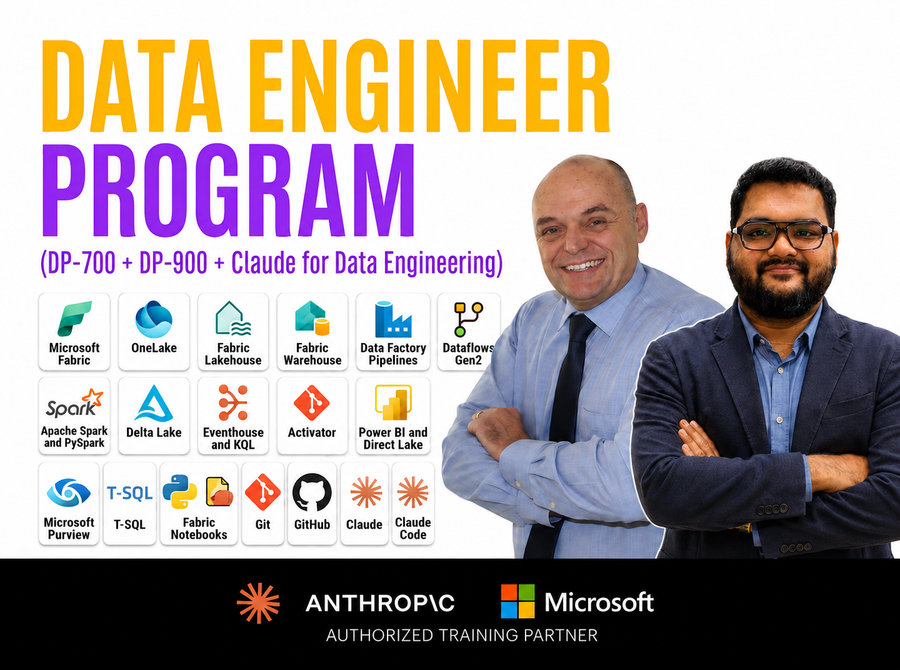
Live weekend sessions covering Microsoft Fabric data engineering for the DP-700 certification, with DP-900 fundamentals included. Hands on projects and mentor support, taught over 8 weeks without leaving your current job.
Explore the course
What Goes Wrong, and the Honest Caveat
Here is the warning a colleague would give you over a desk rather than the one documentation gives you. Do not take real bank data home to practise on. Not a masked extract, not a sample of 200 rows, not one spreadsheet. People have lost careers over far less, and every project in this guide works perfectly on synthetic data. If you want realism, generate it with a script and say so in the README.
- The timeline slips to 14 or 18 months. Quarter end, audit season and a two week production crisis eat study time in exactly the weeks you planned to catch up. Build in a buffer month rather than pretending you will not lose one.
- The certificate arrives and nothing happens. A pass with no repository behind it reads as a course, not a capability. Two projects with failure handling outperform three certifications.
- You get filtered as a fresher. Automated screens read years of relevant experience as zero. The fix is the internal transfer route, BFSI employers, and a resume headline that says "operations analyst moving into data engineering, banking domain" rather than "aspiring data engineer".
- The offer is a maintenance seat. Legacy ETL maintenance on an old stack pays today and costs you the next two switches, because nothing on the resume refreshes.
- The pay cut is permanent in your head. People who treat the first year as a training year cope. People who expected a hike at move one often quit back into banking in month six.
And the honest caveat about the training market, including ours. A course compresses the time you spend being confused, gives you structure on weekends and puts a person in front of you when you are stuck. It does not do the 480 hours for you, it does not hand you a job, and 360DT does not offer placement or recruitment. Anyone selling a nine month switch as a guaranteed outcome is selling you something that does not exist. If you are disciplined, have good SQL already and enjoy reading documentation, you can do most of this with free Microsoft Learn paths and the two exam fees. That is a legitimate choice, and it is cheaper.
Also read: Average Salary Hike on a Job Change in India 2026 for what the market typically reports once you are inside tech and switching normally. For the destination pay picture in detail, see Data Engineer Salary in India 2026.
Related guides
- PL-300 vs DP-700 in 2026 decides the month three question in this plan: analyst credential first, or straight to engineering.
- What Is ETL? is the concept behind every reconciliation you have ever done by hand, explained in engineering terms.
- Data Engineering Projects for 2026 gives six more builds with datasets and real cloud costs if the four above are not enough.
- Data Engineer Interview Questions 2026 is what month nine looks like, with model answers to the failure and grain questions.
- Tech Salary in Mumbai 2026 matters if you are switching inside the city where most Indian banking jobs sit.
- SQL Query Optimization in 2026 is the month one and two skill taken to the level interviews actually probe.
Frequently asked questions
Is a banking to IT career switch worth it in 2026?
It is worth it if you are in operations, settlements, KYC, AML, MIS or regulatory reporting and you are prepared to re-enter at a junior technology title. Entry data roles are commonly advertised from 4.5 to 8 LPA, so the gain is usually in the second move rather than the first. It is a poor trade if you are already above 14 LPA in a front office role, because rebuilding to that level typically takes three years or more.
Can I switch from banking to IT without a technical degree?
Yes. Indian data engineering and analytics listings overwhelmingly ask for skills and certifications rather than a computer science degree, and a BCom or BBA with a Microsoft certification and two working projects clears most screens. The filter you will hit is the automated experience filter, not the degree field, which is why internal transfers and BFSI employers are the easier doors.
Am I too old to switch from banking to IT at 32?
No, but the shape of the switch changes. At 32 with eight or nine years of banking behind you, applying for a generic junior role puts you against candidates who cost less, so aim at roles where your domain is in the job description: financial crime analytics, regulatory reporting engineering, risk data, or a BFSI global capability centre. Those teams routinely hire people in their thirties precisely for the banking context.
Will I have to take a pay cut when I move from banking to a data role?
Often you move flat rather than down. Common outcomes are an internal transfer at the same fixed pay with a new title, or an external junior offer slightly above or slightly below your current number. Plan your finances for twelve flat months. If an employer prices your first year as training, judge the offer on the technology stack, because a modern stack is what makes the next move pay.
Which certification should a banking professional take first, DP-900 or DP-700?
DP-900 first, at roughly Rs 3,696 in India, because it is cheap, it takes a few weeks, and it forces the vocabulary. DP-700, at roughly Rs 4,865, is the one that actually appears in job descriptions, so it is the one worth real study time. If you are already strong in SQL and short on time, skipping straight to DP-700 is a defensible call.
How long does it realistically take to switch from banking to IT in India?
Nine months of study at 10 to 12 hours a week, then one to three months of applying and interviewing. Eleven to thirteen months end to end is the realistic figure for someone starting without code. People who already write SQL at work compress it to six or seven months. Quarter end, audit cycles and production incidents are what push it past a year.
Do banks hire their own operations staff into technology teams?
Many do, through internal mobility programmes, and it is the single highest probability route available to you because your years count as experience rather than reading as a gap. The constraint is open headcount in that team at the moment you are ready, which is why you ask in writing in month nine and keep applying externally in parallel.
Is data engineering better than data analytics for someone coming from banking?
Data engineering has the higher pay ceiling, and the advertised bands above show it. Analytics is the easier first step, because Excel and MIS work transfer almost directly and a Power BI credential takes less time than a Fabric one. The two step route through an analyst title is slower on paper and more reliable in practice for people with no coding background.
What I Would Do in Your Position
If I were the trade finance analyst in that composite, I would do three things this week and ignore everything else. Ask my own bank's data team what they run, in a fifteen minute coffee, because that answer tells me which cloud to pick and gives me a name to go back to in month nine. Book the DP-900 exam for ten weeks out, so the plan has a date rather than an intention. And start SQL tonight on a dataset that looks like my day job, not on a tutorial about movie ratings.
The judgement call I would make differently from most advice: treat the certification as the deadline and the two projects as the product. A pass gets you past a filter. A repository that reconciles two feeds and survives a rerun is what makes an interviewer stop reading your resume and start talking to you. If you want that work taught live on weekends while you keep the bank salary, the Microsoft Fabric Data Engineer course is where the DP-700 syllabus and the project work sit together, and you can see the rest of the roster on the certifications overview or try a free webinar before you spend anything.
About this guide. 360 Digital Transformation is an Anthropic Partner, offering exam preparation and skills training. We do not offer placement or job guarantees. Other certification bodies and employers named here are not affiliated with us. Salary figures are advertised market ranges collected from public job listings, not guarantees of what any individual will earn. Figures cited were checked on 2 October 2026.
 Microsoft Fabric
 Python