Home › Guides › Data Engineer Interview Questions
Career Guide · 2026Data Engineer Interview Questions 2026: 20 Real Questions With Model Answers
Data engineer interview questions in 2026 center on SQL window functions, Python or PySpark transformations, Microsoft Fabric pipelines and the DP-700 exam domains, plus a system design round for anyone with 2+ years of experience. Most Indian product and GCC teams run four rounds, and SQL alone eliminates more candidates than any other single topic.
- Four rounds is the norm: recruiter screen, SQL and Python round, Fabric or Spark scenario round, then system design or behavioral for anyone past their first job.
- SQL still eliminates the most candidates, mostly on window functions and query optimization, not syntax recall.
- Fabric and DP-700 questions are scenario based now: expect "design a pipeline for X," not "define a Lakehouse."
- Data engineer salary in India 2026 runs roughly ₹6 to 9 LPA for freshers up to ₹35 LPA and above for 8+ years, per industry-advertised listings.
- Behavioral rounds score one specific pipeline failure you debugged, not a generic teamwork story.
- Certification gets you past the keyword filter, not the technical round; DP-700 proves vocabulary, your project proves judgment.
Your resume says three years of SQL and Power BI, the recruiter calls it a data engineer round, and forty minutes in you're screen-sharing a PySpark deduplication script while a stranger watches you think. That's the shape of most data engineer interviews in India now: less "define ETL," more "here's a broken pipeline, fix it out loud." We pulled the questions that keep recurring across product companies, GCCs and the service majors building Fabric practices, built around one running example: a Pune-based data analyst with three years of SQL and Power BI, now interviewing for her first data engineer title.
What a Data Engineer Interview in India Actually Tests
Three years ago the bar was "do you know what ETL stands for." Not anymore. Interviewers now assume you've read the job description and spend the round checking whether you can operate the stack it names, which in 2026 increasingly means Microsoft Fabric and DP-700 rather than raw Hadoop or on-prem SSIS. A GCC panel often defaults to Databricks and Spark questions even when the role runs on Fabric, because the interviewers trained on Databricks years ago and never updated their question bank. That mismatch catches candidates off guard more than the Fabric content itself.
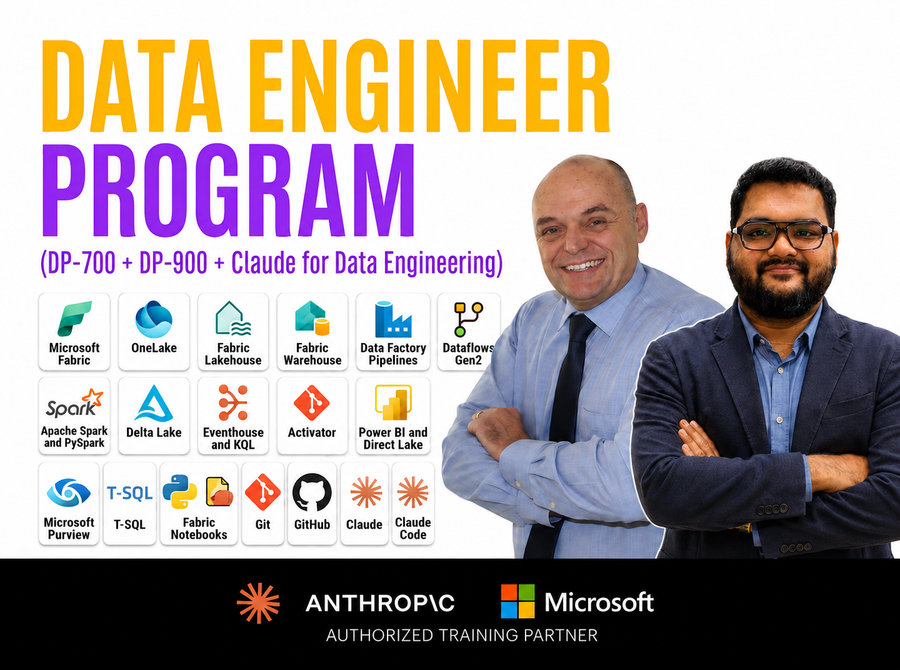
Our data engineer roadmap for 2026 covers the skills sequence this interview assumes you've been through. For our Pune analyst, the interview isn't testing whether she's seen a Fabric screen before; it's testing whether she can reason about partitioning, incremental load and failure recovery in whatever tool sits in front of her, and translate her Power BI and SQL instincts into pipeline language. 360DT's live Fabric Data Engineer Course builds that translation directly, with weekend labs covering DP-900 fundamentals, DP-700 scenarios and a portfolio pipeline you can defend.
The Interview at a Glance
Four rounds, roughly three hours total
A typical Indian data engineer interview loop, end to end
Based on listings and candidate reports reviewed for this guide, checked October 2, 2026.
8 SQL and Python Data Engineer Interview Questions With Model Answers
SQL interview questions for data engineer roles
These come back loop after loop. None need exotic syntax; all need you to reason about the data before you type.
| Question | What It's Really Testing | Model Answer in Brief |
|---|---|---|
| Find the second-highest salary per department without LIMIT or OFFSET. | Window function fluency |
RANK() OVER (PARTITION BY dept ORDER BY salary DESC), filter where rank equals 2. |
| Explain RANK, DENSE_RANK and ROW_NUMBER with an example where they disagree. | Tie handling in ranking logic | Tied scores: RANK leaves gaps, DENSE_RANK doesn't, ROW_NUMBER ignores ties entirely. |
| Deduplicate a PySpark DataFrame on a subset of columns, keeping the latest row. | PySpark transformation and windowing |
Window.partitionBy(cols).orderBy(desc("updated_at")) plus row_number(), filter to 1. |
| When would a broadcast join break in Spark, and why? | Distributed execution judgment | Past the broadcast threshold or with skew, it falls back to a shuffle join with OOM risk. |
| Detect gaps in a daily sequence of dates per customer. | Self-joins and date arithmetic | Generate a date spine, left join against actuals, filter nulls. |
| What changes when you UPDATE a Delta table versus a plain Parquet file? | Lakehouse table formats | Delta logs a new transaction version; Parquet has no update primitive. |
Optimize SELECT * FROM orders WHERE YEAR(order_date) = 2026. |
Query optimization instinct | The function on the column blocks pushdown; rewrite as a date range, select only needed columns. |
| How do you handle schema drift in a daily ingestion pipeline? | Production resilience thinking | Schema-on-read staging, explicit contract checks before promoting to curated, alert instead of silently dropping columns. |
If SQL is genuinely the shaky part of your profile rather than Fabric specifically, that's worth fixing before anything else: 360DT's Data Analyst Course runs a full SQL, Excel and Power BI module live, which is the same foundation this round is checking. If you only have time to drill one category of sql interview questions for data engineer roles before your next interview, make it this table.
6 Microsoft Fabric and DP-700 Data Engineer Interview Questions With Model Answers
DP-700 interview questions you'll actually get asked
These DP-700 interview questions assume you've skimmed the exam's skill outline once, and they're asked as scenarios, not definitions, the same way 360DT's live Fabric course structures its DP-700 prep.
Microsoft Fabric data engineer interview questions on architecture and load strategy
Most microsoft fabric data engineer interview questions in 2026 are scenario based rather than definitional, which is why memorizing the exam guide alone will not carry you through this round.
| Question | What It's Really Testing | Model Answer in Brief |
|---|---|---|
| Design a medallion architecture (bronze, silver, gold) in Fabric for daily sales data. | Layered pipeline design | Bronze as raw files, silver as cleaned and conformed, gold as business-ready aggregates, each in its own Lakehouse schema. |
| Lakehouse versus Warehouse in Fabric: when do you pick one over the other? | Workload-appropriate design | Lakehouse for files, notebooks and Spark; Warehouse for T-SQL-first BI teams needing full transactions. |
| How does OneLake differ from a traditional lake on ADLS Gen2? | Fabric's storage model | One tenant-wide logical lake with shortcuts across workspaces, so data isn't physically copied between stores. |
| A pipeline that's run fine for three months suddenly times out on one table. What do you check first? | Production debugging order | Source row count and skew, then Spark pool sizing, then whether a partition key changed upstream. |
| What does DP-700 expect on Spark pool configuration that the retired DP-203 (Synapse) exam didn't? | Currency with the current exam | Starter pools, autoscale and workspace-level capacity replace the old dedicated-pool sizing conversation. |
| How do you implement incremental load, not a full refresh, in a Fabric pipeline? | Cost and performance awareness | A watermark column plus a copy activity filtered against a control table's last-loaded timestamp. |
3 System Design Questions for 2 to 4 Years of Experience
Past your first role, expect open-ended design prompts with no single correct answer; the interviewer grades your questions as much as your diagram.
- Design a pipeline that ingests 50 GB of clickstream data daily, queryable within 15 minutes of arrival. A strong answer asks about query patterns before proposing streaming versus micro-batch.
- Redesign a pipeline that reprocesses two years of history every night "because it's simpler." Name the real tradeoff: reprocessing is easier to reason about but burns compute linearly as history grows, so you switch to incremental load once the nightly runtime misses its SLA, not before.
- A dashboard shows stale numbers every Monday morning. Debug it live. Check the weekend batch schedule first; most "stale Monday" bugs are a pipeline that silently didn't run, not a transformation bug.
If the job description is AWS rather than Microsoft, swap Fabric for Glue and Redshift in your head: the design logic holds, only the service names change. 360DT's AWS Solutions Architect & DevOps Course covers that side, and the Azure Solutions Architect & DevOps Course covers teams still running Synapse alongside Fabric.
3 Behavioral and Case Questions Recruiters Actually Score
These get answered generically more often than any technical question here, which is exactly why they're worth preparing word for word, not just thinking through.
- "Tell me about a pipeline you broke in production." Name the table, the real cause (usually an unannounced schema change upstream), and the monitoring gap it exposed.
- "How do you decide whether a transformation belongs in SQL or orchestration code?" SQL for set-based logic near the warehouse; orchestration for branching, retries, anything touching multiple systems.
- "Walk me through disagreeing with a data scientist about a schema change." A backward-compatible column addition beats a breaking rename, and naming the dashboards it protected beats "I just did what they asked."
Downstream consumers increasingly include an agent or a RAG pipeline reading your tables, not just a dashboard. If that fits your target role, skim 360DT's AI Engineer Course on how retrieval pipelines consume structured data, so you're not caught flat when asked who reads your gold layer.
What Clearing the Interview Is Worth: Data Engineer Salary in India 2026
Data engineer pay by experience band
Industry-advertised ranges, not a fixed pay scale
Industry and job-listing ranges suggest these bands; offers vary by city and company type, checked October 2, 2026.
For a deeper breakdown by city and company type, see our full data engineer salary guide. What actually moves you between bands isn't years on paper; it's whether you can own a pipeline end to end without an architect designing it for you first.
6 Mistakes That Sink Otherwise Good Candidates
Treating DP-700 vocabulary as debugging instinct
You can define a Lakehouse perfectly and still freeze when a pipeline times out in front of you.
Certification gapOnly knowing Databricks when the JD says Fabric
Concepts transfer, but interviewers notice when you can't name one Fabric-specific screen or setting.
Stack mismatchDefaulting to "add an index" for every slow query
Half these queries are slow from a function wrapped around a column, not a missing index; our SQL optimization guide covers the rest.
SQL habitNo story for "what did you do when it broke"
Walking in without one real production incident is the single most common reason strong candidates still get a pass.
Behavioral gapSkipping data quality checks entirely
No mention of dbt tests, Great Expectations or a basic row-count assertion signals you've never owned a pipeline past demo stage.
Quality gapProposing an architecture before asking data volume
Jumping to "I'd use Spark" without asking if the dataset is 500 MB or 500 GB reads as memorized, not reasoned.
Design habitWhat usually goes wrong: candidates spend three weeks on LeetCode-style SQL puzzles and walk in unable to explain their own resume project in architecture terms. The follow-up is almost always "why did you choose that," not "write one more query." Prepare your project's defense first.
A 2-Week Prep Plan If You Have a Scheduled Interview
If you only drill one thing before a data engineer interview in India, pick SQL window functions over Fabric trivia. Recruiters can coach Fabric vocabulary in a ten-minute call; they cannot coach query intuition that fast, and it shows within the first five minutes.
Days 1 to 4: redo the eight SQL and Python questions above from a blank editor, no notes. Days 5 to 8: rebuild one small Fabric pipeline end to end on free trial capacity. Days 9 to 11: say your production incident story and your "why this architecture" story out loud. Days 12 to 14: mock the system design round with a friend using the three prompts above.
If your debugging already leans on Claude Code, increasingly normal for data engineers, 360DT's CCDV-F prep course turns that into a credential recruiters recognize alongside DP-700.
Walk Into the Fabric Round Having Actually Built the Pipeline
360DT's live Microsoft Fabric Data Engineer Course puts you through medallion architecture, incremental loads and the DP-700 and DP-900 domains across real weekend labs, not slide decks. You leave with a portfolio pipeline you can defend, not just a certificate.
Explore the course
Related guides
- AI Engineer Interview Questions 2026 for the same format on the agentic AI side of the stack.
- Data Analyst vs Data Engineer in 2026 if you're still deciding which title to interview for.
- What Is Apache Kafka? for the streaming concepts a role can add beyond batch Fabric work.
- PL-300 vs DP-700 in 2026 for weighing a BI certification against the engineering one.
- Apache Airflow Tutorial 2026 for the orchestration layer interviewers assume you've touched.
Frequently asked questions
What are the most commonly asked data engineer interview questions in 2026?
They cover SQL window functions, PySpark transformations, Microsoft Fabric or Spark pipeline design, incremental load strategy and one production debugging scenario, usually across four rounds at Indian product companies and GCCs.
What data engineer interview questions should freshers expect?
Simpler versions of the same categories: basic joins and window functions, a definitional round on ETL versus ELT and Lakehouse versus Warehouse, and much less emphasis on production debugging.
Is SQL enough to clear a data engineer interview, or do I need Spark too?
SQL alone clears the first screen at many companies, but any role above fresher level expects conversational PySpark too, since most Fabric and Databricks pipelines mix SQL and Spark notebooks.
Do I need the DP-700 certification before I start interviewing?
No. DP-700 helps past a recruiter's keyword filter and signals current Fabric terminology, but it doesn't replace a portfolio project; interviewers test whether you can build and debug, not whether you've memorized exam objectives.
How many rounds does a typical data engineer interview have in India?
Most loops run four: a recruiter or hiring-manager screen, an SQL and Python round, a Fabric or Spark scenario round, and a system design or behavioral round beyond your first job.
What is the difference between a data analyst and data engineer interview?
A data analyst interview weighs SQL, dashboarding and business communication; a data engineer interview adds pipeline design, orchestration, distributed processing and production failure scenarios on the same SQL base.
How long should I prepare before a data engineer interview?
Two focused weeks if your SQL and one end-to-end project are already solid; six to eight weeks if you're starting Fabric or DP-700 from zero.
Can I switch from a data analyst role to data engineer without a computer science degree?
Yes. Most Indian data engineering teams hire on demonstrated SQL depth and a working pipeline project over degree background, which is why a portfolio project matters more here than in most tech hiring.
About this guide. 360 Digital Transformation is an Anthropic Partner. Other certification bodies, vendors and employers named here are not affiliated with us. Figures cited were checked on October 2, 2026.
 Microsoft Fabric
 Python