Home › Guides › LangChain vs LlamaIndex
Comparison · 2026LangChain vs LlamaIndex in 2026: Real Costs, Code Volume and Which RAG Framework to Build On
LangChain vs LlamaIndex is a scope decision, not a quality one. Choose LlamaIndex when retrieval quality over your own documents is the product; choose LangChain with LangGraph when a stateful agent must plan, call tools and recover from failure. Both are free and open source, and LangSmith's 5,000 monthly traces cost nothing to test.
- Scope decides this, not quality. LlamaIndex is a retrieval and document framework that grew agents. LangChain is an orchestration framework that grew retrieval. Both do both now, and each is still better at the thing it started with.
- LlamaIndex wins on messy documents. LlamaParse, hierarchical chunking, auto-merging retrieval and sub-question decomposition are first-class, not community add-ons.
- LangGraph wins on control flow. Cycles, durable state, human approval steps and resumable runs are the reason Klarna and LinkedIn built on it rather than on a chain abstraction.
- The frameworks are free; the managed services are where money appears. LangSmith's Developer plan is free for one seat with 5,000 base traces a month at 14-day retention, and LlamaCloud's free tier lists 10,000 credits a month, roughly 1,000 parsed pages.
- Indian job postings name LangChain far more often. Around 2,000 LangChain listings sit on Indeed India, with LlamaIndex usually appearing as a secondary bullet in the same ad.
- Do not choose on GitHub stars. The roughly 147,000 to 52,300 gap reported in September 2026 tracks age and scope, not retrieval quality.
- The 2026 production default is both. LlamaIndex as the retrieval layer, LangGraph as the orchestrator, one tracing tool across the whole run.
Your document question-answering demo answered six questions perfectly in the review meeting. Then legal uploaded a 240-page scanned policy PDF with three nested tables, and the same pipeline started confidently quoting a table footnote as the policy limit. That is the week the framework question stops being academic, because the fix is not a better prompt. It is a better parser, a better chunking strategy, and somewhere to put the retry logic.
LangChain vs LlamaIndex: the verdict first
If retrieval quality over your own documents is the product, build on LlamaIndex. If the product is an agent that takes actions and has to survive a half-failed run, build on LangChain with LangGraph. If you are choosing what to learn for a job in India rather than what to ship this quarter, learn LangGraph first, then add LlamaIndex as your retrieval layer.
That last call has a cost, and you should know what you are accepting. Writing a baseline RAG pipeline in LangChain takes noticeably more code than the LlamaIndex equivalent, and independent comparisons published this year put the gap around 30 to 40 percent more lines for the same result. You pay that tax in exchange for two things: the orchestration vocabulary that Indian job ads keep asking for by name, and control over the retry, branch and approval logic that a chain abstraction hides from you. For a solo learner shipping a portfolio project in three weekends, that trade is bad. For someone who wants to be employable as an AI engineer building RAG and agent systems next year, it is the right trade.
Four numbers that settle most of the argument
Version maturity and free-tier limits, because these are what people get wrong in interviews.
From the LangChain 1.0 launch announcement, the LangSmith and LlamaCloud pricing pages and PyPI release history, checked 2 October 2026.
LangChain vs LlamaIndex compared across 12 criteria
Read this table as two different bets on where the hard part of your application lives.
| Criterion | LangChain (with LangGraph) | LlamaIndex (with Workflows) |
|---|---|---|
| What it was built for | Orchestrating LLM calls, tools, memory and multi-step logic | Indexing and retrieving over your own documents |
| Version maturity | 1.0 general availability on 22 October 2025, no breaking changes promised before 2.0; langgraph 1.2.12 on PyPI dated 21 September 2026 | llama-index-core at 0.14.25 on 21 September 2026; Workflows split into its own package, llama-index-workflows, at 2.23.3 dated 22 August 2026 |
| Document parsing | Community and third-party loaders; you choose and wire the parser | LlamaParse is first-party, with Fast, Cost Effective, Agentic and Agentic Plus modes |
| Retrieval sophistication | Solid vector and hybrid retrieval, reranking via integrations | Hierarchical chunking, auto-merging retrieval, sub-question decomposition, response synthesis modes built in |
| Agent orchestration | LangGraph state machines with cycles, durable execution, interrupts and checkpointed resume | Workflows with typed state, event-driven steps, resource injection and human-in-the-loop |
| Code volume for a baseline RAG app | Higher; comparisons this year report roughly 30 to 40 percent more code for the same pipeline | Lower; five to ten lines gets you a working query engine over a folder |
| Integration count | Advertised at over 500 integrations | Advertised at over 350 connectors through LlamaHub |
| Managed cloud product | LangSmith for tracing, evals and prompt management; LangGraph Platform for deployment | LlamaCloud for parsing, indexing and hosted retrieval |
| Observability story | LangSmith is native, which is a real advantage and also a lock-in risk | OpenTelemetry and Arize Phoenix through llama-index-instrumentation, vendor-neutral by default |
| Learning curve | Steeper; graph thinking, state schemas and middleware take a week to click | Gentler for retrieval, steeper once you move past the default query engine |
| Hiring demand in India | Named directly in roughly 2,000 Indeed India listings when checked, around 800 of them in Bengaluru | Usually a secondary bullet in the same ads rather than the headline requirement |
| Who should default to it | Teams shipping agents that act, and anyone optimising for employability | Teams whose product is answers grounded in a document corpus |
One row deserves a flag. The code-volume difference is real but it is measured on the baseline case, a flat corpus and a single retrieval step. Once you add a routing step, a self-correction loop and an approval gate, the two converge, because at that point you are writing orchestration either way. Benchmarks that stop at the baseline flatter LlamaIndex more than production does.
What each one actually does differently
LangChain: the graph is the point
Since 1.0, the headline primitive is create_agent rather than the old AgentExecutor, with middleware hooks for things you used to monkey-patch, and Standard Content Blocks that normalise the differences between providers so swapping a model does not rewrite your message handling. Underneath all of it sits LangGraph as the runtime, which is the part that matters: your application is a graph of nodes with a typed state object, and the framework can checkpoint that state, pause for a human, and resume from the exact node that failed.
That last capability is why finance and support teams pick it. When a tool call times out on step seven of nine, you do not rerun the whole chain and pay for seven more LLM calls. Agent architecture at this level of detail is exactly what the CCAR-F architect foundations syllabus tests, and 360DT's cohort builds a checkpointed graph live rather than reading about one.
LlamaIndex: the index is the point
LlamaIndex starts from the assumption that your documents are hostile. Scanned pages, merged table cells, footnotes that change the meaning of the row above them. LlamaParse exists because a generic PDF-to-text loader throws away the structure that made the document answerable, and the parse modes are priced accordingly: the pricing page lists 1 credit per page for Fast, 3 for Cost Effective, 10 for Agentic and 45 for Agentic Plus.
Above the parser sit the retrieval strategies that most teams reinvent badly. Auto-merging retrieval fetches small chunks for precision then promotes to the parent chunk for context. Sub-question decomposition splits "how did our claims ratio change between FY24 and FY25" into two retrievals and a synthesis step. Workflows 1.0, now shipping as a standalone package with typed state and resource injection, closed most of the orchestration gap that used to be the argument against LlamaIndex.
Also read: Retrieval Augmented Generation Explained in 2026: How RAG Actually Works, Step by Step.
What LangChain and LlamaIndex cost in 2026
Both frameworks are open source and free to install. Every rupee in this section comes from the managed services beside them, and the single biggest variable is not which framework you chose. It is which parse mode you left on.
| Line item | LangChain path | LlamaIndex path |
|---|---|---|
| Framework licence | Free, open source | Free, open source |
| Free tier worth testing on | LangSmith Developer: one seat, 5,000 base traces a month, 14-day retention | LlamaCloud free: 10,000 credits a month, about 1,000 pages |
| First paid step | LangSmith Plus at $39 per seat per month, 10,000 base traces included | LlamaCloud Starter at $50 a month for 40,000 credits |
| Overage pricing | $2.50 per 1,000 base traces, $5.00 per 1,000 extended traces at 400-day retention | Credits bill at $1 per 1,000; Pro listed at $500 a month for 400,000 credits |
| Document parsing, 50,000 pages | Bring your own parser; cost depends entirely on what you picked | $50 on Fast, $150 on Cost Effective, $500 on Agentic |
| Observability | Priced into LangSmith seats | Self-hosted OpenTelemetry collector, so infrastructure cost only |
| Realistic first-year cost, two-person team | About $0 while you stay inside the Developer tier, then $78 a month at two Plus seats | About $50 a month on Starter, parse mode permitting |
Parsing 50,000 pages: what the mode switch actually costs
Same corpus, same framework, four parse modes. This one dropdown swings the bill 45 times over.
Calculated from the per-page credit rates and the $1 per 1,000 credits rate listed on LlamaIndex pricing pages, checked 2 October 2026. Published tier limits vary between sources, so confirm yours in the LlamaCloud console before you budget.
The useful move here is a two-pass pipeline: run the whole corpus through Fast, flag the documents where extraction confidence or table density looks bad, and re-parse only those on Agentic. On a typical insurance or contracts corpus that is 5 to 10 percent of the pages, which turns a $500 bill into something near $90. Cost control of this kind is a production concern rather than a modelling one, and it sits squarely in the territory the MLOps engineer track built around AI-300 covers alongside monitoring and rollout.
Best RAG framework in 2026: retrieval quality against orchestration power
On retrieval, LlamaIndex is ahead and it is not close
Give both frameworks a clean markdown corpus and they tie. Give them a folder of scanned purchase orders and the gap opens immediately, because LlamaIndex treats parsing, chunking and reranking as the core problem rather than as plumbing before the interesting part. Published comparisons this year also report lower per-call overhead for LlamaIndex retrieval than for an equivalent LangGraph path, in the single-digit milliseconds, which matters at high query volume and matters not at all for an internal tool with forty users a day.
If your evaluation harness says retrieval precision is your bottleneck, changing frameworks is a reasonable response. If it says your bottleneck is the model ignoring retrieved context, changing frameworks will do nothing, and you need an eval loop instead. Our guide on LLM evaluation and the 8 metrics that matter covers how to tell those two cases apart before you rewrite anything.
LangGraph against LlamaIndex Workflows
Workflows 1.0 is good. Typed state, event-driven steps, resource injection, and the same package now ships in Python and TypeScript. For a linear pipeline with a branch or two it is genuinely nicer to read than a graph definition.
Where LangGraph still pulls ahead is the ugly stuff: supervisor patterns over several specialist agents, time-travel debugging through checkpointed state, interrupts that park a run for three days while a human approves a refund. Those are not demo features. They are what separates a pilot from a deployment, and they are the reason the LangGraph customer list reads the way it does. If you are weighing this against the other orchestration options, our LangGraph vs CrewAI comparison takes the same argument further into multi-agent territory.
Choose LangChain if, choose LlamaIndex if
Choose LlamaIndex if your corpus is the hard part: scanned documents, dense tables, 10,000 contracts nobody has read. If a non-engineer will judge your system on whether it quoted the right clause. If you have three weekends and need a working prototype, not an architecture. If you want vendor-neutral tracing from day one. If your team is two people and one of them is a domain expert rather than a developer.
Choose LangChain with LangGraph if the agent has to do something, not just say something: file a ticket, update a CRM record, move money. If a step needs human approval before it executes. If runs fail halfway and rerunning from scratch is expensive or unsafe. If several specialist agents need a supervisor. If you are learning for the Indian job market, where the framework is named in the posting. If you want tool-calling depth across many providers without rewriting message handling each time, which is the ground the CCDV-F developer foundations prep drills through the Claude SDK.
Choose both if you are building a grounded agent, which by 2026 is most real projects. LlamaIndex owns ingestion and retrieval, LangGraph owns control flow, and one tracing tool watches the whole run end to end.
Which framework, in one question
Start from what breaks first in your build, not from what is popular.
Decision logic drawn from the capability differences documented on both projects' sites, checked 2 October 2026.
Who chose what: Klarna, KPMG, and a two-person team in Pune
Klarna's AI assistant runs on LangGraph with LangSmith, and the case study LangChain publishes describes it serving 85 million active users with customer resolution time cut by about 80 percent. That is an orchestration problem wearing a support-chat costume: identity checks, refund rules, escalation paths, and a human in the loop for anything above a threshold. LinkedIn built a recruiting agent on the same pair. Both are on LangChain's own published customer list, which is worth reading with the usual caution about who commissioned it.
On the other side, LlamaIndex's customer page names Rakuten, Carlyle, Salesforce and KPMG, and KPMG is described as both an investor and a user, with LlamaIndex inside compliance review and document workflows. The company also announced a $19M Series A in June 2026 led by Norwest Venture Partners, taking total funding to $27.5M, which tells you the document-intelligence bet is being funded rather than wound down. For scale context on the other side, LangChain raised a $125M Series B in October 2025 at a $1.25B valuation.
The worked scenario, because your situation is not Klarna's
Here is an illustrative scenario rather than a real client. A mid-size insurer in Pune has a two-person data team. They hold about 48,000 pages of policy documents and endorsements, mostly scanned, and the ask from the claims head is a tool that answers "what is the sub-limit for cataract surgery under this policy version" without a human opening the PDF. Query volume will be maybe 300 a day. Budget is roughly ₹15,000 a month for tooling.
LlamaIndex wins this clearly. The whole product is retrieval precision on hostile documents, there is no action to take, and nobody needs an approval gate. Parse the corpus once through LlamaParse on Fast, re-parse the 4,000 table-heavy pages on Agentic, and the one-time bill lands near $88, comfortably inside budget. Observability goes to a self-hosted OpenTelemetry collector, so no per-seat cost. If the claims head later asks the tool to also raise the claim ticket, that is the day a LangGraph node appears around it, and the retriever they already built keeps working.
Change one fact and the answer flips. If those same two people were asked to build an agent that reads the policy, decides eligibility and files the claim in the core system, LangGraph first is the right call, because the approval gate and the resumable run are the requirement and the retrieval is comparatively easy.
- You pick the framework before you measure retrieval. Teams rewrite a pipeline in the other framework and get the same wrong answers, because the problem was the parser, not the abstraction. Measure recall at k on fifty real questions first.
- Agentic Plus gets left on. Someone tests the best parse mode, likes the result, and never switches back. Three months later finance asks why document processing costs 45 times the estimate.
- Free-tier trace limits bite in week two. 5,000 base traces disappear fast when every retrieval step is a span. Sample traces in development, or your evidence vanishes at 14 days anyway.
- You learn the framework instead of the pattern. Interviewers ask why you chunked at that size and how you measured it. Nobody asks you to recite the import path.
Difference between LangChain and LlamaIndex on Indian job postings
Search either name on an Indian job board and the asymmetry is immediate. LangChain is the requirement; LlamaIndex is the nice-to-have in the same ad, usually sitting in a list beside CrewAI and AutoGen. That is a fact about hiring vocabulary rather than a fact about engineering quality, and it is still the single most practical input into what you learn first.
How often the two names appear in Indian listings
Counts move daily and portals double-count, so treat these as order of magnitude.
Aggregator listing counts read on 2 October 2026; job boards duplicate and republish heavily, so these are indicative rather than exact.
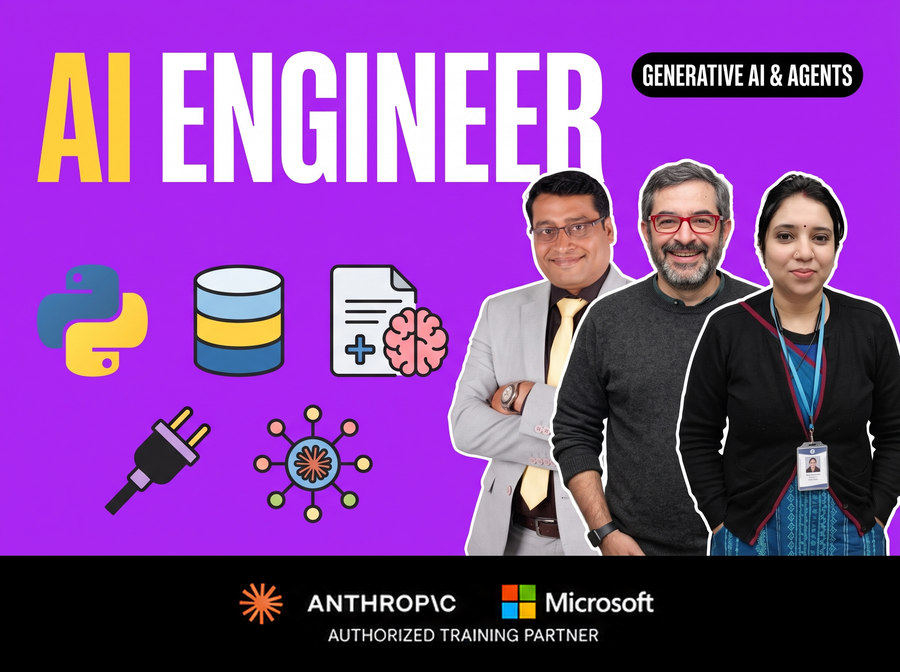
What those ads actually ask for underneath the framework name is consistent: RAG architecture, embeddings, a vector store you can defend choosing, and an orchestration framework you have shipped something in. That is the spine of the live AI engineer programme, which runs 100-plus hours over 16 weeks and is certified on both Microsoft and Claude stacks. If your gap is the Azure side of the same skill set rather than the framework side, the AI-103 generative AI developer track and the AI-200 Azure AI developer course cover that ground, and the full certifications overview maps which exam sits where.
Also read: RAG vs Fine-Tuning in 2026: Real Costs, 10 Decision Criteria and Which One to Pick.
The honest caveat nobody in this debate wants to say
For a large share of projects, neither framework is doing the hard part for you, and a plain provider SDK with 200 lines of your own code would ship faster and break less. Both libraries carry abstraction weight you will eventually have to read through, and a real minority of production teams have migrated away from framework code in exactly that direction. If your application is one retrieval and one model call, use the SDK and skip this entire comparison.
The place that argument fails is documents. Nobody writes a competitive PDF table parser in an afternoon, and that is the specific reason LlamaIndex earns its place in a stack even when the rest of your orchestration is hand-rolled. Where a framework earns its keep is where the problem is genuinely hard, not where it merely looks tedious.
In your position, here is what I would do. Spend one weekend building the LlamaIndex version of your document problem, because it is the fastest route to something that works and it will tell you honestly whether retrieval is your bottleneck. Then spend the next month learning LangGraph properly, with state, interrupts and a checkpointed resume, because that is the skill the postings name and the one you cannot bluff in an interview. Ship both in a single repository and you have answered the framework question and the hiring question at the same time.
If you would rather do that with a mentor watching your graph fail in real time than alone at 1am, the AI Engineer course runs 100-plus hours live over 16 weeks on exactly this stack, Saturdays and Sundays from 8 to 11 PM IST. Sit in on a free webinar first if you want to see how the cohort actually works before you commit.
Build the LangGraph and retrieval stack this comparison recommends, live with a mentor
The AI Engineer course teaches you to build agents that plan, use tools and act, certified on both Microsoft Copilot Studio and Claude Code, the two stacks real job postings name. You ship RAG and agent systems in cohort over 16 weeks rather than reading about them.
Explore the course
Related guides
- How to Build Production RAG: Why Your Demo Works and Your Deployment Doesn't the failure modes that no framework choice saves you from.
- AI Engineer Salary in India 2026 what the orchestration skill you just picked is actually worth by city and experience.
- AI Engineer Interview Questions 2026 including the chunking and retrieval questions that follow a framework answer.
- What Is AI Agent Observability in 2026? how to instrument the run so your trace budget tells you something useful.
- 8 Generative AI Project Ideas for 2026 portfolio builds you can ship on either framework this month.
- What Is Apache Iceberg in 2026? for when the corpus you are indexing starts life in a lakehouse table.
Frequently asked questions
Is LangChain or LlamaIndex better for RAG in 2026?
LlamaIndex, if retrieval quality is what you are judged on. It treats parsing, chunking and reranking as the core problem, with LlamaParse, auto-merging retrieval and sub-question decomposition built in rather than bolted on. LangChain's retrieval is perfectly competent; it just was not the reason the project exists.
Can you use LangChain and LlamaIndex together in the same project?
Yes, and by 2026 that is the common production shape. You expose a LlamaIndex retriever or query engine as a tool, then call it from a LangGraph node that owns the state, retries and any human approval step. One tracing tool watches the whole run so you can see which layer failed.
Is LlamaIndex free to use?
The framework is free and open source. LlamaCloud, the managed parsing and indexing service, lists a free tier of 10,000 credits a month, roughly 1,000 parsed pages, with Starter at $50 a month for 40,000 credits and Pro listed at $500 a month for 400,000 credits. Credits bill at about $1 per 1,000 beyond your plan.
What is the difference between LangGraph and LlamaIndex Workflows?
Both model multi-step agent logic with typed state. LangGraph goes further on durable execution: checkpointed state you can resume from, interrupts that park a run for human approval, and supervisor patterns over multiple agents. Workflows, now shipping as its own package in Python and TypeScript, is lighter and reads better for mostly linear pipelines.
How long does it take to learn LangChain vs LlamaIndex?
Expect a working LlamaIndex query engine in an evening and a usable mental model in about two weeks. LangChain with LangGraph takes longer, realistically four to six weeks of weekend practice before graph state, middleware and checkpointing stop feeling arbitrary. The second framework is much faster than the first, because the retrieval concepts transfer whole.
Do Indian employers ask for LangChain or LlamaIndex in interviews?
LangChain is named far more often in the posting, with roughly 2,000 listings on Indeed India when checked and around 800 of those in Bengaluru. In the interview itself the questions move past the framework quickly: why that chunk size, how you measured retrieval, what you did when the agent looped.
Is LangChain still worth learning after the 1.0 release?
More so than before. The 1.0 release on 22 October 2025 replaced AgentExecutor with create_agent, added middleware hooks and normalised provider differences through Standard Content Blocks, with no breaking changes promised before 2.0. The churn that made people wary of LangChain in 2023 and 2024 is the problem that release was aimed at.
Which framework should a beginner pick for a first portfolio project?
LlamaIndex, then add LangGraph to the same project. Ship the document question-answering version first so you have something that works, then wrap it in a graph that takes one real action and logs an approval step. A reviewer can see both skills in one repository, which is worth more than two half-finished ones.
About this guide. 360 Digital Transformation is an Anthropic Partner. Other certification bodies, vendors and employers named here are not affiliated with us. Product features and pricing change often; figures cited were checked on 2 October 2026.
 Python
 Claude API
 FAISS
FAISS ChromaDB
 LangChain
 LangGraph
 CrewAI
 AutoGen (AG2)