Home › Guides › RAG vs Fine-Tuning
Comparison · 2026RAG vs Fine-Tuning in 2026: Real Costs, 10 Decision Criteria and Which One to Pick
RAG vs fine-tuning comes down to one question: are you adding knowledge, or changing behaviour. Use RAG when answers depend on data that changes, because retrieval updates the moment your documents do. Fine-tune only for format, tone or latency, and budget $1.70 to $3.00 per hour just to keep a hosted fine-tuned model deployed.
- Facts go in retrieval, behaviour goes in weights. Fine-tuning is poor at teaching a model things it has never seen. That one line resolves most of the argument.
- The hosting bill is the trap. Microsoft Learn's fine-tuning cost management page puts a deployed fine-tuned model at roughly $1.70 to $3.00 per hour, charged whether you query it or not.
- OpenAI closed self-serve fine-tuning. Its deprecations page blocked new organisations from 7 May 2026 and stops existing customers creating training jobs on 6 January 2027.
- Fine-tuning moved to open weights. Together AI lists LoRA training from $0.48 per million tokens for models up to 16B, served at base model price with no hourly hosting.
- RAG's running cost is storage, not tokens. OpenAI lists text-embedding-3-small at $0.02 per million tokens, and Qdrant and Pinecone both still run usable free tiers.
- Most mature systems do both, almost never in the same sprint, and almost always retrieval first.
Your support bot tells a customer the policy covers dental. It does not. Someone escalates, you read the logs, and the model has invented a clause that was edited out of the document eight months ago. Now you decide what to fix. Half the internet will tell you to fine-tune on your own documents. That advice is wrong, and it is expensive in a way that shows up only on the invoice.
RAG vs Fine-Tuning: What Each One Actually Changes
Retrieval augmented generation leaves the model alone. At query time you search your own content, paste the best few passages into the prompt, and ask the model to answer using only those. The weights never move. Change a policy PDF on Tuesday and Tuesday's answers change with it.
Fine-tuning does the opposite. You show a base model a few hundred or few thousand input and output pairs and nudge its weights until it responds the way your examples do. What it learns well is shape: your brand's tone, a strict JSON schema, a classification label set, the habit of refusing certain requests. What it learns badly is content.
The difference between RAG and fine-tuning in one line
RAG gives the model a library card. Fine-tuning gives it a personality. If you would fix the problem by handing a new employee a document, it is a retrieval problem. If you would fix it with three months of feedback on how to phrase things, it is a fine-tuning problem.
Which lever to pull when an answer is wrong
Start with what is missing, not with what is fashionable. Most production incidents land on the top branch.
Decision logic reflects vendor guidance and 2026 practitioner write-ups reviewed on 17 September 2026.
One caveat, because the retrieval camp oversells it. RAG does not make hallucination go away. It moves the failure into your search layer, and a retriever that returns the wrong three paragraphs produces a confident, well-cited, completely wrong answer. That is harder to spot than a plain hallucination, because it arrives with a source link attached. Also read: how RAG actually works step by step and why your RAG demo works and your deployment does not.
RAG vs Fine-Tuning: The 10-Criteria Decision Table
Run your use case down this table and count the rows. If retrieval wins six or more, stop reading about fine-tuning and go build a retriever.
| Criterion | RAG | Fine-tuning | Winner |
|---|---|---|---|
| Adding facts the model has never seen | Works immediately, no training | Weak, and worse for multi-step questions | RAG |
| Enforcing tone, house style, brand voice | Possible but drifts across long prompts | What it is actually built for | Fine-tuning |
| Data that changes weekly | Re-index the changed documents only | A fresh training run every time | RAG |
| Citations and an audit trail | Every answer carries its source chunks | No provenance at all | RAG |
| Latency per request | Adds a retrieval hop plus a longer prompt | Short prompt, single call | Fine-tuning |
| Cost floor when nobody is using it | Storage only, often a free tier | Hourly hosting on managed clouds | RAG |
| Labelled examples you must produce first | None | Typically hundreds to thousands | RAG |
| Time to a working first version | Days | Weeks, including data preparation | RAG |
| Locking output to a strict JSON schema | Needs validation and retries | Learns the schema reliably | Fine-tuning |
| Serving a 50,000 document corpus | Scales with your index | Impractical to encode in weights | RAG |
| Vendor availability in 2026 | Every major provider, plus self-hosted | Narrowing on closed models, healthy on open weights | RAG |
Notice what fine-tuning wins: latency, output shape, and behavioural consistency. Nothing on that list is about knowledge. That is not an accident, and it is the strongest available argument against the most common beginner plan, which is to fine-tune a model on a folder of PDFs and expect it to answer questions about them.
What RAG and Fine-Tuning Actually Cost in 2026
LLM fine-tuning cost: the line item people forget
Training is the cheap part. What surprises teams is the deployment charge on managed clouds, because a fine-tuned model is not a file you call, it is a running endpoint. Microsoft's cost management documentation puts that at roughly $1.70 to $3.00 per hour. Multiply by a 30 day month and your idle floor sits between $1,200 and $2,200 before a single user shows up.
| Line item | RAG | Fine-tuning |
|---|---|---|
| One-time prep | Chunking and embedding your corpus | Building and cleaning a labelled dataset |
| Training | None | $0.48 to $25 per million tokens depending on model size and provider |
| Storage | Vector index, free tier to a few dollars a month at small scale | None |
| Serving | Base model token price plus a longer prompt | Managed cloud: hourly hosting. Open weights: base model price |
| Cost when data changes | Re-embed only what changed, at $0.02 per million tokens | A full retraining run |
| Evaluation | Retrieval quality plus answer quality | Held-out set plus regression checks on general ability |
| Idle cost | Near zero | Near zero on open weights, $1,200 and up per month on managed clouds |
Price per million tokens, training against embedding
The retrieval side of the argument is roughly three orders of magnitude cheaper per token processed.
Provider list prices as published on vendor pricing pages and checked on 17 September 2026. Training and embedding are different operations on different token counts, so read this as an order-of-magnitude comparison, not a like-for-like quote.
Storage on the RAG side stays trivial until you are genuinely large. Qdrant's free cloud tier gives you one node with 0.5 vCPU, 1 GB RAM and 4 GB disk, roughly a million 768-dimension vectors, though it suspends after a week of inactivity and is deleted after four. Pinecone's Starter plan allows 5 indexes, 2 GB of storage and 2 million write units a month in AWS us-east-1. For a first company knowledge base, either is enough. The surrounding cloud architecture is covered in the Azure AI cloud developer program and the AWS solutions architect and DevOps course.
Is Fine-Tuning Still Worth Learning in 2026?
Yes, but not the version of it most tutorials teach.
The big change this year is a supply change, not a technical one. OpenAI's deprecations page records that it is winding down the fine-tuning platform: organisations that had never run a fine-tuning job could no longer create one from 7 May 2026, the restriction tightened again on 2 July 2026, and existing customers lose the ability to create new training jobs on 6 January 2027. Models already tuned stay available for inference until their base models retire, and OpenAI has said it will not add new models or platform features during the wind-down.
Anthropic's position has been narrower for longer. Claude fine-tuning is offered through Amazon Bedrock rather than the Anthropic API, and Claude 3 Haiku has been the model exposed for supervised fine-tuning there since it reached general availability in the US West (Oregon) region. If your mental model is that you can fine-tune any frontier model on a credit card, that stopped being true a while ago.
Open weights are where fine-tuning is thriving. Together AI lists LoRA training from $0.48 per million tokens for models up to 16B, larger full fine-tunes around $3.20 per million, and Fireworks prices in the same band. Both serve the result at base model rates, which removes the hourly hosting charge. The skill is still valuable. It has moved from "call the fine-tune endpoint" to "know LoRA, know your eval set, know how to serve an open model", which is closer to MLOps than to prompt work. 360DT's MLOps engineer course builds that training, deployment and monitoring loop live over eight weeks, and is the right home for this skill now.
The honest caveat
Retrieval has real drawbacks and you should hear them before committing. Every RAG system adds a network hop and a much longer prompt, so p95 latency rises and per-query token cost rises with it. You also own a second system, the index, which can go stale, drift out of sync with the source, or quietly return nothing. And for a narrow, high-volume, fixed-format task, say classifying 200,000 support tickets a day into twelve categories, a small fine-tuned model beats a RAG pipeline on cost, speed and consistency, and it is not close. Do not let fashion talk you out of that.
When to Use RAG vs Fine-Tuning: A Worked Scenario
An illustrative scenario, not a real customer. A mid-size Indian insurer in Pune has a two-person data team, about 4,000 policy documents of which roughly 60 are amended in a given month, and a support desk fielding around 30,000 questions a month. Leadership wants a bot. Budget is about Rs 40,000 a month for infrastructure, and eight weeks of calendar time.
Fine-tuning fails this brief three ways. Sixty amended documents a month means sixty reasons to retrain. There is no labelled dataset, so someone writes thousands of question and answer pairs first, which in a two-person team is the entire eight weeks. And a regulated insurer has to show which clause an answer came from, which weights cannot do.
RAG fits almost exactly. Embedding 4,000 documents at roughly 3,000 tokens each is 12 million tokens, about $0.24 as a one-off at OpenAI's listed $0.02 per million. Re-embedding the 60 amendments each month is loose change, and the vector store sits inside a free tier at that volume. The real costs are generation tokens on 30,000 queries and the two weeks of engineering to get chunking and ranking right.
Then the part that decides it. Six weeks in, the bot answers correctly but writes like a chatbot, and compliance wants a fixed four-part response format every time. That is where fine-tuning earns its place: a small open-weight model, a few hundred examples of the approved format pulled from the logs the RAG system has already generated, LoRA training costing under a dollar at Together's listed rate. Retrieval supplies the facts. The tuned model supplies the shape.
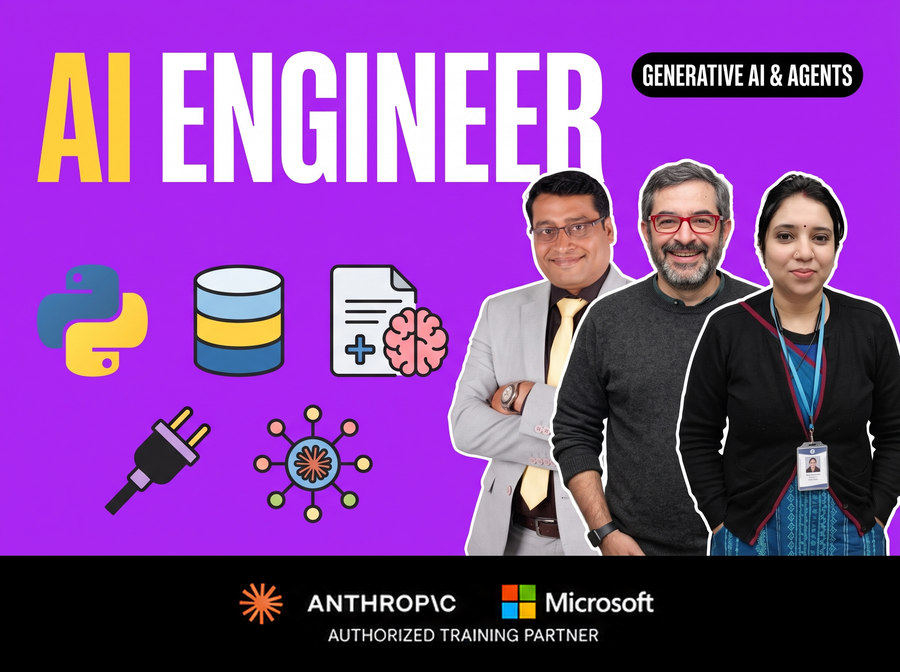
That sequence is the real answer to when to use RAG vs fine-tuning: retrieval first because it is cheap and reversible, tuning second and only against a problem you have measured. Building that retrieval and agent stack end to end is the spine of 360DT's AI Engineer course, 100+ hours live over 16 weeks.
Choose RAG If, Choose Fine-Tuning If
Choose RAG if answers depend on documents, tickets, prices, code or policies that change; if you must show where an answer came from; if you have no labelled training data and no appetite to build some; if your corpus runs past a few dozen documents; if you need something working this month; or if nobody queries the system overnight and you would rather not pay for idle capacity.
Choose fine-tuning if the model knows the facts and gets the delivery wrong; if a rigid output schema keeps breaking under prompting; if you run high volume on a narrow task where a small model is dramatically cheaper than a frontier one; if your latency budget cannot afford a retrieval hop; or if you need behaviour consistent across thousands of calls without a 2,000 token system prompt carrying it.
Choose both if you have shipped retrieval, measured where it falls short, and the shortfall is about form rather than fact. Industry write-ups through 2026 suggest a clear majority of mature production systems combine the two. Almost none start that way.
What Usually Goes Wrong Here
Fine-tuning to inject knowledge
You train on your documents, the model picks up the vocabulary and the cadence, and it still gets specifics wrong, because a few thousand examples do not overwrite what a base model learned from trillions of tokens. Comparisons reported through 2026 put retrieval at roughly double supervised fine-tuning's accuracy on multi-step questions about unseen knowledge.
Most commonShipping without an eval set
You cannot tell whether your retriever improved without a fixed set of questions with known correct sources. Write 50 by hand before any pipeline code. It is boring, it takes an afternoon, and it is the highest-return hour in the project.
Do it firstChunking by character count
Splitting every 1,000 characters cuts tables in half and orphans clause numbers from their clauses. Chunk on document structure, keep the heading path in each chunk's metadata, and retrieval quality jumps before you touch the model.
Retrieval qualityForgetting the idle endpoint
A desk warning, not a documentation one: someone will fine-tune a model for a demo, the demo goes fine, and three months later finance asks what the recurring line item is. At $1.70 to $3.00 an hour on Azure, a forgotten deployment is a real bill. Set a calendar reminder the day you create it.
Budget- Write the eval set first. 50 real questions, each with the document that should have answered it.
- Try the prompt fix before either. A surprising share of "we need to fine-tune" problems are context problems, which our guide to context engineering unpacks properly.
- Check availability before you design. Confirm your chosen provider still offers fine-tuning to new accounts on the model you want, because that answer changed twice in 2026.
- Price the idle state, not the busy state. Ask what the setup costs on a Sunday with zero traffic.
Build the retrieval stack first, the way production teams actually do
The AI Engineer course teaches you to build agents that plan, use tools and act, certified on both Microsoft Copilot Studio and Claude Code, the two stacks real job postings are naming. Sixteen weeks of live weekend sessions, built around retrieval, evaluation and agent design rather than chat demos.
Explore the course
Which One Do Indian Employers Actually Ask For?
Read enough job descriptions and the pattern is hard to miss. Retrieval vocabulary appears constantly: vector databases, embeddings, chunking, reranking, hybrid search, evaluation. Fine-tuning shows up far less outside research teams and the few product companies running their own models, and when it does it sits beside LoRA, PEFT and a serving stack rather than an API call. So retrieval and evaluation are the employable core if you are switching in; open-weight tuning is the rarer differentiator once you are already inside. The data plumbing under both, where most projects stall, is the same skill set taught in a live Microsoft Fabric data engineering program.
There is no exam named "RAG". The closest credentials worth paying for are the Azure AI developer track behind the Generative AI developer course, and Anthropic's developer and architect exams, which test tool use and context design directly. 360DT's CCDV-F prep course drills that material over six weeks, the CCAR-F foundations track covers the architecture side, and the full certifications overview lays out the paths side by side.
The Verdict
Build RAG. Almost certainly, for almost everyone reading this, build RAG.
The trade-off you are accepting is real and you should name it: slower responses, longer prompts, and a second system to maintain. You are buying, in exchange, correctness you can update on Tuesday afternoon, an audit trail your compliance team will ask for eventually, and the ability to be wrong cheaply. Fine-tuning asks you to pay in labelled data and retraining cycles for a benefit that is mostly cosmetic until you have volume.
The one case where I would reverse that is narrow and high volume: a fixed task, a stable label set, millions of calls, a small open-weight model you serve yourself. There, fine-tuning is not a nice-to-have, it is the only thing that makes the unit economics work. If that is not your situation, and it usually is not in year one, tuning is a distraction with a monthly hosting bill attached.
If you are learning this with a job in mind rather than a side project, the order is retrieval, evaluation, agents, and only then tuning. That is the sequence the AI Engineer course runs over its 16 weekend weeks, and it is the same order the Pune insurer in our scenario arrived at the hard way. You can skip their six weeks. Start with the thing you can undo.
Related guides
- AI Engineer vs Machine Learning Engineer in 2026 settles which of these two jobs actually owns the fine-tuning work in most Indian teams.
- How to Run an LLM Locally in 2026 is the practical next step if the open-weight fine-tuning route appealed to you.
- MLOps Engineer Salary in India 2026 prices the career that training and serving models actually belongs to.
- 8 Generative AI Project Ideas for 2026 gives you a retrieval project worth putting in front of an interviewer.
- LangGraph vs CrewAI is the next decision you will face once retrieval works and you start orchestrating agents.
- What Is Claude Opus 5 explains how a very large context window changes what you need to retrieve at all.
Frequently asked questions
RAG vs fine-tuning: which is better for a chatbot over company documents?
RAG, in nearly every case. Company documents change, and a fine-tuned model needs retraining each time they do. Retrieval also gives you a citation for every answer, which matters the first time legal asks where a response came from. Tune later, if the format is wrong.
Can you use RAG and fine-tuning together?
Yes, and mature systems often do. Retrieval handles facts, a lightly tuned model handles response shape, tone or refusals. What wastes money is doing both at once before you know which half of the problem is which. Ship retrieval, measure it, then tune what is left.
Is fine-tuning dead in 2026?
No, but self-serve fine-tuning on closed frontier models has narrowed sharply. OpenAI's deprecations page records that it stopped accepting new fine-tuning organisations in May 2026 and ends new training jobs for existing customers on 6 January 2027, while Claude fine-tuning runs through Amazon Bedrock rather than Anthropic's own API. The work has moved to open weights and LoRA.
How much does it cost to fine-tune an LLM?
Training runs from roughly $0.48 per million tokens for LoRA on models up to 16B at Together AI, to about $25 per million for GPT-4o on OpenAI's published rates. Serving usually costs more: Microsoft Learn puts a deployed fine-tuned model on Azure at roughly $1.70 to $3.00 per hour, charged regardless of traffic.
Do you need a GPU to build a RAG system?
No. With a hosted model and a hosted embedding API, a laptop runs the whole pipeline. You need your own GPU only to run a model locally or to fine-tune open weights yourself, which is a separate project with separate hardware questions.
Does fine-tuning reduce hallucinations?
Not reliably, and it can make them more confident. Fine-tuning teaches the model how to sound, so a model trained on your documents will hallucinate in your house style. Grounding answers in retrieved passages and requiring citations is what constrains invention, and even then the retriever has to return the right passages.
How long does it take to build a production RAG system?
A prototype takes days. Production takes weeks, and most of them go on chunking strategy, retrieval evaluation, documents that are really tables or scans, and deciding what the system says when it finds nothing relevant. Budget more time for evaluation than for the pipeline.
Which skill do Indian employers ask for more, RAG or fine-tuning?
Retrieval vocabulary appears far more often in AI engineering listings: embeddings, vector search, reranking, evaluation, agent frameworks. Fine-tuning tends to appear in ML platform and research roles, usually beside LoRA and a serving stack. Learn retrieval first if you are switching in, and add tuning once you are inside.
About this guide. 360 Digital Transformation is an Authorized Training Partner of Anthropic and Microsoft. Other certification bodies, vendors and employers named here are not affiliated with us. Product features and pricing change often; figures cited were checked on 17 September 2026.
 Python
 Claude API
 FAISS
FAISS ChromaDB
 LangChain
 LangGraph
 CrewAI
 AutoGen (AG2)