Home › Guides › Prompt Engineer Salary
Career & Salary · 2026Prompt Engineer Salary in India 2026: Pay by Experience, Company Type and Why the Range Runs 4 to 60 LPA
Prompt engineer salary in India in 2026 is advertised from roughly 4 to 8 LPA for freshers, 12 to 20 LPA at three to six years, and 25 LPA and above for engineers who also write Python and build retrieval pipelines. Prompting-only roles plateau near 10 to 15 LPA.
- One title, two jobs. Prompting-only roles are advertised around 4 to 15 LPA. Roles that expect Python, retrieval and evaluation work are advertised at 25 LPA and above. The gap is skills, not seniority.
- Two public averages disagree by roughly 10x. AmbitionBox lists an average near Rs 3.2 to 4.6 lakh a year for the prompt engineer title, while 6figr lists an average near Rs 35 lakh for prompt engineering. Both are reporting real people doing very different work.
- The standalone title is thinning out. Naukri's prompt engineering jobs page counted 13,394 vacancies in its August 2026 listing count, against 41,718 on its AI engineer jobs in India page.
- Employer type moves your band more than years do. A five-year prompting specialist at a content agency and one at a banking GCC can be two bands apart on the same resume.
- Python is the gate, not the garnish. The single clearest divider in advertised bands is whether the listing asks you to ship code.
- Skip the prompt engineering certificate. Spend the same money on a credential that proves you can build and evaluate an LLM application.
You are already the person on your team who gets the model to behave. Marketing sends you their failed drafts, support sends you the macro that keeps inventing a refund policy, and you fix both before lunch. Then you search your own job title on a job board and the numbers make no sense: the same role shows up at 5 LPA and at 45 LPA on the same page. That is not noise in the data. It is two different jobs wearing one title, and knowing which one you are in decides everything about what you can ask for.
Prompt Engineer Salary in India by Experience
Start with what listings actually say, not with averages. Averages for this title are close to meaningless, for reasons the next section gets into. Advertised ranges, read by experience band and by whether the listing mentions code, hold together much better.
| Experience | Prompting-only roles (advertised) | Prompting plus engineering (advertised) | What the listing usually asks for |
|---|---|---|---|
| 0 to 2 years | Rs 4 to 8 LPA | Rs 8 to 14 LPA | Prompt libraries, tone and format control, basic Python for the second track |
| 2 to 5 years | Rs 8 to 15 LPA | Rs 14 to 28 LPA | Retrieval quality, structured output, an evaluation set you maintain |
| 5 to 8 years | Rs 12 to 18 LPA | Rs 25 to 45 LPA | Owning an LLM feature end to end, cost and latency budgets, guardrails |
| 8 years and above | Rs 15 to 22 LPA | Rs 35 to 60 LPA and above | Architecture choices, model selection, agent design, stakeholder risk sign-off |
Collection basis: advertised ranges compiled on 17 September 2026 from public India job listings and published salary guides for the prompt engineer, AI engineer and applied AI engineer titles, including Naukri listing pages, recrew.ai's 2026 prompt engineer salary guide and AmbitionBox. These are ranges employers advertise, not guarantees of what any individual will be paid.
Advertised top of band, by title and skill mix
The ceiling tracks what you can build, not what you are called.
Bar widths are proportional to the top of each advertised band on a 70 LPA scale. Ranges checked 17 September 2026 against public India listings and published 2026 salary guides.
Read the listing, not the title
Two listings can both say prompt engineer. One asks for "strong written communication and familiarity with ChatGPT and Claude". The other asks for "Python, LangChain or the Anthropic SDK, experience building an evaluation set, and comfort with vector search". Those are not the same job and they are not in the same band. Before you apply, scan the requirements block for the word Python. That one word is worth more signal than the title, the company size and the years-of-experience line put together.
Why Two Public Salary Sources Disagree by 10x
Here is the number that explains the whole market.
The 10x problem with this job title
Two reputable aggregators, one title, two completely different populations.
AmbitionBox lists an average around Rs 3.2 to 4.6 lakh a year for prompt engineer, while 6figr lists an average around Rs 35 lakh for prompt engineering. Neither is wrong; they are averaging different jobs that share a name.
Both figures read on 17 September 2026 from the public pages of AmbitionBox and 6figr. Aggregator averages depend entirely on who self-reports, so treat them as signals of a split, not as benchmarks.
The low average comes from a real population: content operations, annotation, AI trainer and support-automation roles that were relabelled prompt engineer some time in 2024 and never had an engineering scope. The high average comes from an equally real population: people at product companies whose job is to make a language model behave reliably inside a shipped feature, which means code, tests and a pager.
If you are negotiating, this is your most useful piece of ammunition and your biggest risk. A recruiter quoting you a market average has almost certainly picked the one that suits them. Quote advertised ranges for the specific scope of the role instead, and be ready to say which of the two populations you belong to.
Prompt Engineer Salary in India by Company Type
Years of experience is the weakest predictor on this list. Who signs the cheque is the strongest.
| Employer type | Mid level, 3 to 6 yrs (advertised) | Senior (advertised) | What they are actually buying |
|---|---|---|---|
| Content or marketing agency | Rs 4 to 10 LPA | Rs 10 to 16 LPA | Volume output and consistency. No engineering scope, so the band closes early. |
| IT services and consulting | Rs 8 to 16 LPA | Rs 18 to 28 LPA | Reusable prompt assets across client accounts, documentation, delivery hygiene. |
| Indian product and SaaS | Rs 14 to 26 LPA | Rs 30 to 50 LPA | One person accountable for an LLM feature's quality, cost and latency. |
| GCC (banking, retail, pharma) | Rs 16 to 28 LPA | Rs 35 to 65 LPA | Evaluation harnesses, guardrails, audit trails and model risk paperwork. |
| AI-first startup | Rs 12 to 30 LPA plus equity | Rs 28 to 55 LPA plus equity | You build the whole pipeline yourself. Cash is often below the GCC band. |
Collection basis: advertised ranges for India-based roles compiled on 17 September 2026 from public job listings and 2026 salary guides covering prompt engineer, AI engineer and applied AI engineer titles. GCC bands draw on published 2026 India GCC benchmark ranges. Equity is excluded from every figure. Advertised ranges are not offers.
The GCC line is the one most people underestimate. A bank does not pay well because the prompting is harder. It pays well because a wrong model output there is a regulatory event, so the job quietly becomes evaluation, logging and defensibility. That work is closer to MLOps and LLMOps than to writing instructions, and 360DT's MLOps Engineer course runs those AI-300 evaluation and monitoring workflows as live weekend labs rather than slides.
Also read: What Is Context Engineering in 2026? for the discipline that has quietly absorbed most of what prompt engineering used to mean.
Prompt Engineer Salary for Freshers: What Entry Level Actually Looks Like
Fresher listings cluster at Rs 4 to 8 LPA, and the honest version is that most of them are not engineering jobs. They are AI-assisted content, annotation, QA of model output, or support-macro maintenance. The work is real and it teaches you things, but the band closes fast: two years in, you will be looking at 8 to 12 LPA and a title that hiring managers at product companies do not read as engineering.
The fresher listings that pay 8 to 14 LPA ask for a portfolio, not a certificate. Specifically: one application you built where a language model does something a plain script could not, with a written evaluation of how often it gets the answer right. That last part is what almost nobody brings to an interview. A candidate who can say "my retrieval step misses about one query in eight, here is the eval set, here is what I tried" is immediately in a different conversation.
If you want a shortcut to a first credential, the cheapest formal option is Anthropic's Claude Certified Associate Foundations exam, listed at USD 99, with CCAO-F prep covering the non-coding fundamentals. Be honest with yourself about what it buys: it gets you past a keyword filter, not past a coding round.
AI Engineer vs Prompt Engineer Salary: Where the Money Moved
The demand did not disappear. It changed its name.
Where the openings actually are
The prompting skill is everywhere; the prompting title is not.
Counts read from the public listing pages of Naukri and Jooble on 17 September 2026. Job board counts include duplicates and stale posts, so read them as relative signals rather than headcount.
Roughly three AI engineer openings exist for every prompt engineering opening, and the AI engineer listings are the ones carrying the 25 LPA and above bands. Glassdoor's India average for AI engineer sits near Rs 11 LPA, which again describes almost nobody, because it blends a services fresher at 6 LPA with a GCC senior at 50.
What this means practically: if you are searching job boards with "prompt engineer" in the box, you are seeing less than a third of the roles you are qualified for, and systematically the worse-paid third. Search for AI engineer, applied AI engineer, LLM engineer and GenAI developer instead, then read the requirements to find the ones that suit a prompting-heavy background.
Also read: AI Engineer vs Machine Learning Engineer in 2026 if you are choosing between the applied and the research-shaped version of this career.
What Actually Drives the Top of the Band
Four things separate a 15 LPA offer from a 35 LPA offer for people with identical years of experience.
1. Whether you ship code
This is not close. Python plus one orchestration library plus vector search is the difference between the two tracks in the first table. You do not need to be a strong software engineer. You need to be able to write a retrieval pipeline, wire it to an API, and put it behind a test.
2. Whether you can prove quality
Anyone can demo a prompt that works once. The rare skill is a repeatable evaluation: a fixed set of inputs, a scoring method, a number that moves when you change something. Teams pay for the person who turns "it feels better" into "accuracy went from 71 to 84 percent on our 200-case set". If you build nothing else this quarter, build that. The AI Engineer course spends its RAG and agent modules on exactly this loop, building the eval set alongside the pipeline in live sessions.
3. Domain, when the domain is expensive
Prompting for a healthcare claims workflow or a credit underwriting assistant is paid differently from prompting for blog copy, because the cost of a wrong answer is different. If you already work in banking, insurance, pharma or logistics, that context is the most undervalued asset you have. Do not leave it off your resume in an attempt to look more technical.
4. Negotiating against the right number
Try this line when a recruiter opens with an average: "I understand the market average for the title is lower. The scope you described includes owning the evaluation and the production behaviour of the feature, and listings with that scope are currently advertised in the 22 to 30 LPA range. Can we work from that band?" It works because it is specific, it is verifiable, and it moves the conversation from your history to the role's scope.
- Weak: "Designed and optimised prompts for enterprise AI use cases using ChatGPT and Claude."
- Strong: "Built and maintained a 200-case evaluation set for a customer support assistant; raised first-response accuracy from 71 to 84 percent and cut average tokens per query by 38 percent by moving from few-shot prompting to retrieval over the policy base."
- Why it works: it names an artefact you own, a number that moved, and a technical decision you made. Every sentence on a senior resume should do at least two of those three.
An Illustrative Transition: Content Ops to Applied AI Engineer
What follows is an illustrative composite built from typical market paths in India, not a real named individual and not a 360DT student outcome.
Picture a 27-year-old content operations specialist at a mid-size Pune SaaS company, on Rs 6.5 LPA in early 2025. She becomes the unofficial model person: her prompt templates cut the support team's draft time noticeably, and in April she is given the title AI Specialist with no change to her band. That is where most of these stories stall, and it is worth saying plainly that a title change without a band review is a cost-free way for a company to keep you.
She gives herself eleven months. Months one to three: Python to the point of writing a script that calls an API, parses JSON and fails gracefully. Months four to six: a retrieval pipeline over her company's own help centre, plus the thing that actually changed her interviews, a 150-question evaluation set with a scored baseline. Months seven to nine: interviews. Two rejections in coding rounds, both on basic data structure questions rather than anything AI-related, which she had not prepared for at all. One offer arrives at 7.2 LPA, a lateral move dressed up as a promotion, and she turns it down.
Month eleven: an applied AI engineer role at a Bengaluru product company, advertised at 18 to 24 LPA. The evaluation set was the thing every interviewer asked about. Not the certificate, not the prompt library.
Two honest details from that arc. The salary did not move at all for the first nine months, and the hardest part was not AI. It was the ordinary software engineering hygiene that a content background never teaches you.
Move from writing prompts to shipping the system around them
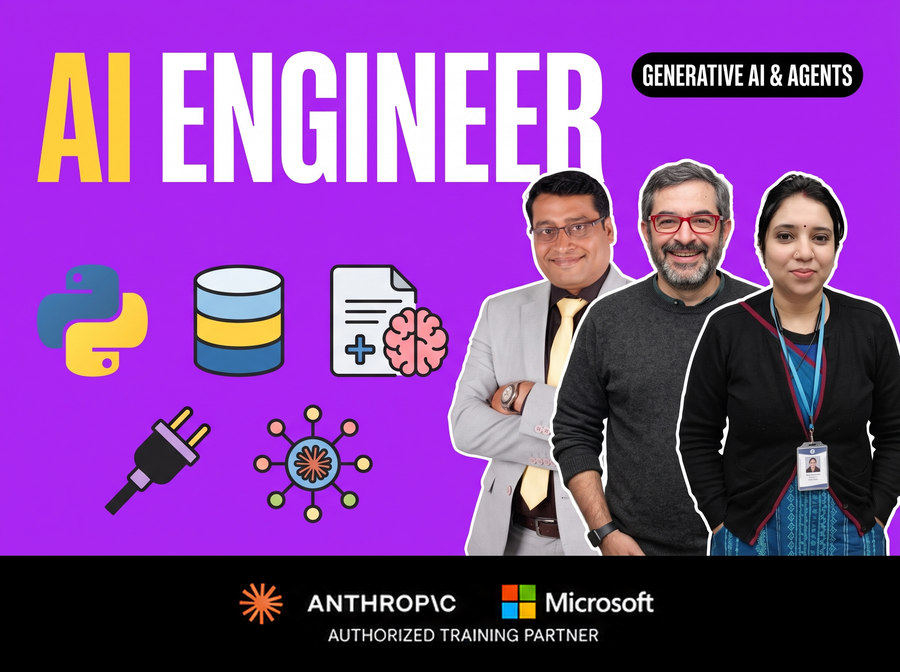
The AI Engineer course teaches you to build agents that plan, use tools and act, certified on both Microsoft Copilot Studio and Claude Code, the two stacks real job postings are naming. Weekend evening batches mean you can train without leaving your current job.
Explore the course
Is Prompt Engineering a Good Career in 2026?
As a standalone career, no. As a skill inside a broader engineering role, it is one of the better bets available in India right now. That is the honest answer and it is worth sitting with, because a lot of course marketing depends on you not hearing it.
Reporting through 2026 has been consistent on the direction: the standalone title has shrunk from its 2023 peak while prompting requirements have spread across AI job descriptions generally. You can verify the shape of that yourself in five minutes on any job board by comparing the two searches. The easy part of the work, getting a model to produce the right format and tone, has been absorbed into the tools. What is left is the part that pays: evaluation, retrieval design, cost control, failure handling and knowing when a language model is the wrong solution.
- The title trap. Accepting an internal move to AI Specialist or Prompt Engineer without a written band review is the most common way people lose a year. Ask for the revised band in writing before you accept the title.
- The coding round nobody warned you about. Applied AI interviews still include ordinary data structure questions. Candidates from content, support and analyst backgrounds get filtered there far more often than on anything AI-specific.
- The sideways offer. Moving from a non-technical role into a junior engineering one can mean a flat year or, occasionally, a small pay cut on the way in. Budget for that before you resign from anything.
- It takes longer than the internet says. Nine to fourteen months of consistent weekend and evening effort is a realistic expectation for someone starting without Python. Plans that promise a switch in twelve weeks are describing the study, not the hiring.
- Certificates do not clear coding rounds. A credential gets your profile read. An eval set and a working project are what get you through the technical stage.
How to Move From Prompting to the Paid Version of This Job
If I were in the composite's position with roughly ten spare hours a week, this is the order I would work in, and the order matters more than the content.
Python first, for eight weeks, and only as much as you need. Functions, requests, JSON parsing, error handling, virtual environments. Stop there and start building. If you are coming from a reporting or analyst background and want the SQL and Python foundation covered properly, a structured data analyst program handles that ground more thoroughly than another tutorial series will.
Then one retrieval application, for six weeks. Chunk a document set you genuinely know, embed it, retrieve, answer, and log every query. Use your own company's documentation if you can get permission, because you will spot wrong answers instantly.
Then evaluation, for four weeks. This is the step almost everyone skips and the one that changes interviews. A hundred questions, expected answers, a score, a spreadsheet of what changed when you adjusted retrieval.
Then, and only then, a credential. Pick by what you want to prove. Anthropic lists the Claude Certified Developer Foundations exam at USD 125, and CCDV-F prep is the right fit if you now write code. If your employer runs on Azure, AI-103 is listed at USD 165 and maps to the Generative AI Developer track. If your company is rolling out Microsoft 365 Copilot and you would rather own governance than build pipelines, AB-900 Copilot administration is a genuinely different and underrated career branch. The full certifications overview lays out how these fit together, and 360DT's free webinars are a low-cost way to test whether a track suits you before you spend anything.
One thing I would skip outright: a paid prompt engineering certificate. No Indian employer I can find is filtering on one, and the same money spent on an exam that proves you can build and evaluate an application does measurably more for your profile.
Also read: Agentic AI Jobs in India 2026 for the six role shapes this hiring wave is actually creating.
Related guides
- Generative AI Developer Salary in India 2026 the closest adjacent role, and the band most prompting specialists move into next.
- AI Engineer Jobs in Bangalore 2026 where most of the 25 LPA and above listings in this guide are physically located.
- 8 Generative AI Project Ideas for 2026 if you need a portfolio project to attach that evaluation set to.
- Retrieval Augmented Generation Explained in 2026 the mechanics behind the six-week retrieval build recommended above.
- CCAO-F vs CCDV-F: Which Claude Certification First a direct comparison of the two exam fees quoted in this guide.
- Java Developer to AI Engineer in India 2026 the same destination reached from a coding background instead of a content one.
Frequently asked questions
What is the prompt engineer salary in India in 2026?
Advertised ranges run from about Rs 4 to 8 LPA for freshers to Rs 35 to 60 LPA for senior people who pair prompting with Python, retrieval and evaluation work. Prompting-only roles typically plateau around Rs 10 to 15 LPA regardless of years served. These are ranges employers advertise, not guarantees.
Is prompt engineering a good career in 2026?
As a standalone job title, it is a shrinking bet: Naukri listed 13,394 prompt engineering vacancies in its August 2026 count against 41,718 for AI engineer. As a skill inside an AI engineer or applied AI engineer role, it is one of the stronger positions in the Indian market right now.
What is the prompt engineer salary for freshers in India?
Entry-level listings cluster at Rs 4 to 8 LPA, and most are content, annotation or support-automation roles rather than engineering. Fresher listings that advertise Rs 8 to 14 LPA generally ask for Python and a working project with a written evaluation of accuracy.
Do I need Python to get a prompt engineering job?
Not for the lower band, and yes for the higher one. Whether the listing asks you to write code is the single clearest divider between the 10 to 15 LPA track and the 25 LPA and above track. You do not need to be a strong software engineer; you need to be able to build a retrieval pipeline and test it.
Is prompt engineering dead now that models follow instructions better?
The easy part is being absorbed into the tools. Formatting, tone and basic instruction-following need much less human work than they did in 2023. What remains is evaluation, retrieval design, cost and latency control, guardrails and knowing when a language model is the wrong answer, and that part is being hired under engineering titles.
Am I too old to switch into AI engineering at 35?
Age is rarely the blocker; the band you are leaving is. Someone at 35 on 18 LPA in a non-AI role often has to accept a flat year rather than a hike on the way in, which is a financial decision more than a technical one. Domain experience in banking, insurance or pharma usually works in your favour, because that context is scarce among younger candidates.
Which certification helps most for prompting and AI roles in India?
Pick by what you need to prove. Anthropic lists CCAO-F at USD 99 for fundamentals and CCDV-F at USD 125 for developers, while Microsoft's AI-103 is listed at USD 165 for Azure-based teams. A generic prompt engineering certificate is the weakest of the options, because no common Indian job filter asks for one.
How long does it take to move from a prompting role to an AI engineer role?
Nine to fourteen months of consistent part-time effort is a realistic planning assumption if you are starting without Python: roughly two months on Python, six weeks on a retrieval application, a month on evaluation, and then a hiring process that commonly takes three months on its own.
If you take one thing from this guide, take the reframe: stop trying to be paid well as a prompt engineer and start being paid well as an engineer who is unusually good with models. In your position I would spend the next eight weeks on Python rather than on another prompting course, build one retrieval application over documents you actually understand, and write the evaluation set before applying anywhere. When you are ready to put that on a structured timetable with live weekend sessions, the AI Engineer course is the track that maps to this destination.
About this guide. 360 Digital Transformation is an Authorized Training Partner of Anthropic and Microsoft, offering exam preparation and skills training. We do not offer placement or job guarantees. Other certification bodies and employers named here are not affiliated with us. Salary figures are advertised market ranges collected from public job listings, not guarantees of what any individual will earn. Figures cited were checked on 17 September 2026.
 Python
 Claude API
 FAISS
FAISS ChromaDB
 LangChain
 LangGraph
 CrewAI
 AutoGen (AG2)