Home › Guides › Java Developer to AI Engineer
Career & Salary · 2026Java Developer to AI Engineer in India 2026: The 8-Month Plan, Skills Gap and What the Switch Actually Pays
A Java developer to AI engineer switch in India typically takes 6 to 10 months of part-time study while you stay employed, and it lands you at the bottom of a new band rather than the top of your old one. Naukri listed 42,614 AI engineer vacancies when we checked, and most ask for Python, RAG and shipped agents.
- This is a lateral move, not a promotion. Most backend developers who cross over land near their existing band first, then re-rate at the switch after that.
- Eight months at 10 hours a week is the honest middle. Six if you already write Python at work, twelve if your evenings are unpredictable.
- Your backend years transfer further than you expect. API design, testing discipline and deployment carry over. Evaluating non-deterministic output is the one genuinely new muscle.
- Advertised ranges split hard by employer type. A services AI pod and a product company can sit 15 LPA apart at identical years of experience.
- A certificate with no deployed project behind it moves very little. Sit the exam after your first real build, and decide your pay floor before any offer call.
You are six years into Java, your last appraisal came in around 9 percent, and the generative AI pod your company announced in March was staffed almost entirely from outside. That is the week most developers start reading pages like this one. The gap between you and those external hires is smaller than the job descriptions suggest. Closing it still takes about two hundred evenings, and the first offer on the other side is rarely the number you have been picturing.
Is the Java Developer to AI Engineer Switch Realistic for You?
Two things predict whether this works, and neither is your college tier. The first is whether you can ship a service end to end without supervision. If your last two years were tickets inside a framework someone else set up, that is the gap to close first, and it has nothing to do with AI. The second is time that actually exists: 10 hours a week sounds small until you subtract the two weekends a month that go to family and the two weeks a quarter that go to releases.
Here is the qualifier nobody includes. If you want to train models, publish, or work on architectures, this is not the route, and part-time study will not get you there. What you are switching into is applied AI engineering: wiring language models into products, making retrieval accurate, making agents fail safely, keeping the token bill from doubling. That is where the volume of Indian hiring sits, and it is where a backend developer has an advantage over a data science graduate. The trade-off is a ceiling on roles that want model training. Most people never reach it. Decide now that you are fine with that.
Software developer to AI engineer: what transfers and what does not
Almost everything about running a service in production transfers. The testing model does not. In Java you assert equality. In an AI system you assert that retrieval returned the right context roughly 90 percent of the time, and you watch that number over a fixed evaluation set every time anyone edits a prompt. Developers who absorb this quickly get offers. Developers who treat the model as a black box that either works or does not tend to stall around month four.
What AI Engineer Listings in India Actually Ask For
Open AI engineer roles on one Indian job board
The volume is real, but the title covers everything from prompt work to full MLOps, so read each description before you believe the band.
AI engineer vacancies listed for India on Naukri when we checked, against 82,597 for the broader "AI" keyword. Listing counts include duplicates and agency reposts, so read this as a demand signal rather than a count of distinct jobs.
Source: Naukri India listing counts for "AI engineer jobs in India" and "AI jobs", checked 14 September 2026.
Strip the buzzwords out of those postings and the same stack keeps appearing: Python with FastAPI, an orchestration framework such as LangChain, LangGraph or CrewAI, a vector store (Pinecone, Chroma, FAISS or pgvector), and increasingly a named way of proving quality, with RAGAS metrics and LangSmith tracing appearing by name. Cognizant's own agentic engineering posting lists Python, LangChain, LangGraph and LLM APIs as the core requirement, which tells you the services sector now hires for the same stack as the product companies. Put that against what you already have.
| What your Java years already cover | What AI engineer listings add | Time to close |
|---|---|---|
| REST APIs, Spring Boot, request lifecycles | FastAPI and async Python. Same concepts, different syntax, plus streaming responses. | 3 to 4 weeks |
| SQL, schema design, indexing | Embeddings and vector search. Similarity instead of exact match, and chunking choices that change your answers. | 3 weeks |
| JUnit, mocks, CI gates | Evaluating non-deterministic output: golden question sets, faithfulness and context recall scores, regression runs on every prompt change. | 4 to 6 weeks, the hard one |
| Logging, APM, alerting | Trace-level observability for model calls, plus cost per request in tokens, which finance will ask you about. | 2 weeks |
| Docker, pipelines, promotion | Mostly identical, plus inference hosting choices and when a GPU is worth paying for. | 1 to 2 weeks |
Mapped from recurring requirements in Indian AI engineer postings read on 14 September 2026. Time estimates assume roughly 10 study hours a week and are our judgement, not survey data.
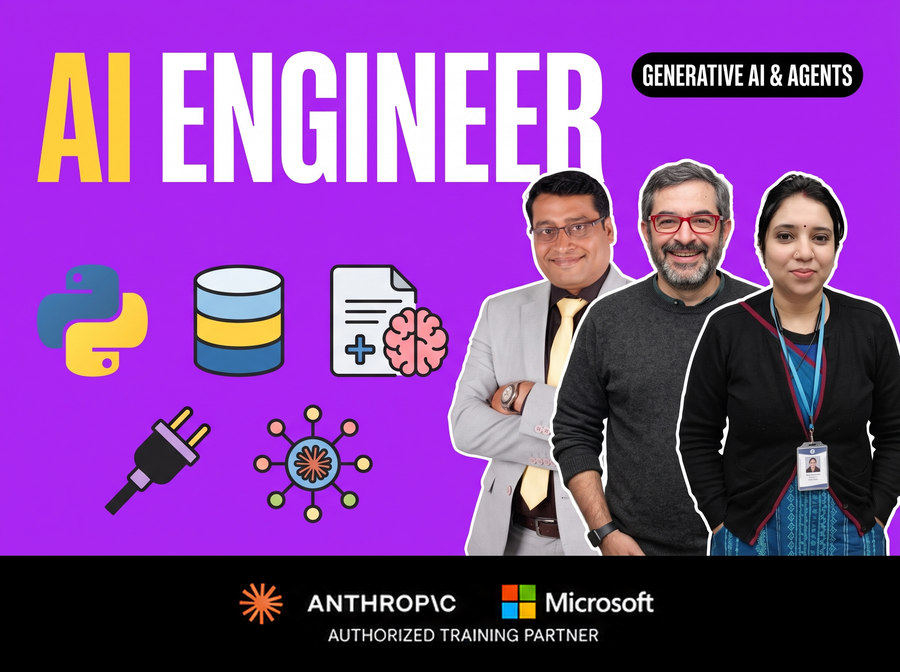
Retrieval and agent orchestration are the two rows that take longest to learn from documentation alone, which is why 360DT's live AI Engineer course spends most of its 100+ hours building and breaking those systems rather than surveying them. If the evaluation row is where you feel weakest, that instinct is correct. It is the row hiring managers probe hardest.
Also read: Retrieval Augmented Generation Explained in 2026 for the mechanics of the pipeline you will build in months 3 and 4.
The Java Developer to AI Engineer Plan, Month by Month
This assumes 10 hours a week alongside a full-time job, front-loads the unglamorous foundation work, and makes you ship something every month, because a portfolio assembled at the end always looks like it was assembled at the end.
| Month | Focus | What you must be able to show | Hours |
|---|---|---|---|
| 1 | Python for a Java brain | A command line tool with type hints, tests and a virtualenv you understand. Stop translating Java idioms. | ~40 |
| 2 | LLM API mechanics | A FastAPI service that streams output, returns structured JSON, retries on rate limits and logs tokens per call. | ~40 |
| 3 | First RAG pipeline | Question answering over documents you care about: your team's runbooks, a regulator's circulars. Ugly is fine. | ~45 |
| 4 | Retrieval quality | The same pipeline, measured. A 50 question golden set, faithfulness and context recall scored, and a note on what moved the number. | ~45 |
| 5 | Agents and tool use | An agent that calls two real tools, survives a tool failure without looping, and has a hard cost stop. | ~45 |
| 6 | Deployment and tracing | That agent containerised in a cloud environment, with traces you can screenshot in an interview. | ~40 |
| 7 | Certification and project two | One exam cleared, plus a second project with at least five real users who are not you. | ~40 |
| 8 | Applications and interviews | Rewritten resume, 40 applications out, answers rehearsed for the three questions below. | ~35 |
Built by the 360DT editorial team from requirement patterns in current Indian postings, 14 September 2026. Hours are targets for a working professional, not a measure of readiness.
Advertised pay by route, 5 to 8 years
Employer type moves the number more than the job title does.
Midpoints of advertised ranges collected from Naukri, Glassdoor India and public salary aggregators on 14 September 2026. Advertised ranges, not guarantees.
Where the 320 study hours go
Over half sits in retrieval and agents, which is where interviews concentrate too.
Our recommended allocation for roughly 10 hours a week across 8 months, not a survey figure. Compiled 14 September 2026.
The job hunt is its own project
Months 1 to 6 are study. Weeks 25 to 36 are a different discipline, and treating them as an afterthought is the most common way good preparation ends in silence.
Weeks 25 to 36: the search phase
Run it as a pipeline with stages, the way you would run any delivery.
Book the exam, then rewrite the resume
Booking creates a deadline you cannot renegotiate. Deliverable: one page, two AI projects with measured outcomes at the top.
Make the work visible
A public repository with a real README, a two minute screen recording, and your evaluation numbers before and after one fix. Deliverable: three links you can paste into any application.
Internal first, always
Your own company's AI pod credits your domain knowledge and skips the trust problem. Deliverable: a 20 minute conversation with whoever staffs that team.
Apply narrowly, in volume
Forty applications to roles naming your exact stack beats two hundred sprayed at anything with "AI" in the title. Deliverable: a tracker with company, stack named, referral status.
Rehearse the three questions
Why did your retrieval fail and what changed. How do you know the output is correct. What does one request cost. Deliverable: a three minute spoken answer to each, timed.
Negotiate on the band, not your past
Anchor on the advertised range, not your current CTC. Deliverable: a number you will accept and a number you will decline, written down before any call.
Sequence compiled by the 360DT editorial team from common failure points in mid-career switches, 14 September 2026.
Build the RAG pipelines and tool-calling agents that Indian AI engineer postings name
Sixteen weeks of live weekend sessions on generative AI, retrieval systems and agents that plan and use tools, certified on both Microsoft Copilot Studio and Claude Code. The weekend schedule means you build and deploy the projects without leaving your current job.
Explore the course
AI Engineer Salary in India for Experienced Developers
Any single average will mislead you. Glassdoor India reported an average AI engineer salary of roughly Rs 11 lakh a year in mid 2026, with a typical range around Rs 6.7 lakh to Rs 18 lakh and a 90th percentile near Rs 28.2 lakh. The aggregator 6figr, whose respondents skew senior and product-side, reports an average closer to Rs 38 lakh for the same title. Both are describing real people. They are describing different halves of the market.
| Route in | Advertised range | What the posting usually requires |
|---|---|---|
| Internal move to your company's AI pod | Existing band plus the standard increment, commonly Rs 9 to 14 LPA | Proof you can do the work, and a manager willing to release you |
| Lateral to a services firm AI pod | Rs 14 to 22 LPA | Python, LangChain or similar, one deployed RAG or agent system |
| Global capability centre | Rs 22 to 38 LPA | Production experience, evaluation practice, cloud deployment |
| Product company | Rs 28 to 55 LPA | A strong engineering bar plus depth in one area: retrieval, agents or inference cost |
| Reset as a near-fresher | Rs 5 to 8 LPA | Avoid this if you have 5+ years. It is almost never necessary. |
Collection basis: advertised ranges seen on Naukri, Glassdoor India and public salary aggregators for India on 14 September 2026, grouped by employer type. These are what employers advertise, not what any individual will be offered.
What drives the top of the band
Depth in one hard area beats familiarity with ten tools, and the areas paying best right now are retrieval quality at scale, agent reliability and inference cost engineering. Domain knowledge you already own is worth real money: a developer who spent six years inside a bank's payments stack is more useful to a financial services AI team than a generalist with prettier projects. And the band you negotiate against is fixed by the employer type you applied to, which makes that the single most consequential decision in the whole switch, taken before any interview.
What a Career Change to AI Engineer in India Costs You Along the Way
The direct costs are small and worth naming precisely. Model API credits for eight months of building run in the low thousands of rupees if you cache and keep a hard spend cap. Microsoft associate level exams cost roughly Rs 4,800 to Rs 4,900 in India. The Claude certification exams are priced at 99 US dollars for the associate paper and 125 dollars for the developer and architect foundations papers, with every retake charged at full price. A vector database free tier will carry both portfolio projects.
The real cost is compounding. Stay on the Java track and your increments continue at the 9.1 percent that Deloitte, Aon and EY have independently projected for Indian salary increments in 2026. Step sideways and you restart the clock on tenure, credibility and the internal relationships that get you staffed on good work. That is the actual price, and no course fee comes near it.
- The timeline slips, usually by a quarter. One production incident in month three costs four weekends, and eight months becomes eleven. Plan for it instead of reading it as failure.
- You may be offered less than you earn now. Candidates crossing functions are sometimes benchmarked against the new function's junior band. Some accept a flat number to get in and re-rate at the next move. Know your floor first.
- "AI engineer" is not one job. The same title covers prompt tuning, full MLOps and data engineering. Applying without reading the stack named in the description wastes months.
- Certificates without deployments get filtered. A credential with no repository behind it reads as a course completion, not as evidence.
- Some switches simply stop. People stall at month five with a half-built project and nothing to show. The ship-every-month rule exists because of exactly that.
One piece of popular advice worth ignoring: you do not need two months of linear algebra and backpropagation before touching an API. You are not going to implement a transformer at work. Spend that time on evaluation, which you will use in your first week on the job.
A Composite Transition: Pune Services Firm to a Capability Centre
Illustrative composite assembled from typical market paths. Not a real individual, not a 360DT student, and not an outcome being described or promised.
Take a 2019-batch Java developer at a mid-size services firm in Pune. Six years in, Spring Boot and Oracle, around Rs 9.5 LPA, two appraisals in a row at 8 to 9 percent. The GenAI team formed in early 2026 and hired entirely externally. That was the trigger.
Months 1 and 2 went to Python, slower than planned, because writing Java in Python syntax is a trap that takes weeks to notice. Month 3 produced a retrieval system over the company's internal deployment runbooks, documents they already knew cold, which is why it was useful rather than a toy. Month 4 was the turning point: a 50 question golden set put retrieval accuracy near 60 percent, and moving from fixed-size chunks to section-aware chunking took it to the high eighties. That before-and-after became the story in every interview.
Month 5 broke the plan. A production release ate four weekends and the agent project stalled. Months 6 and 7 recovered it with a containerised agent, tracing, and the CCDV-F developer certification cleared. Month 11, not month 8, produced the result: an offer from a capability centre in Pune at the lower end of that employer type's advertised range, a real step up from Rs 9.5 LPA but well short of the headline numbers on social media. Twenty-two applications, four first rounds, two finals.
The detail worth copying is the resume line, which read close to this: "Built and deployed a retrieval system over 1,200 internal runbooks; raised answer faithfulness from 0.61 to 0.88 on a 50 question evaluation set by replacing fixed-size chunking with section-aware chunking; served via FastAPI on Azure Container Apps at under Rs 4 per 100 queries." Every number in that sentence invites a follow-up the candidate can answer for ten minutes. That is the entire job of a resume line.
Also read: AI Engineer Jobs in Bangalore 2026 if you are weighing relocation, and the AI Engineer Roadmap 2026 for this path aimed at people entering without backend experience.
How to Talk About the Switch Without Sounding Like a Beginner
Interviewers for these roles are usually answering one question in their heads: has this person been surprised by a language model yet. Everything else follows from that.
When asked why you are moving, do not say you are passionate about AI. Say what you built and what broke. A usable shape: "I spent six years on payments backends, and the retrieval system I built over our runbooks failed in a way I had never seen in Java, where it was confidently wrong rather than throwing an exception. Measuring that and fixing it is the work I want to do." That answer is unfakeable, which is why it lands.
On money, anchor on the role rather than your history: "Based on the range advertised for this level and what I have seen at similar capability centres, I am targeting the middle of that band. I am happy to walk through how I would spend the first ninety days to justify it." If they press for your current CTC, give it, then steer straight back to the advertised range. Indian recruiters will benchmark against your last salary unless you keep moving the conversation.
Match your certification to the postings you are answering, not to a general ranking. Azure-heavy teams line up with the AI-103 generative AI developer track, and note that the older AI-102 exam has been retired, so any 2024 study material still teaching to it is stale. Teams running models at scale ask about the AI-300 MLOps side instead, architecture-heavy roles lean on the CCAR-F foundations syllabus, and if cloud deployment is the rusty part, a cloud and DevOps track closes it faster than documentation will. The certifications overview lays out what each one covers.
Related guides
- 8 Generative AI Project Ideas for 2026 gives you the month 3 and month 7 builds with the stack already chosen.
- AI Engineer vs Machine Learning Engineer in 2026 settles which of the two titles you should actually apply to.
- Docker Tutorial for Beginners 2026 covers the month 6 containerisation step end to end.
- How to Run an LLM Locally in 2026 is how you keep API spend near zero while you experiment.
- CCDV-F Exam Prep 2026 is the six week plan if you sit the certification in month 7.
Frequently asked questions
How long does the Java developer to AI engineer switch really take?
Six to ten months of part-time study is the honest band for a working backend developer, and the plan above is built around eight. Six is realistic only if you already write Python at work. Add a quarter if release cycles regularly eat your weekends.
Do I need a master's degree or machine learning theory to become an AI engineer in India?
Not for applied AI engineering, which is where the hiring volume sits. Indian postings ask for Python, retrieval pipelines, agent frameworks and deployment, not published research. A degree matters for roles that train or modify models, a different and much smaller market.
Am I too old to switch to AI engineering at 35?
No, but the strategy changes. With ten or more years behind you, do not compete for entry level roles. Compete on domain: your knowledge of insurance claims, payments or telecom provisioning is exactly what an AI team building in that domain lacks. The risk is being benchmarked against a junior band, so target teams where your domain is the product.
Will I have to take a pay cut to move into an AI engineer role?
Sometimes, and you should plan for the possibility. People crossing functions are occasionally benchmarked against the new function's junior band rather than their years of experience. An internal move usually avoids this because your existing band carries over. Decide your floor before you are in a negotiation.
Which certification is worth taking for a career change to AI engineer in India?
Follow the stack named in the postings you are applying to. Azure-heavy teams favour the current Microsoft AI track, noting that AI-102 has been retired. Teams building on Claude look at the Anthropic exams, priced at 99 US dollars for associate and 125 dollars for the foundations papers. In every case the certificate supports a deployed project rather than replacing one.
Is Python mandatory, or can I stay in Java?
Python is effectively mandatory. The orchestration frameworks, evaluation libraries and vector store clients that Indian postings name are Python-first, and the Java equivalents lag by a release cycle or more. The language is the fastest part of this transition though, usually four to six weeks for an experienced developer.
What should my first AI portfolio project be?
A retrieval system over documents you already understand, with a measured before-and-after. Not a chatbot demo. The measurement is the differentiator: a 50 question evaluation set and a note on which change moved faithfulness, and by how much, will out-interview a flashier project carrying no numbers.
Are AI engineer jobs in India only in Bengaluru?
Bengaluru carries the largest share, but Hyderabad, Pune, Chennai, Gurugram and Noida all show substantial volume, largely from capability centres. Remote-first AI roles exist and are more competitive, because you are then bidding against the whole country rather than one city.
If you are in the position this guide describes, here is what we would do. Do not quit. Do not start with mathematics. Pick the documents you already know better than anyone on your floor, build a retrieval system over them in the next ninety days, measure it honestly, and let that one artefact carry your applications. The certification comes after, as evidence of range rather than as the thing that gets you read. If you would rather build that guided than self-taught, the AI Engineer course runs the same sequence live on weekends, and a free webinar is a cheaper way to test whether the format suits you first.
About this guide. 360 Digital Transformation is an Authorized Training Partner of Anthropic and Microsoft, offering exam preparation and skills training. Other certification bodies, vendors and employers named in this guide are not affiliated with us. We do not offer placement or job guarantees. Salary figures are advertised market ranges collected from public job listings, not guarantees of what any individual will earn. Figures cited were checked on 14 September 2026.
 Python
 Claude API
 FAISS
FAISS ChromaDB
 LangChain
 LangGraph
 CrewAI
 AutoGen (AG2)