Home › Guides › Fabric vs Synapse
Comparison · 2026Microsoft Fabric vs Azure Synapse in 2026: 10 Criteria, Real Capacity Costs and Which One to Learn First in India
Microsoft Fabric vs Azure Synapse comes down to one fact: Synapse still runs, but every new Microsoft data engineering investment, and the only live certification path, now sits in Fabric. Fabric bills one shared capacity from $0.36 an hour at F2; Synapse bills each pool separately and can be paused to zero compute.
- Nothing is switched off. No service-wide retirement date has been announced for Azure Synapse, and dedicated SQL pools, serverless SQL, Spark pools and pipelines all still run.
- The certification door closed. DP-203 retired in March 2025 and DP-700 took its place, so no current Microsoft credential certifies Synapse skills.
- The billing models are opposites. Synapse meters each service and pauses to zero. Fabric meters one capacity, and pausing it bills your pending smoothed usage immediately.
- Small teams usually pay less on Fabric. Third-party pricing summaries checked on 11 November 2026 put F2 at about $0.36 an hour against $1.20 to $1.51 for one DW100c pool.
- F64 is a licensing cliff. Below it, everyone who opens a Power BI report still needs a Pro or PPU licence.
- Your Synapse experience is not wasted. T-SQL, Spark, Delta and pipeline design all carry across. What changes is where data lives and how it is billed.
You inherited a Synapse workspace someone built in 2021. The dedicated pool runs a nightly load, the pipelines mostly work, and twice a quarter you lose a Saturday to a DWU bottleneck. Then a FabCon slide lands in your inbox and your manager asks whether all of it should move to Fabric by March. That is really two questions with two different answers: what to do with the estate you run, and what to learn so you are still hireable in 2028.
Microsoft Fabric vs Azure Synapse: The Short Answer
If you are choosing what to learn, learn Fabric, and it is not close. The reason has nothing to do with which engine is better engineered. Microsoft retired the Synapse-era certification and routed the roadmap, including the real-time and Copilot work interviewers ask about, through Fabric and OneLake.
For an estate you already run, the answer flips. A stable Synapse workspace with a tuned pool and no pending real-time requirement does not need a migration this quarter. That project buys risk, not capability, until a release window gives you room.
What Actually Changed Between Synapse and Fabric
Synapse was a workspace bundling four independently billed services over storage you provisioned yourself. Fabric is one capacity, one storage layer called OneLake, and workloads that all read and write the same Delta tables. That single change explains nearly every row in the table below.
The practical effect: in Synapse you copied data from a lake into a dedicated pool so Power BI could query it fast. In Fabric, the warehouse and the lakehouse both write Delta into OneLake, and a semantic model in Direct Lake mode reads those files with no copy and no refresh schedule. One fewer pipeline is one fewer thing that breaks at 3am.
Four services over your storage, or one capacity over OneLake
The copy step between lake and warehouse is the thing Fabric removes.
Drawn from Microsoft's Synapse-to-Fabric guidance and the Fabric capacity documentation, checked 11 November 2026.
Microsoft Fabric vs Azure Synapse on 10 Criteria
Most of these differences are not about capability. They are about who absorbs the operational cost of the choice.
| Criterion | Azure Synapse Analytics | Microsoft Fabric | Who it favours |
|---|---|---|---|
| Compute model | Four services, each sized and billed on its own | One F capacity in capacity units, shared by every workload | Synapse for isolation, Fabric for simplicity |
| Storage | ADLS Gen2 you create, plus a loaded copy inside the pool | OneLake, auto-provisioned, Delta by default | Fabric |
| Pause to zero | A dedicated pool pauses cleanly and compute billing stops | Pausing immediately bills pending smoothed usage and overages | Synapse |
| Spike handling | You resize the pool, which is a deliberate action | Bursting and smoothing absorb spikes, then average them out | Fabric |
| T-SQL warehouse | MPP dedicated pool with mature levers like distribution and DWU | Warehouse over Delta, fewer knobs to turn | Synapse for heavy tuned batch |
| Spark | Synapse Spark pools, with cluster start latency | Starter pools and notebook-native Delta writes | Fabric |
| Streaming | Synapse Data Explorer preview retired on 7 October 2025 | Eventstream and Eventhouse are first-class workloads | Fabric, decisively |
| Power BI | Import or DirectQuery, so you own the refresh | Direct Lake reads OneLake files with no refresh step | Fabric |
| Reader licensing | Power BI licensing sits outside Synapse compute | Below F64, every report reader needs Pro or PPU | Synapse for small teams with many readers |
| Certification | DP-203 retired March 2025, no current credential | DP-700 Fabric Data Engineer Associate, DP-600 for analytics | Fabric, decisively |
The row people argue with is the dedicated pool. A tuned DW1000c pool with sensible hash distribution on a 10 TB fact table will still beat a comparably priced Fabric Warehouse on a predictable nightly batch. That advantage is real, and it is shrinking, because almost nobody is building that workload from scratch in 2026. If this pulls you toward the lakehouse question rather than the Microsoft one, our Also read: Microsoft Fabric vs Databricks comparison is the next stop.
Microsoft Fabric Pricing vs Synapse Pricing: What Each One Bills
Here is the scenario we will keep using, and it is an illustrative one rather than a customer result. A two-person data team at a mid-size insurer in Pune runs a 1.5 TB warehouse, loads it nightly, and serves 40 Power BI readers in claims and underwriting. The pool is needed about 8 hours a weekday, roughly 176 compute-hours a month.
Monthly compute for the Pune insurer scenario
Fabric is priced per capacity unit hour, so the real question is how many hours you need it on.
From third-party pricing summaries checked 11 November 2026: about $0.18 per capacity unit hour for Fabric, so $0.36 at F2, and DW100c between $1.20 in East US 2 and $1.51 in Central US, with a 41% reservation saving applied to the reserved row. Storage is extra on both. Verify on the Azure pricing calculator before budgeting.
That chart does not say Fabric is cheaper. It says the entry tier is cheaper and the second rung is not. F2 running nonstop undercuts a DW100c pool that only runs office hours, which is the strongest cost argument for a small team. Move up to F8 because Spark keeps throttling and you are at $1,051, past a DW200c pool you could have paused.
| Cost line | Synapse today | Fabric F2 reserved | What changes |
|---|---|---|---|
| Warehouse compute | About $211 at DW100c, 176 hrs | Included in capacity | Warehouse and Spark now share one budget |
| Spark and pipelines | Separate meters, plus per-activity runs | Included in capacity | Spike risk moves into your CU budget |
| Storage, 1.5 TB | About $35 at $23.20 per TB | About $35 in OneLake hot | Effectively unchanged |
| 40 Power BI readers | Pro licences, billed per user | Still Pro licences below F64 | No saving until F64, a different budget |
| Quiet weeks | Pause the pool to zero compute | $156 committed for a year | You trade flexibility for a lower rate |
- Someone pauses the capacity mid-month to save money. Pausing settles your pending smoothed consumption and accumulated overage straight onto the Azure bill, so the saving arrives as a spike finance will ask about.
- One runaway notebook starves the warehouse. Shared CUs mean a badly written Spark job throttles the nightly load. Separate Synapse pools could not touch each other.
- Nobody owns the CU budget. Capacity metrics exist, but a named person has to read them weekly. Decide who before go-live, not after the first throttling incident.
Is Azure Synapse Being Deprecated in 2026?
Not as a service, and anyone quoting you a deadline is selling something. Microsoft's lifecycle material and the independent write-ups agree on three points: no retirement date has been announced for Azure Synapse Analytics as a whole, dedicated SQL pools, serverless SQL, Spark pools and pipelines all continue to run, and Microsoft has said it would give advance notice before changing Synapse PaaS plans.
What is going away is narrower. Synapse Data Explorer, still in preview, was retired on 7 October 2025 with Fabric Eventhouse named as the destination, and the Synapse-based Cloud-Scale Analytics reference guidance is deprecated and slated for deletion in April 2026. The product is supported; the roadmap has moved.
The honest caveat: supported but end of roadmap is an uncomfortable place to sit for five years, because you keep paying for a stack that stops gaining features while your team's market value drifts. If the Pune insurer has a core-system replacement funded for 2029, the right call may be to leave Synapse alone and fold the Fabric move into that programme.
Azure Synapse to Fabric Migration: What the Tooling Actually Does
There is no one-click path, and the coverage is uneven. This is the part vendor comparisons skip.
- Dedicated SQL pool: the Fabric Migration Assistant for Data Warehouse converts schema and code. Best-supported route.
- Spark: a migration workflow exists in public preview, and it does not cover GPU pools or VNet-bound workspaces.
- Pipelines: a migration option is in preview inside Synapse Studio.
- Serverless SQL: no one-to-one tool. Those external tables and views get rewritten by hand against OneLake shortcuts.
For the Pune team that reorders the plan immediately. The dedicated pool is the easy part. The 30-odd serverless views that analysts query directly are the project, and those are exactly the objects nobody documented. Scope the serverless surface first and the estimate stops being fiction. The design work this needs, meaning capacity sizing, workload isolation and a defensible cutover, is what an Azure architecture track built around AZ-305 drills, which is why migration leads often hold that credential rather than a data one.
DP-700 Certification vs the Retired DP-203: What to Study Now
DP-203, the Azure Data Engineer Associate exam that certified Synapse and ADF skills, retired in March 2025. DP-700 replaced it and awards the Fabric Data Engineer Associate certification.
DP-700 at a glance
If you are choosing what to study, these four numbers settle it faster than any feature table.
Fee and format from third-party DP-700 guides; the customer count is from Microsoft's FY26 Q3 earnings call, which also reported 60% year-on-year growth. India exam pricing is set locally and sources disagree, so check Microsoft Learn. Checked 11 November 2026.
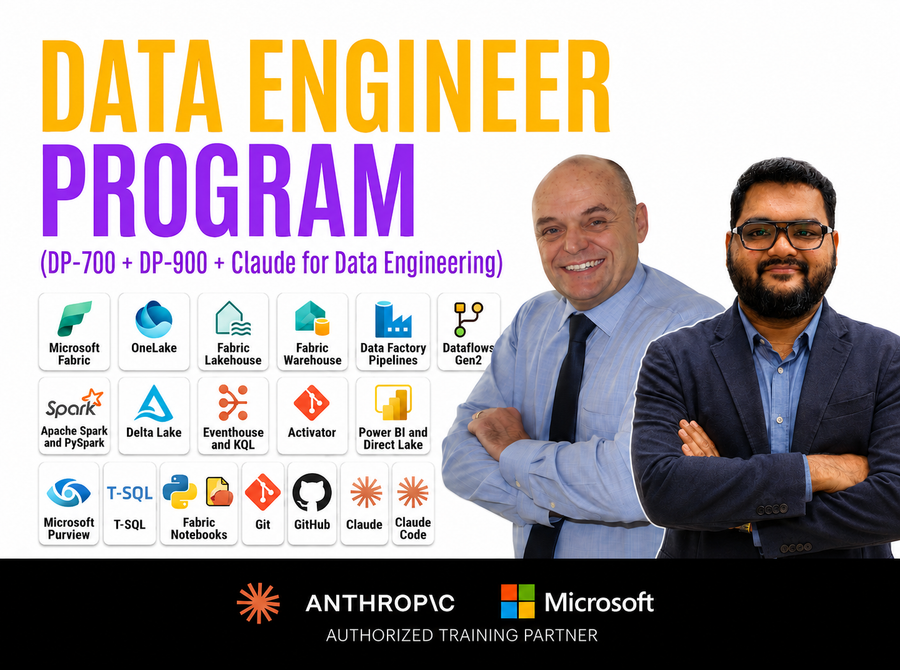
That retirement is the whole argument. You can still be excellent at Synapse, but you can no longer prove it with a current Microsoft credential, and Indian recruiters screen on credential names more than any of us would like. A live Microsoft Fabric data engineering programme that runs DP-700 with DP-900 fundamentals closes that gap in one pass, with the lakehouse, pipeline and Eventstream labs done in class rather than left as homework.
Two adjacent decisions come up constantly. If your day job is semantic models rather than pipelines, DP-600 and the PL-300 Power BI analyst path fit you better, and our Also read: DP-700 vs DP-900 guide settles the sequencing; the full certifications overview maps the rest. And Fabric Data Agent work pulls data engineers into retrieval territory faster than most expect, which is where RAG and agent engineering practice pays, while governing those agents falls to whoever runs the tenant under the Copilot administration track.
The verdict says learn Fabric. This is the 8-week route to DP-700.
Covers Microsoft Fabric data engineering for the DP-700 certification with DP-900 fundamentals included, over 8 weeks of live weekend classes. Hands-on projects, mentor support and placement guidance are part of the programme.
Explore the course
Choose Microsoft Fabric If, Choose Azure Synapse If
Choose Fabric if
You are building something new, or learning for your next job rather than maintaining your current one. Your team is two to five people and you would rather tune one capacity than four services. You need real-time or Direct Lake. Or you simply want a certification that still exists.
Choose Synapse if
You run a tuned dedicated pool that meets its SLA and the migration has no budget owner. Your workload is spiky enough that pausing to zero genuinely beats a committed capacity. You need hard cost and performance isolation between teams, which separate pools give you and shared CUs do not. Or you are taking contract work on an existing estate, where Synapse depth is the thing being paid for.
An 8-week plan to move your Synapse skills to Fabric
For the Pune engineer with about 30 spare hours a month, this sequence front-loads the two things interviewers probe hardest: OneLake semantics and capacity behaviour.
Synapse engineer to DP-700 ready, eight weeks
Each week ends in something you can show, not something you have read.
OneLake and shortcuts
Create a trial capacity, land one Synapse source into a lakehouse, then shortcut the same files instead of copying them. Deliverable: one table queryable from both a lakehouse and a warehouse.
Warehouse in T-SQL
Rebuild your smallest dedicated-pool schema as a Fabric Warehouse. Deliverable: a written list of the distribution and DWU levers that no longer apply.
Pipelines and Dataflow Gen2
Port one Synapse pipeline by hand, then run the preview migration option on a second. Deliverable: both versions running on a schedule, differences documented.
Spark and Delta maintenance
Move one notebook across, then run OPTIMIZE and VACUUM and watch what they do to CU consumption. Deliverable: a before and after capacity metrics screenshot.
Real-time with Eventstream
Push a synthetic claims feed into an Eventhouse and query it in KQL. Deliverable: a dashboard that updates without a refresh schedule.
Capacity, Git, then the exam
Throttle the capacity deliberately with a bad notebook and fix it, wire the workspace to Git, then work the DP-700 skills outline against your own build and sit it. Deliverable: the certification plus a project you can talk through for 20 minutes.
Sequenced against the published DP-700 skills-measured domains, checked 11 November 2026. Trial capacity availability and preview features change, so confirm in the portal.
360DT's Fabric data engineering cohort runs this arc live on Saturday and Sunday evenings, 8:00 to 11:00 PM IST, and the free webinars or a demo class cover week one if you want to check the pace first. To build it alone, our Also read: Microsoft Fabric tutorial for beginners walks the same first week.
The Verdict
If you are deciding what to learn, learn Fabric and stop deliberating. The exam that certified Synapse skills no longer exists, the real-time and BI integration work is happening in Fabric, and every hour spent getting fluent in OneLake stays valuable. The trade-off is real: you give up the fine-grained cost and performance isolation that separate pools gave you, and you take on a capacity someone has to watch.
If you are deciding what to migrate, be slower. Nothing is being switched off, serverless SQL has no migration tool, and a rushed cutover costs more credibility than the old stack costs in fees.
In your position I would do both, in this order: get DP-700 certified next quarter so your skills are current, then use what you learned to write the migration plan your manager keeps asking for. That is the sequence the Microsoft Fabric Data Engineer course is built around, so that is where I would start.
Related guides
- Data Engineer Salary in India 2026 for what these Fabric skills are worth once you have them.
- Data Engineer Jobs in Chennai 2026 shows which employers are naming Fabric in postings.
- What Is a Data Warehouse? if the warehouse and lakehouse rows above felt slippery.
- ETL Developer to Data Engineer in India 2026 maps the same transfer from Informatica and SSIS.
- What Is Apache Iceberg in 2026? covers how portable your OneLake data really is.
Frequently asked questions
Is Microsoft Fabric replacing Azure Synapse?
In roadmap terms, yes. In billing terms, no. Microsoft has positioned Fabric as the long-term data platform but has announced no service-wide retirement date for Azure Synapse Analytics, so dedicated SQL pools, serverless SQL, Spark pools and pipelines keep running. The clearest signal is that DP-203, the exam that certified Synapse skills, retired in March 2025 and DP-700 replaced it.
Microsoft Fabric vs Azure Synapse: which is cheaper for a small team?
Usually Fabric at the entry tier. Third-party pricing summaries checked in November 2026 put F2 at about $0.36 an hour, roughly $263 a month running nonstop or about $156 with a one-year reservation. One DW100c Synapse pool runs about $1.20 to $1.51 an hour, so it only wins if you pause it aggressively. Past F4 the arithmetic turns, because Fabric capacity does not pause for free.
Is Azure Synapse being deprecated in 2026?
Not as a whole service. Specific pieces are gone or going: Synapse Data Explorer, which was in preview, was retired on 7 October 2025, and the Synapse-based Cloud-Scale Analytics reference guidance is deprecated with deletion slated for April 2026. Treat Synapse as supported but end of roadmap, and plan accordingly rather than urgently.
Do my Synapse and Azure Data Factory skills transfer to Fabric?
Most of them. T-SQL, Spark and PySpark, Delta Lake, pipeline and trigger design, incremental loading and partitioning all carry across, and Fabric Data Factory shares its lineage with ADF. What you relearn is where data physically lives, how OneLake shortcuts replace copy steps, and how one shared capacity behaves under load instead of four separately sized services.
Should I still study DP-203 in 2026?
No. It retired in March 2025, so you cannot sit it and no new certificate can be earned. A course still selling DP-203 preparation is a sign the content has not been maintained. Study DP-700 for the Fabric Data Engineer Associate credential, with DP-900 first if you need the fundamentals.
How long does an Azure Synapse to Fabric migration take?
It depends almost entirely on your serverless SQL surface, because that is the part with no one-to-one migration tool. Dedicated SQL pool schemas and code are handled by the Fabric Migration Assistant for Data Warehouse, Spark and pipeline migration options are in preview, and anything built on serverless external tables and views gets rewritten by hand. Inventory the views before you quote a date.
Is DP-700 enough to get a data engineer job in India?
It gets you past the screen, not through the interview. Pair it with one end-to-end build you can walk through live: ingestion, a medallion layout in OneLake, an incremental load, and something that shows you understand capacity behaviour, such as a throttling incident you diagnosed. Advertised pay bands for data engineering roles in India vary widely by employer type, so treat any single figure with suspicion.
About this guide. 360 Digital Transformation is an Anthropic Partner and a Microsoft Authorized Training Partner. Other certification bodies, vendors and employers named here are not affiliated with us. Product features and pricing change often; figures cited were checked on 11 November 2026.
 Microsoft Fabric
 Python