Home › Guides › Fabric vs Databricks
Comparison · 2026Microsoft Fabric vs Databricks in 2026: Cost, Certifications and Which One Gets You Hired in India
Microsoft Fabric vs Databricks comes down to who owns the data. Fabric wins for Power BI centric teams already inside Microsoft 365, with capacity starting near $262 per month for F2 pay as you go. Databricks wins for Spark heavy engineering, custom ML and multi cloud. For a first data engineering job in India, learn Fabric first.
- Fabric is SaaS, Databricks is a platform you operate. That single difference explains almost every other row in the comparison table below, including price predictability and how fast a two person team can ship.
- The entry price gap is real but smaller than people assume. Fabric F2 runs about $262.80 per month pay as you go and about $156.33 per month on a one year reservation, while pricing guides published in 2026 put most Databricks teams at $500 a month and up before cloud infrastructure.
- Both have a genuinely free way in. Databricks Free Edition has been permanent and serverless since its launch on 11 June 2025, and the Fabric trial gives you 60 days on a 64 CU capacity with up to 1 TB of OneLake storage.
- The certifications are not equivalent in difficulty or price. DP-700 is $165 and 100 minutes, the Databricks Certified Data Engineer Associate is $200 and 90 minutes and expires after two years.
- For an Indian fresher or switcher, Fabric is the faster route to a first offer because the hiring pool is GCC and services heavy, and those employers already buy Microsoft.
- For product companies and senior pay, Databricks still has the edge. Do not let the easier on ramp decide your whole career.
Your Power BI report refreshes at 6am, the finance team opens it at 9am, and twice a month it is stale because the overnight pipeline silently queued behind something else. You have two engineers, a 200 GB warehouse that grows about 8 GB a month, and a CTO who has just been shown a Fabric demo and a Databricks demo in the same week. Now someone has to pick. This is the decision, and the honest answer depends on things nobody puts on a slide.
Microsoft Fabric vs Databricks: What Actually Changed by 2026
The 2023 version of this argument was easy. Databricks was the serious engineering platform and Fabric was Power BI with ambitions. Both halves of that have stopped being true.
Fabric closed two specific gaps. Direct Lake now serves Power BI queries straight off the lake with no separate import or refresh step, which removes the exact failure your finance team keeps hitting. And Real Time Intelligence, the Eventhouse and KQL side of the product, reached general availability, so Fabric has a streaming story rather than a roadmap slide. Neither of those makes it Databricks. Both of them make the "Fabric cannot do real engineering" objection out of date.
Databricks moved the other way, toward being easier to start. Free Edition launched on 11 June 2025 alongside a $100 million education investment, and it is permanent rather than a trial. It is serverless only and quota limited, with outbound internet restricted to a short list of trusted domains, but it is a real Lakehouse you can keep. The company also retired the Standard tier on AWS and GCP in October 2025, so Premium is now the default and Unity Catalog comes with it rather than being an upsell.
The other thing that changed is that these two stopped being mutually exclusive. OneLake shortcuts expose external storage without copying it, and cross workspace MLflow logging lets a model trained in Azure Databricks be registered and promoted into Fabric for serving. Plenty of real architectures now run Databricks for transformation and Fabric for delivery. Keep that in your back pocket, because it is often the right answer and almost nobody proposes it.
Also read: What Is Apache Iceberg in 2026? for why the table format underneath both platforms matters more than the logo on top.
Microsoft Fabric vs Databricks: The 11 Point Comparison Table
Every row here is a place where the two products genuinely diverge. Rows where they are now broadly equivalent, such as notebook authoring or Git integration, are left out on purpose.
| Criterion | Microsoft Fabric | Databricks |
|---|---|---|
| Delivery model | SaaS. Microsoft runs the infrastructure, you buy capacity units | Platform on your cloud account. You choose VM types, you tune clusters |
| Cloud portability | Azure centric | Runs on AWS, Azure and Google Cloud |
| Storage layer | OneLake, Delta based, with shortcuts to external storage | Delta Lake on your own object storage |
| Governance | Workspace and capacity based, tied to Microsoft Entra | Unity Catalog, included in Premium since Standard retired in Oct 2025 |
| Billing unit | Capacity units. F2 from about $262.80 per month pay as you go | DBUs, roughly $0.07 to $0.70 each on Premium, plus cloud infrastructure |
| Cost predictability | High. You pick an F SKU and that is the bill | Low by default. Infrastructure often adds another 50% to 100% |
| BI delivery | Power BI is the product, Direct Lake removes the refresh step | Dashboards and SQL warehouses, usually paired with an external BI tool |
| Streaming | Real Time Intelligence, Eventhouse and KQL, now generally available | Structured Streaming and Delta Live Tables, longer track record |
| Custom ML at scale | Workable, not the centre of gravity | Core strength. MLflow, Mosaic AI, GPU compute |
| Free entry path | 60 day trial, 64 CU capacity, up to 1 TB OneLake storage | Free Edition, permanent, serverless only, quota limited |
| Who it suits | Teams already inside Microsoft 365 and Power BI | Spark heavy engineering, custom ML, multi cloud mandates |
Read it once more with your own org in mind. If you cannot honestly claim a Spark heavy workload or a multi cloud mandate, four of those rows stop being arguments for Databricks and start being arguments against it.
Microsoft Fabric vs Databricks Pricing: What a Small Team Actually Pays
The published rates are less useful than they look, because the vendors price different things. Fabric sells a capacity and lets you run whatever fits inside it. Databricks sells consumption, so the bill follows your behaviour. The fair comparison is a worked scenario, not rate against rate.
Published entry cost per month, September 2026
Fabric has a fixed floor you can quote to finance. Databricks has no floor, which cuts both ways.
Fabric F2 rates and the 60 day 64 CU trial are from Microsoft Fabric pricing and trial documentation; the Databricks Free Edition terms and the $500 a month starting range are from Databricks pricing guides published in 2026. Checked 15 September 2026. Rates vary by region.
A worked scenario: the two person team at a Pune insurer
This is an illustrative scenario, not a real customer. Take that finance refresh problem from the top of the page. Two engineers, 200 GB, one daily batch load, about 40 Power BI report consumers, no data science team, everything already in Microsoft 365.
On Fabric, this team buys an F2 on a one year reservation at roughly $156 a month, which is about Rs 13,000, and that is the whole platform bill apart from OneLake storage. Direct Lake removes the import step that was breaking the 6am refresh. Nobody tunes a cluster. Nobody gets paged about autoscaling.
On Databricks, the same workload is technically trivial, and the bill is not. Even the reported floor of $500 a month is triple the Fabric reservation, and the pricing guides are blunt that infrastructure frequently adds another 50% to 100% on top of DBU spend. You would also be paying two engineers to do cluster sizing work that Fabric simply does not ask for.
Fabric wins that scenario, clearly, and it is not close. Now change one variable. Give the same team a fraud model to train on three years of claims data. Suddenly Databricks Jobs Compute, MLflow and GPU access matter more than the $344 monthly difference, and the answer flips. The scenario decides, not the brand.
- Fabric: capacity units are shared across everything in the workspace. One badly written notebook can throttle your Power BI reports, and the fix is to buy a bigger SKU, which is a step change in cost rather than a gentle slope.
- Databricks: All Purpose Compute clusters can cost two to three times more per DBU than Jobs Compute. Moving scheduled production work off interactive clusters is the single fastest saving available, commonly cited at 40% to 60%.
DP-700 vs Databricks Certification: Cost, Format and Recruiter Recognition
If you are learning one of these to get hired rather than to run a platform, the certification question is the practical one. The two credentials are close in scope and quite different in economics.
DP-700 at a glance
The Microsoft Fabric Data Engineer Associate exam, in the four numbers that affect your planning.
From Microsoft DP-700 exam documentation and 2026 exam guides. Checked 15 September 2026.
DP-700 splits into three domains of roughly equal weight, each in the 30% to 35% band: implementing and managing analytics solutions, ingesting and transforming data, and monitoring and optimising solutions. That last domain is where most self taught candidates lose marks, because it is the part you cannot fake without having watched a pipeline fail. 360DT's live Microsoft Fabric data engineering programme runs that monitoring and tuning work as live lab sessions for exactly this reason.
The Databricks Certified Data Engineer Associate is the other side. It costs $200, runs 90 minutes, has 45 multiple choice questions, needs 70% to pass, and expires after two years, which is a recurring cost DP-700 does not impose in the same way.
Databricks Certified Data Engineer Associate: 2026 domain weights
Six out of ten marks sit in ingestion and transformation, so that is where study time belongs.
Domain weights as published in 2026 Databricks certification guides. Checked 15 September 2026.
Cost and time to job ready, compared honestly
| Line item | Fabric path | Databricks path |
|---|---|---|
| Exam fee | $165 (DP-700) | $200 (DE Associate) |
| Exam length | 100 minutes, 40 to 60 questions | 90 minutes, 45 questions |
| Passing bar | 700 out of 1000 | 70% |
| Renewal | Annual renewal, free online | Expires after two years, full re-sit |
| Free practice environment | 60 day trial, then you pay | Free Edition, permanent, quota limited |
| Realistic study time, working full time | 8 to 10 weeks | 10 to 14 weeks if Spark is new to you |
| Prerequisite you will actually need | SQL, plus Power BI literacy | SQL, plus working Python and Spark |
| Guided live option | Rs 24,999, 50+ hrs live over 8 weeks | Self study or vendor training |
Note the asymmetry in the free practice row, because it matters more than the $35 exam fee difference. Databricks will let you practise indefinitely for nothing. Fabric gives you 60 days and then the meter starts, which means you should not start the Fabric trial until you have cleared your calendar. That is a genuine point in Databricks' favour for a self funded learner in India, and anyone who tells you otherwise is selling something.
Fabric vs Databricks for Data Engineer Jobs in India in 2026
The bulk of data engineering hiring in India sits in global capability centres and services firms. Those employers have enterprise agreements with Microsoft, they already run Microsoft 365, and Power BI is already on every finance desk. When they modernise, Fabric is the path of least procurement resistance. That is not a technical judgement, it is a purchasing one, and it is the single biggest reason a Fabric skill converts to interviews faster for a fresher or a switcher.
Databricks demand is concentrated differently: product companies, data platform teams, anywhere with a real ML function. Those roles are fewer, harder to get, and pay better. Industry reports suggest a premium for Spark and Databricks experience at the mid and senior end, though the roles thin out fast outside Bengaluru, Hyderabad and Pune.
Typical advertised progression for a data engineer in India
The platform matters less at the start than it does at the third jump, which is when Spark and ML depth begins to price itself.
Year 0 to 1
Year 2 to 3
Year 4 to 6
Year 7 plus
Ranges reflect pay typically advertised on Indian job listings and vary widely by city, company type and interview performance. Treat as indicative, not as an offer prediction.
The practical move for our Pune pair is not to choose forever. It is to ship on Fabric now, because that is what the employer bought, and to keep a Databricks Free Edition workspace open on the side for the Spark work that will price their next jump. If they later move toward serving models rather than tables, an MLOps engineering track is the natural continuation, and retrieval and agent engineering is where a lot of that pipeline work is heading.
Also read: Data Engineer Roadmap 2026 for the step by step version of this, and Power BI vs Tableau in 2026 if the BI layer is the part you are still deciding.
If the verdict says Fabric first, this is the eight week version of that plan
Covers Microsoft Fabric data engineering for the DP-700 certification with DP-900 fundamentals included, taught live with hands on projects and mentor support. The next batch starts 27 Sept 2026.
Explore the course
Choose Microsoft Fabric If, Choose Databricks If
Choose Microsoft Fabric if
- Your organisation already runs Microsoft 365 and Power BI is the delivery surface your business users expect. Direct Lake alone is worth the migration for a team fighting refresh windows.
- You need a number to give finance before you start. An F2 reservation is a line item, not a forecast.
- Your team is small enough that nobody has time to own cluster tuning.
- You are a fresher or switcher in India optimising for time to first offer, particularly targeting GCC and services employers.
- Your workload is batch loads plus BI, with modest streaming. That describes a large share of Indian enterprise data work.
Choose Databricks if
- You have real Spark workloads, meaning transformations that genuinely need distributed compute rather than a large SQL warehouse.
- You train and serve custom models. MLflow, Mosaic AI and GPU compute are not things Fabric is trying to beat.
- You have a multi cloud mandate, or a board level aversion to Azure lock in.
- You are already mid career and choosing where to specialise for the next five years rather than where to start.
- You want to practise for free indefinitely rather than inside a 60 day window.
Choose both if
If you have more than about eight engineers and both a BI mandate and an ML mandate, stop treating this as a fork. Run Databricks for heavy transformation and model work, shortcut the output into OneLake, and let Fabric do delivery. This costs more in licence terms and less in argument. Teams reach this design eventually; you can just start there.
What Usually Goes Wrong Here
Three things, over and over.
Sizing Fabric off a demo
The demo ran on a trial capacity of 64 CU. You buy an F2, which is not that, and then wonder why a report that flew now crawls. Size against your actual concurrent load, not against the sales environment.
FabricRunning production on interactive clusters
Someone builds the pipeline in a notebook on All Purpose Compute and schedules it there because it works. Two to three times the DBU rate, paid nightly, forever, until a FinOps review catches it.
DatabricksBurning the 60 day trial on evaluation
Teams start the Fabric trial to "have a look", lose six weeks to competing priorities, and reach the buying decision with no real evidence. Start the clock when you have a workload to port, not before.
FabricPicking the platform before the workload
The most expensive mistake on this page. The fraud model changes the answer; the 6am refresh changes the answer. Write down your top three workloads first, then read the table again.
BothHere is the honest caveat, and it cuts against the recommendation you are about to read. Fabric's capacity model is the reason it is easy to budget and also the reason it is easy to get stuck. Everything in a workspace draws on the same pool, so one heavy notebook can degrade the reports your executives are watching, and the remedy is to jump to the next SKU rather than to scale a single job. Databricks' consumption billing is scarier on a spreadsheet and more forgiving in practice, because you can throw compute at one bad job without touching anything else. If you are the kind of team that will not do capacity monitoring, Fabric will punish you for it somewhere around month four.
And if you are aiming at a platform engineering role at a product company, be clear eyed: Fabric on your CV will not carry the same weight in that specific interview loop as demonstrated Spark and Unity Catalog experience. Pick the on ramp that gets you employed, but do not mistake it for the destination.
The Verdict: Is Microsoft Fabric Worth Learning in 2026?
Yes, and for most people reading this it is the one to learn first. Not because it is the better engineering platform, which on Spark and ML it is not, but because the Indian hiring market is dominated by employers who have already bought Microsoft, and skills convert to interviews fastest where the licences already exist. A DP-700 plus two shipped Fabric pipelines will get a switcher in front of more hiring managers this year than an equivalent effort on Databricks will.
The trade-off you are accepting is real, so name it. You are trading depth for speed. You will learn less about distributed compute, you will be less prepared for a product company platform interview, and in three years you will have to go and learn Spark properly anyway. Accept that consciously and it is a good deal. Drift into it and you will plateau around the second jump in that progression chart.
For anyone already mid career with Spark in their hands, ignore all of the above and stay on Databricks. You are not the reader this verdict is written for, and switching to Fabric would be trading a scarce skill for a common one.
One genuinely bad option: learning neither properly while reading comparison posts. Both have a free door, so open one this week. And if you want the Fabric route with structure and a deadline attached rather than a browser tab you stop opening by March, the live Microsoft Fabric Data Engineer course is the eight week version of everything above.
Related guides
- Data Engineer Jobs in Hyderabad 2026 shows what the Fabric and Azure skew looks like in one of India's biggest data hiring markets.
- Data Analyst to Data Engineer in 2026 is the switch plan if you are coming from Power BI rather than from software.
- SQL Interview Questions for 2026 covers the prerequisite both paths assume you already have.
- MLOps Engineer Salary in India 2026 prices the ML side of the fork, which is where Databricks depth pays.
- What Is Kubernetes? explains the layer underneath the Databricks side of this comparison.
Frequently asked questions
Microsoft Fabric vs Databricks: which is better for a beginner in India?
Fabric, for most beginners. The hiring pool in India is weighted towards global capability centres and services firms that already own Microsoft licences, so a Fabric skill converts to interviews faster. Databricks is the stronger engineering platform, but it demands working Python and Spark before you are employable on it, which adds months.
Is Microsoft Fabric worth learning in 2026 if I already know Power BI?
It is close to the highest return move available to you. You already have the semantic modelling half, and Direct Lake means your existing Power BI knowledge applies directly rather than being replaced. Realistically you need eight to ten weeks to add the pipeline and Lakehouse side and sit DP-700. A Power BI and PL-300 foundation is the prerequisite most people skip and regret.
How much does Microsoft Fabric cost per month compared to Databricks?
Fabric F2 is about $262.80 per month pay as you go and about $156.33 per month on a one year reservation, which is a fixed, quotable number. Databricks has no equivalent floor: DBU rates on Premium run roughly $0.07 to $0.70 depending on compute type, and 2026 pricing guides put most teams at $500 a month and up, with cloud infrastructure often adding another 50% to 100% on classic compute.
Can I practise Databricks and Fabric for free?
Both, but on different terms. Databricks Free Edition has been permanent since 11 June 2025, serverless only and quota limited, with outbound internet restricted to trusted domains. The Fabric trial gives you 60 days on a 64 CU capacity with up to 1 TB of OneLake storage, though Copilot, Private Link and the AI experiences are excluded from the trial. Start the Fabric clock only when you have time to use it.
DP-700 vs Databricks certification: which one do recruiters ask for?
It depends entirely on employer type. GCC, services and enterprise IT roles increasingly name DP-700 or Fabric experience directly. Product companies and data platform teams ask for Spark, Delta and Unity Catalog, where the Databricks Certified Data Engineer Associate is the recognised credential. DP-700 costs $165 and runs 100 minutes; the Databricks associate exam costs $200, runs 90 minutes and expires after two years. Browse the full certifications overview if you are mapping a longer path.
Do I need to know Spark to get a Fabric data engineering job?
Not to get hired, yes to progress. Fabric notebooks run PySpark and DP-700 tests transformation with SQL, PySpark and KQL, so you need working familiarity. You do not need the cluster tuning depth a Databricks role expects. Plan to learn Spark properly around your second or third year, not before your first offer.
Should I learn AWS or Azure alongside one of these?
Azure, if you are going the Fabric route, because the identity, networking and storage concepts carry straight across and most Fabric shops are Azure shops. An Azure architect and DevOps track is the usual pairing. If your target employers are AWS first, the AWS solutions architect and DevOps route makes more sense and Databricks runs there natively.
Can Fabric and Databricks be used together?
Yes, and increasingly they are. OneLake shortcuts expose external storage without copying data, and cross workspace MLflow logging lets a model trained in Azure Databricks be registered and promoted into Fabric for serving. The common pattern is Databricks for heavy transformation and ML, Fabric for governed delivery to Power BI users. Above roughly eight engineers with both BI and ML mandates, this is usually the right architecture.
About this guide. 360 Digital Transformation is an Authorized Training Partner of Anthropic and Microsoft. Other certification bodies, vendors and employers named in this guide are not affiliated with us. Product features and pricing change often; figures cited were checked on 15 September 2026.
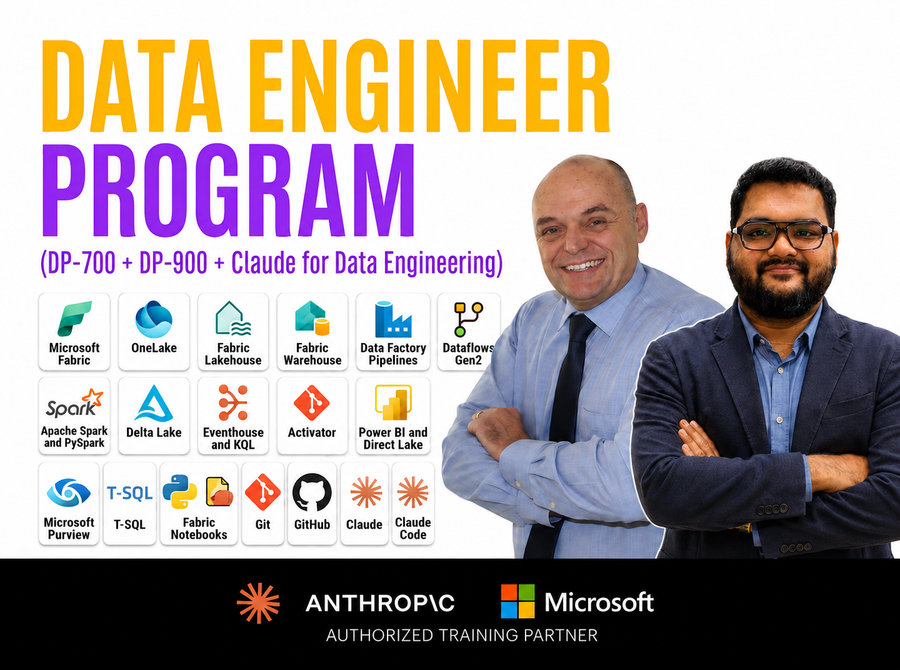
 Microsoft Fabric
 Python