Home › Guides › ETL Developer to Data Engineer
Career & Salary · 2026ETL Developer to Data Engineer in India 2026: What Transfers, the 7-Month Plan and Advertised Pay Bands
The ETL developer to data engineer switch usually takes six to nine months of part-time study, because the hard part is not SQL, it is Spark, Python and cloud orchestration. Advertised pay moves less than people expect: AmbitionBox figures put data engineers at roughly 13 LPA in the six to nine year band against 11.5 LPA for ETL developers.
- Your SQL and modelling knowledge is most of the job. The gap is PySpark, Python as a language rather than a scripting convenience, and deploying through Git instead of exporting an XML.
- The title change is not the hike. At the same years of experience, reported bands for the two roles sit about 0.7 to 1.5 LPA apart. Employer tier and Spark depth move the number far more than the job title does.
- Budget six to nine months at 35 to 45 hours a month. Three-month claims assume you already write Python daily.
- One certification is enough. DP-700 is the cleanest signal for the Microsoft side of the market. Third-party listings put the India exam fee between roughly Rs 3,700 and Rs 4,900 depending on tax treatment.
- Two finished pipelines beat ten tutorials. Interviewers ask what broke and how you found it, which a tutorial cannot give you.
- Expect a lateral move first. Many switchers take the data engineer title internally at flat pay, then re-price themselves on the next external move.
- Legacy ETL work is not disappearing this year. Indeed India still carried roughly 4,400 ETL Informatica developer vacancies when we checked on 24 October 2026.
Your Informatica workflow has run every night since 2019, and last month the client's architect circulated a target-state deck in which your whole folder becomes four Fabric pipelines that nobody on your team has written yet. You are not being made redundant. You are being quietly re-scoped, and the people who get the new work are the ones who can already read a Spark execution plan. That is the actual reason to make this move now, and it is a better reason than any salary chart.
Is the ETL Developer to Data Engineer Switch Realistic for You?
For most working ETL developers, yes, and more easily than for the mechanical engineers and bank operations staff who make up the rest of the career-switch traffic. You are not changing field. You are changing runtime. The warehouse concepts that take a newcomer eight months to internalise, grain, surrogate keys, late-arriving dimensions, idempotent reloads, are already in your head.
The three tests that actually predict it
Be honest about these before you spend money. First, can you write a window function, a correlated subquery and a seven-table join without opening a browser tab? If yes, you can skip almost the entire SQL month that most roadmaps sell you. Second, in the last two years, have you fixed a performance problem by reading an execution plan rather than by adding a partition and hoping? That habit is what Spark tuning is. Third, have you ever written a hundred lines of anything in a real programming language? If every transformation you have ever shipped was drag-and-drop, add two months to every timeline in this guide, and spend them on Python alone.
Where people genuinely struggle: ETL developers who have spent six years in production support rather than development. If your week is incident tickets, restarts and SLA reports, you have operational credibility but very little recent build experience, and the interview will find that out in round two. The fix is not more study. It is getting yourself onto a build task at your current employer, even an unglamorous one, before you start applying.
Is ETL Developer a Good Career in 2026?
Whether ETL developer is a good career in 2026 depends on which half of the work you sit on. It is a stable career with a falling ceiling, which is a different thing from a dying one. On 24 October 2026, Indeed India listed around 4,400 ETL Informatica developer vacancies and Foundit's ETL Informatica page cited a total in the thousands, so the hiring has not stopped. What has changed is where the salary growth is. Those listings are concentrated in service companies on maintenance and migration work, and migration work is finite by definition. The honest reading is that you have two or three comfortable years to make this move deliberately, rather than six months to make it in a panic.
What Transfers From ETL Development, and What Does Not
The single most useful mental model is that nothing about the intent of your work changes. A Lookup transformation and a broadcast join solve the same problem. An Update Strategy and a Delta MERGE INTO implement the same slowly changing dimension. What changes is that the logic now lives in code you can diff, review and test, and that the compute is elastic and billed by the second, which makes your choices visible in a way a fixed on-premise grid never did.
What your Informatica mapping becomes
Four familiar objects and their direct equivalents in a cloud lakehouse. The intent on the left survives the move.
Object equivalences drawn from Microsoft Fabric and Apache Spark documentation, checked 24 October 2026.
Informatica to Azure Data Engineer: the three real gaps
The Informatica to Azure data engineer route has three gaps that study plans routinely understate. One is Spark's distributed execution model: until you understand why a join on a skewed key takes forty minutes and the same join with a salted key takes four, you will write Spark that works on sample data and dies on production volume. Two is software engineering hygiene, meaning Git branches, pull requests, parameterised notebooks and a deployment that is not a manual export. Three is cost. A badly written notebook on a Fabric F64 capacity is not just slow, it is expensive, and in 2026 the architect reviewing your code cares about both.
| What you already do | Where it lands in data engineering | What you still have to add |
|---|---|---|
| Complex SQL, query tuning, index and partition decisions | Carries over almost untouched. Spark SQL is the same language with different physics. | Reading a Spark physical plan and the difference between a sort-merge and a broadcast join |
| Dimensional modelling, SCD type 1 and 2, surrogate keys | Directly reusable. This is what the silver and gold layers of a lakehouse are. | Expressing the same model as Delta tables with MERGE, time travel and OPTIMIZE
|
| Transformation logic built in a GUI mapping | Same logic, now written as PySpark DataFrame chains or SQL in a notebook | Python properly: functions, modules, error handling, a test you can run |
| Scheduling and dependency chains in Workflow Manager, Autosys or Control-M | Becomes Fabric Data pipelines, Airflow DAGs or Azure Data Factory triggers | Retries, idempotency on re-run, alerting that reaches a human |
| Production support, root-cause analysis, SLA discipline | Undervalued and genuinely rare. Say this out loud in interviews. | Observability in cloud terms: run history, lineage, capacity metrics |
| Source system knowledge and data quality rules | Your strongest differentiator against a bootcamp graduate | Encoding those rules as tested expectations rather than tribal knowledge |
Mapping compiled from Microsoft Fabric and Databricks role documentation and from skill requirements stated in open Indian job listings reviewed on 24 October 2026.
On the tooling choice, I would pick one cloud and stop reading about the other. If your current client is a Microsoft shop, which is the common case for Informatica and SSIS developers in Indian service companies, go to Microsoft Fabric and the DP-700 track and ignore the AWS material entirely for now. 360DT teaches that stack live on weekend evenings, which is the only format that works while you are still carrying a production rota. If you are on an AWS account instead, the AWS Solutions Architect and DevOps track is where Glue, EMR and Redshift are practised. Learning both at once is the most common way people spend nine months and arrive with neither.
Also read: Data Analyst vs Data Engineer in 2026, if part of you is wondering whether analytics is the easier door.
ETL Developer vs Data Engineer Salary in India: the Advertised Bands
Search for ETL developer salary in India and you will get four averages that disagree by a factor of three, so the collection basis sits under every figure below. This is also where most career-switch content loses its nerve, so here is the unflattering version first: at the same years of experience, the two roles are not far apart.
Reported pay by experience band, both roles
The gap at equal experience is real but modest. The title alone does not carry you.
AmbitionBox averages for ETL developer and Azure data engineer, as reported in public salary guides, checked 24 October 2026. Market ranges, not guarantees of individual pay.
| Experience | ETL developer, typically reported | Cloud data engineer, typically advertised or reported | What explains the difference |
|---|---|---|---|
| 0 to 3 years | Around 5.0 LPA average | Around 5.7 LPA average | Almost nothing. At entry the market pays for the employer, not the stack. |
| 3 to 6 years | Around 7.2 LPA average | Around 8.6 LPA average | Spark and cloud experience start to be priced separately here. |
| 6 to 9 years | Around 11.5 LPA average | Around 13.0 LPA average | Design ownership and streaming or governance work |
| Spread across all levels, India | Glassdoor 25th to 75th percentile roughly 4.7 to 9.7 LPA | Glassdoor Bengaluru 25th to 75th percentile roughly 5.4 to 13.0 LPA from 168 submissions | The top of the data engineer band is much higher than the top of the ETL band. That is the prize, and it is not automatic. |
Collection basis: figures above were read on 24 October 2026 from public AmbitionBox averages quoted in salary guides and from Glassdoor India and Glassdoor Bengaluru percentile bands for ETL developer and Azure data engineer. Sources disagree by wide margins because of sample size and inconsistent job titles, so treat these as market ranges rather than offer predictions. Nobody is guaranteed any of these numbers.
What the switch is actually worth at each stage
Same-experience comparisons. Notice how small the early jumps are and how wide the top gets.
1 to 3 years
3 to 6 years
6 to 9 years
75th percentile
First three cards compare AmbitionBox averages for the two roles. The fourth compares Glassdoor's India-wide ETL developer 75th percentile with its Bengaluru Azure data engineer 75th percentile, so it is indicative rather than like for like. Checked 24 October 2026.
So the case for moving is not the 14 percent at the bottom. It is that the ETL developer distribution runs out of room somewhere around 10 to 12 LPA in most service companies, while the data engineer distribution keeps going, and the employers at the top of it are different employers. Where it clearly pays off is the combination that keeps appearing in listings: SQL plus PySpark plus one cloud platform plus Delta or Iceberg. Foundit showed roughly 6,673 Databricks roles in India on 6 October 2026 and Glassdoor showed 751 Azure Databricks with PySpark openings, which tells you which two words to get onto your resume.
Also read: Data Engineer Salary in India 2026 for the full breakdown by company type.
How to Switch From ETL Developer to Data Engineer in 2026: a 7-Month Plan
This plan assumes roughly 40 hours a month, which is two weekday evenings and most of one weekend day. It assumes you keep your job. It also assumes you are starting from strong SQL, which as an ETL developer you almost certainly are, and that is exactly why your plan is shorter than the ten-month ones written for career changers.
| Month | Focus | Hours | What you must be able to show at the end |
|---|---|---|---|
| 1 | Python as a language, not a script | 40 | A module with functions, type hints and a pytest test that reads a CSV and writes partitioned Parquet |
| 2 | PySpark fundamentals and the execution model | 45 | A notebook that joins two multi-million row datasets, plus your own written explanation of where the shuffle happened |
| 3 | Lakehouse and Delta Lake | 40 | A bronze, silver and gold lakehouse with a MERGE INTO driven SCD type 2 dimension |
| 4 | Orchestration, Git and deployment | 40 | A scheduled pipeline in source control, with retries and an alert that actually fires on failure |
| 5 | DP-700 preparation and the exam | 45 | The exam booked, sat and behind you |
| 6 | Second project, with streaming | 40 | An incremental or streaming ingest with watermarking and de-duplication, and a documented cost per run |
| 7 | Resume, portfolio and applications | 30 | A repository README a stranger can follow, three numbers on your resume, and ten applications a week going out |
Hours are a planning estimate for someone already fluent in SQL. If your transformation work has been entirely GUI based, add two months to month 1 before continuing.
Where DP-700 Certification Fits
Take exactly one certification, in month 5, after you have built something. Taken first, it becomes a vocabulary exercise you forget by June. The DP-700 certification covers ingesting, transforming and administering analytics solutions in Fabric, and because the exam expects working KQL, T-SQL and PySpark rather than recall, preparing for it forces exactly the skills a hiring manager will test. Third-party sites listed the India fee between about Rs 3,700 excluding taxes and Rs 4,865 when we checked on 24 October 2026, against the widely quoted 165 US dollar list price, so confirm the current price on Microsoft's own exam page when you book. If you want to see how DP-700 sits alongside DP-900 and the rest, the full certifications overview lays out the sequence.
What I would skip: a second cloud certification, any Databricks credential until an employer asks for it, and the entire genre of 60-hour video courses on "big data" that spend four modules on Hadoop. Hadoop is not where the openings are.
Also read: Data Engineer Interview Questions 2026, which is worth reading in month 6 rather than month 7.
Build the Fabric skills an ETL developer is missing, without leaving your current job
Eight weekends of live Microsoft Fabric data engineering aligned to DP-700, with DP-900 fundamentals included and hands on projects with mentor support. The current batch starts 25 October 2026.
Explore the course
What You Actually Earn During the Transition
Nothing, for about seven months. That is the part the roadmaps leave out, and it matters more than the destination band, because it is the bit you have to survive.
Three money realities to plan for. The first is that the cheapest route is an internal move, and internal moves are usually made at flat pay. If your organisation is migrating a client from Informatica to Fabric, ask to be on that migration team. You will get paid your current salary to learn on the company's time, which is strictly better than paying for lab credits at midnight. The trade you are accepting is a slower re-pricing, because your employer already knows your old number.
The second is that external offers for a first-time data engineer with no production cloud delivery tend to come in at your current band or slightly above, not at the 13 LPA average. The average belongs to people with two years in the role. Expect your first offer to be a sideways step with a better trajectory.
The third is variable pay. If a third of your CTC sits in a bonus that pays out in June and you resign in April, you are taking a real cut that no offer letter will mention. Check your payout date before you give notice.
One sentence worth having ready when the recruiter asks for your expectation: "I am currently at X fixed. I am moving for the Fabric and Spark work rather than for a jump, so I am looking at X plus 20 percent fixed, and I am flexible on the variable component." It is honest, it anchors on fixed pay rather than CTC, and it does not pretend you have three years of Spark you do not have.
The Interview Rounds, and What Each One Is Really Testing
The sequence is predictable enough that you can prepare for it round by round. The thing to understand is that only one of these rounds is about syntax.
A typical Indian data engineer loop
What is really being assessed in each round, and the one sentence that wins it.
Recruiter screen
Testing whether your resume words are yours. Have a 40 second answer that names the volume, the platform and the schedule of something you built. Vague answers end here.
SQL on a shared screen
Window functions, de-duplication, and a gaps-and-islands question. This is your round. An ETL developer who fumbles this round has not practised typing without autocomplete.
PySpark and the physics question
Expect "this job takes two hours, make it faster". Answer with partitioning, broadcast thresholds, skew handling and caching, and say which one you would try first and why.
Design and failure
Design an incremental load for a 400 million row table, then explain what happens when it runs twice. Idempotency is the answer most switchers miss.
Manager and fit
Where your production support years pay for themselves. Describe one incident end to end, with the detection, the root cause and the fix you shipped so it could not recur.
Round structure compiled from skill requirements and interview stages described in open Indian data engineer listings reviewed on 24 October 2026.
Round 3 is where the switch is won or lost, and it is the round that pure certification study does not prepare you for. If you want that kind of code review on your own work before a stranger does it in an interview, a free webinar session is a low-cost way to see how the material is actually taught before you commit money to anything.
Case Study: Seven Years on Informatica to a Fabric Data Engineer Role
Illustrative composite. The path below is assembled from typical market routes and the pay bands cited earlier in this guide. It is not a real named individual, a 360DT learner or an outcome anyone should expect to repeat.
Take a Pune-based Informatica developer with seven years on a retail client's warehouse, reported band around 11 to 12 LPA, whose week is thirty mappings in maintenance and one enhancement. Months 1 and 2 go on Python and PySpark, done badly at first, because the instinct to solve everything in SQL is hard to shake. Month 3 produces the first real artefact: a lakehouse where the silver layer rebuilds the client's customer dimension as a Delta SCD type 2, which is a direct port of a mapping already in production, and that choice is what makes it convincing in interviews.
Month 4 is the obstacle. The scheduled pipeline silently produces duplicates whenever it reruns after a failure, and finding out why teaches more about idempotency than the previous three months taught about Spark. Month 5 is DP-700. Months 6 and 7 bring an internal move onto the client's Fabric migration pod at flat pay, which is the unglamorous but sensible step: eight months of real delivery on someone else's capacity bill.
The external move comes at month 15, not month 7, into a mid-size product company at a band consistent with the 13 LPA average for the six to nine year group, with a wider variable component. Total elapsed time from first notebook to new title and new employer: fifteen months, of which seven were study and eight were paid delivery. The resume line that did the work, which you can adapt directly: "Migrated 34 Informatica mappings to Microsoft Fabric pipelines, rebuilt a 40 million row SCD2 customer dimension in Delta, and cut nightly load from 2h 50m to 48m."
What Usually Goes Wrong
- The timeline doubles. Seven months at 40 hours assumes no production escalation, no wedding season and no sick child. Plan for nine and you will not quit in month four.
- The portfolio is ten tutorials. Finished copies of someone else's notebook prove nothing. Two projects you broke and fixed beat ten you followed.
- The pay cut arrives sideways. Not in the base, but in a forfeited bonus, a lost retention payment or a notice period buyout you have to fund yourself.
- The internal move never gets priced. People take the flat-pay lateral and then stay three years in it. Give yourself a date, twelve to eighteen months out, when you test the external market.
- The exam becomes the project. A certificate with no repository behind it reads as a certificate with no repository behind it.
And the honest caveat about this whole move: for a 48-year-old ETL developer in a stable maintenance role with ten years to retirement and no appetite for weekend study, it may not be worth it. The gap at the top of the band is real, but it is captured by people who then spend several years doing demanding build work in an unfamiliar stack. Depth in the platform your employer has actually bought, plus governance and data quality ownership, is a legitimate alternative career and nobody writes guides about it. Choose the switch because you want to build things again. Not because a chart said 13 LPA.
If the destination you actually want is further along, the modelling and SQL foundation here also feeds the PL-300 and Power BI analyst route, while the pipeline and deployment skills from month 4 transfer almost intact into MLOps work on AI-300, and into the RAG and agent engineering roles that increasingly sit on top of a well-governed lakehouse. The same is true of Azure architecture on AZ-305 if you would rather design than build.
What I Would Do in Your Position
Pick the cloud your employer already pays for. Spend month 1 on Python and refuse to start Spark until you can write a tested module. Get onto a migration team inside your own company even if it costs you a title and a year, because paid delivery beats unpaid study at every point on this path. Take DP-700 in month 5, not month 1. Then set a calendar reminder fifteen months out to test the external market, and keep it.
If you want that done with a syllabus and live instruction rather than a browser full of tabs, the Microsoft Fabric Data Engineer course runs the DP-700 stack live on Saturday and Sunday evenings over eight weeks, which is the one schedule that survives a production support rota. Start there, and start with month 1.
Related guides
- DP-700 vs DP-900: Which Microsoft Fabric Certification Should You Take First in 2026? settles the month 5 question if you are unsure whether to start at fundamentals.
- Star Schema Explained in 2026 is the modelling vocabulary your gold layer will be judged on in round 4.
- Data Engineering Projects for 2026 gives six builds with datasets and real running costs, for months 3 and 6.
- What Is Apache Iceberg in 2026? covers the table format question that follows Delta in most senior interviews.
- CTC vs In-Hand Salary in India 2026 is how you check whether an offer in this band is actually an increase.
- Data Engineer Jobs in Hyderabad 2026 if relocating is one of the levers you are willing to pull.
Frequently asked questions
How long does the ETL developer to data engineer switch really take?
Six to nine months of part-time study at roughly 40 hours a month if your SQL is already strong, which for an ETL developer it usually is. Add two months if all your transformation work has been drag-and-drop with no scripting. Getting the new title on a payslip often takes longer than the learning does, because the common route is an internal move first and an external re-pricing twelve to eighteen months later.
Do I need to learn Python to become a data engineer?
Yes, and more of it than most roadmaps admit. You can pass interviews on SQL alone for some warehouse-centric roles, but the listings that pay the top of the band ask for PySpark, and PySpark is Python. You do not need web frameworks or data science libraries. You need functions, modules, error handling, a test you can run and enough comfort to read a stack trace.
Will I have to take a pay cut to move from ETL development to data engineering?
A cut in base pay is uncommon. A cut in total earnings is quite common, and it arrives through forfeited variable pay, a lost retention bonus or a notice period buyout you fund yourself. Internal moves onto a migration team are usually made at flat pay. Check your bonus payout date before you resign.
Am I too old to switch to data engineering at 38?
No, but the shape of the move changes. At 38 with twelve years of ETL behind you, competing for a junior data engineer slot is the wrong play. Position yourself on migration and modernisation work, where your knowledge of the legacy system you are replacing is scarce and valuable, and expect your first step to be lateral rather than a jump.
Is DP-700 or a Databricks certification better for an ETL developer?
Follow your employer's stack rather than the internet's preference. DP-700 is the better first choice if you are in a Microsoft shop, which describes most Informatica and SSIS teams in Indian service companies, and it forces hands-on PySpark, T-SQL and KQL rather than multiple choice recall. Add a Databricks credential only when a specific role or client asks for it.
Can I switch to data engineering without leaving my current job?
That is the route most people actually take, and it is the one we would recommend. Two weekday evenings plus most of one weekend day gets you to about 40 hours a month, which is the pace the plan in this guide assumes. Live weekend evening classes exist precisely because resigning to study is an expensive way to remove your own safety net.
Is ETL developer a dead career in 2026?
No. Indeed India still listed roughly 4,400 ETL Informatica developer vacancies when we checked on 24 October 2026. What is shrinking is the ceiling, not the volume, because the work is concentrated in maintenance and migration, and migration projects end. Treat it as two or three years of runway to move deliberately rather than as an emergency.
Which is an easier switch for an ETL developer, data engineering or data analytics?
Data analytics is the shorter study path, because Power BI and DAX are faster to learn than Spark and distributed execution. Data engineering is the closer fit to what you already do and has the higher band at the top. If you enjoy the pipeline and dislike stakeholder presentations, the extra three months of Spark is the better investment.
About this guide. 360 Digital Transformation is an Anthropic Partner and a Microsoft Authorized Training Partner, offering exam preparation and skills training. We do not offer placement or job guarantees. Other certification bodies and employers named here are not affiliated with us. Salary figures are advertised market ranges collected from public job listings, not guarantees of what any individual will earn. Figures cited were checked on 24 October 2026.
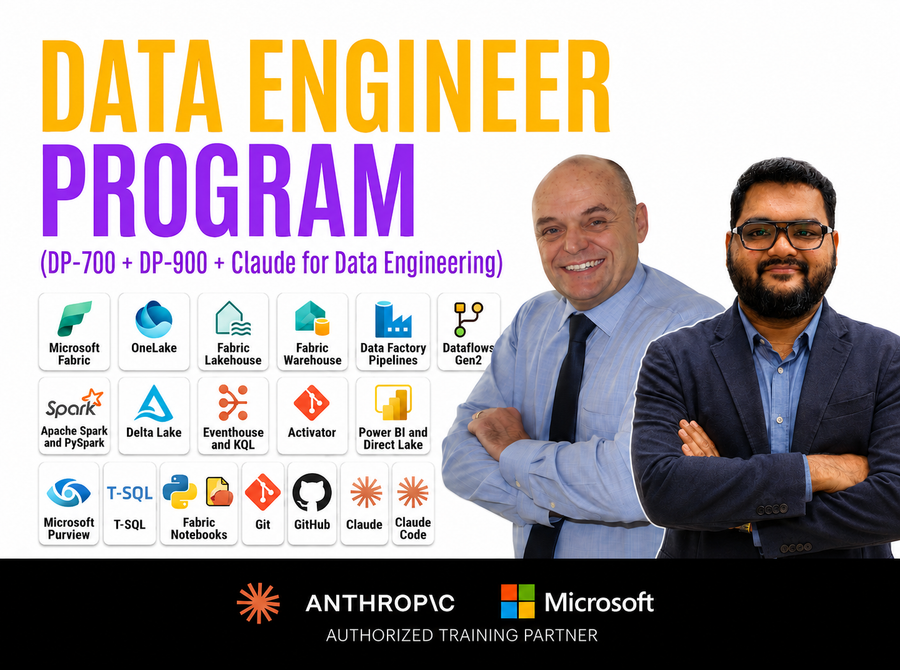
 Microsoft Fabric
 Python