Home › Guides › Java Developer Salary
Career & Salary · 2026Java Developer Salary in India 2026: Pay Bands by Experience, Company Type and Why the Band Splits at 8 Years
Java developer salary in India in 2026 is advertised from roughly Rs 3.5 to 7 LPA for freshers, Rs 8 to 16 LPA at three to six years, and Rs 25 to 45 LPA for senior engineers at product companies and GCCs. Cloud and distributed systems depth, not years of Java, decides which band you land in.
- Two markets, one job title. The same Java resume is priced at 14 LPA by a services firm and 30 LPA by a product company, and the gap is not negotiation skill.
- The band splits at about eight years. Before that, years still move pay. After that, what you own technically moves pay, and years stop counting.
- Cloud is the single biggest multiplier on an Indian Java resume in 2026, ahead of any language feature or framework version.
- Spring Boot 4.0 landed in November 2025 and open-source support for Boot 3.5 ended on 30 June 2026, so migration work is live hiring demand right now.
- Aon's 2026 survey puts average Indian salary increases at 9.1%, which is what staying put is worth. Band changes come from switching the kind of work, not from appraisals.
- An Oracle Java certification barely moves the number. Cloud and AI integration credentials move it more, and the listings say so.
You have seven years of Java. You write Spring Boot services, you fix Oracle queries someone wrote in 2016, and you have just found out that a colleague with five years and an AWS certificate joined a product company at a number you cannot say out loud at home. Nothing about your work got worse. The market simply stopped paying for the thing you are best at and started paying for the thing next to it.
That is why a single average is useless here. Below are the advertised bands, the four company types that explain most of the variance, and what it actually takes to move from one band to the next.
Java Developer Salary in India 2026: The Advertised Bands
These are advertised ranges, which is to say what employers put in listings and what salary trackers report candidates accepting. They are not guarantees, and the spread inside each row is wider than the gap between rows.
| Experience | Services and mid-market (advertised) | Product, GCC and funded startups (advertised) | What the listing usually asks for |
|---|---|---|---|
| 0 to 2 years (fresher) | Rs 3.5 to 7 LPA | Rs 8 to 14 LPA | Core Java, collections, one Spring Boot project, SQL |
| 3 to 6 years | Rs 8 to 16 LPA | Rs 18 to 30 LPA | Spring Boot, REST, one cloud, Docker, CI pipeline |
| 7 to 10 years | Rs 14 to 24 LPA | Rs 25 to 45 LPA | System design, Kafka or equivalent, Kubernetes, on-call ownership |
| 10+ years (lead, staff, architect) | Rs 22 to 35 LPA | Rs 40 LPA and above | Multi-team design, cost and latency targets, migration ownership |
Collection basis: advertised and reported ranges read on 4 November 2026 from public Indian job listings and from 2026 salary trackers including Scaler, Guvi and Codegnan, with Codegnan citing Indeed's reported average of about Rs 3.58 LPA for Java freshers from 123 reported salaries. Where sources disagreed we took the lower cluster. Individual offers fall outside these ranges in both directions.
The four numbers worth knowing before you negotiate
Three describe the market you are negotiating inside. One is what the obvious credential costs.
Figures as reported by Aon, ANSR, Oracle exam storefront listings and the official Spring release notes, checked 4 November 2026.
Java Developer Salary in India by Company Type
The single field that predicts a Java offer best is the employer's business model, not the candidate's years. A services firm bills your hours to a client at a rate it negotiated two years ago, so your pay is a cost line inside that rate. A product company prices you against what the system failing would cost. That is different arithmetic, and interview polish does not bridge it.
| Company type | 3 to 6 years (advertised) | 8 to 12 years (advertised) | What shifts the number |
|---|---|---|---|
| Indian IT services (large) | Rs 8 to 14 LPA | Rs 18 to 28 LPA | Band and grade tables, client billing rate, internal promotion cycle |
| Mid-market services and staffing | Rs 9 to 16 LPA | Rs 16 to 26 LPA | Immediate joiner premium, client interview cleared or not |
| GCC or captive centre | Rs 16 to 26 LPA | Rs 28 to 45 LPA | Parent company grade mapped to India, domain knowledge, English-heavy stakeholder work |
| Product company and funded startup | Rs 18 to 32 LPA | Rs 30 to 50 LPA plus equity | System design round outcome, scale you have genuinely operated, referral strength |
Collection basis: advertised ranges and reported offer bands read on 4 November 2026 across public listings for Java, Java backend and Java full stack roles in Bengaluru, Hyderabad, Pune, Chennai and Delhi NCR. GCC bands reflect the concentration ANSR describes, with Bengaluru and Hyderabad alone holding more than 200 Fortune 500 centres and over 560,000 professionals. Equity is excluded from all figures.
Java full stack developer salary in India
Java full stack developer salary in India tracks the backend bands closely, with one caveat worth money: the premium goes to people who can own an end-to-end feature, not to people who list React under skills. If your React is three components you copied from a template, drop it from the resume. Interviewers for full stack roles ask you to add a field to a form, carry it through the API, migrate the table and ship it behind a flag. Listings for these roles in 2026 commonly pair Spring Boot with React or Angular and ask for Docker plus one cloud, and that cloud line is where most services-side candidates lose the shortlist.
Senior Java Developer Salary in India: Why the Band Splits at 8 Years
Senior java developer salary in India looks bimodal when you plot it, and the fork sits somewhere around year eight. Before it, employers still read years as a proxy for capability, so each appraisal cycle and each switch adds a predictable slice. After it, the proxy stops working. A hiring manager with a 35 LPA budget is not asking how long you have written Java. They are asking whether you can be handed a system that costs the company money when it is slow, and left alone with it.
Keep one person in mind for the rest of this guide, an illustrative composite rather than a real individual: a Java developer with seven years at a Pune services firm, Rs 15.5 LPA fixed, Spring Boot and Oracle every day, no production access, no on-call, and a laptop that cannot reach any cloud console. Their Java is genuinely good. Their market is capped at roughly 24 LPA, and the cap has nothing to do with Java.
What decides a services shortlist
Language depth and delivery reliability carry most of the weight.
Our editorial weighting of what decides a shortlist, based on the language of listings and screening calls read on 4 November 2026. It is a judgement, not a count of postings.
What decides a product or GCC shortlist
The same Java knowledge is assumed, then barely scored.
Same basis and same caveat: an editorial weighting read from 2026 listing language, checked 4 November 2026.
Read those two panels side by side and the strategy writes itself. The skill you have spent seven years deepening is worth 35% of the decision in the market that pays less, and 15% in the market that pays more. That is not unfair, it is just pricing: product teams can hire Java depth easily in India and cannot hire operational judgement easily.
Java Developer Salary for Freshers in India: What the First Offer Looks Like
Java developer salary for freshers in India starts at a number that shocks people who were told Java is the safe choice. Mass-hiring services offers cluster at Rs 3.5 to 4.5 LPA, and trackers reporting an average near Rs 3.6 LPA are measuring exactly that cluster. The Rs 8 to 14 LPA fresher offers exist, but they come from product companies and GCC graduate programmes that interview on data structures and one working project, not on a certificate count.
Two practical things change a first offer. The first is a project an interviewer can open and break: a service with authentication, a database migration, a Dockerfile and a deployed URL beats four tutorial clones. The second is a cloud fundamentals credential, because it gets the resume past the filter that most fresher resumes die in. If you are starting from zero and want the cloud half done properly, the AWS Solutions Architect and DevOps course covers SAA-C03 and DOP-C02 with the labs you need, and the full certifications overview lays out which exams sit at which level.
A resume line you can copy and adapt: "Built and deployed a Spring Boot order service on AWS ECS behind an ALB, Postgres with Flyway migrations, GitHub Actions pipeline, p95 latency 180 ms under 200 concurrent users (load tested with k6)." Every clause in that line is something an interviewer can ask a follow-up question about, which is the whole point.
Also read: Python Developer Salary in India 2026, for the same analysis on the other default language choice.
What Actually Drives the Top of the Band
Skills, in the order the market pays for them
Cloud first, and it is not close. One cloud operated for real, meaning you have deployed, debugged and watched a bill, clears filters that deeper Java does not. Kubernetes and observability come next, because the 30 LPA question is usually "a pod is restarting every nine minutes in production, walk me through it" rather than anything about streams or records. Then event-driven work: consumer groups, idempotency, replay. We teach the container and pipeline half live in the Azure Solutions Architect and DevOps programme, and the AZ-305 design material maps almost one to one onto the system design round.
Then there is AI integration, which is where the honest answer differs from the LinkedIn answer. Spring AI reaching 1.0 GA in May 2025 means a Java developer can add retrieval and tool calling inside the stack they already run, and a working RAG and agent build on your resume is now a genuine differentiator in GCC interviews. It is also true that most Indian AI job postings still name Python, so treat Spring AI as a way to make your Java role more valuable rather than as a ticket into an AI title. If the production side is what interests you, the deployment and monitoring half of that work belongs to the MLOps engineer track built around AI-300, and the developer-level Claude exam is covered in 360DT's CCDV-F prep course.
The migration window nobody is talking about
Spring Boot 4.0.0 shipped on 20 November 2025 with first-class Java 25 support on a Java 17 baseline, and open-source support for Boot 3.5 ended on 30 June 2026. Every large Indian enterprise with a Spring estate now has an upgrade on a slide somewhere. If you have actually done one, including the Jakarta namespace work and the dependency archaeology that comes with it, say so in the first three lines of your resume. Migration experience is specific, it is dated, and it is the rare line that makes a recruiter call you instead of forwarding you.
Domain and location
Domain pays in exactly two places: regulated work where mistakes are expensive, and systems where latency is revenue. BFSI payments, capital markets, insurance claims and telecom billing all carry a premium over generic enterprise CRUD. Location matters less than it did, but it has not stopped mattering: Bengaluru and Hyderabad still carry the top of the GCC band, Pune and Chennai sit a notch below for the same work, and remote-first product roles now price mostly on the role rather than your pin code.
Negotiation, said out loud
The expensive mistake is answering the expected CTC question with a number before you know the range. Say this, close to verbatim: "I am interviewing in the 28 to 32 range for roles with this scope. If your band for this level is different, tell me where it sits and I will tell you honestly whether it works." That gives a range, anchors it to scope rather than your current pay, and invites the recruiter to disclose first. Then negotiate the fixed component, not the total, because variable pay and joining bonuses are the parts that quietly evaporate. The longer version of that conversation is in our salary negotiation guide.
A 12-Week Plan to Move Your Band
This is the plan we would give the Pune developer from earlier, built for someone with a full-time job and roughly eight hours a week. It is deliberately narrow. Twelve weeks is not enough time to become an architect, but it is enough to change what your resume lets you interview for.
Twelve weeks, six deliverables
Each block ends in something a stranger can open, run or break.
Get your Java into production shape
Move one existing side project to Java 21 or 25 with virtual threads where they fit, and add a real test suite. Deliverable: a repo with a README that explains one design decision you reversed.
One cloud, operated for real
Deploy the service to ECS or AKS, add a managed database, wire logs and metrics, then deliberately break it and read the trace. Deliverable: a screenshot of your own bill and a note on what drove it.
Containers and pipeline
Multi-stage Dockerfile, GitHub Actions build, a Kubernetes deployment with readiness probes and a rollback you have tested. Deliverable: a 90-second screen recording of a deploy and a rollback.
Event-driven and idempotency
Add Kafka or a managed equivalent, handle duplicate delivery properly, write the replay path. Deliverable: a failure test that proves the same message twice does not double-charge anyone.
AI integration inside your stack
Add one retrieval endpoint with Spring AI over your own documents, with evaluation on 20 real questions. Deliverable: an honest accuracy table, including the questions it got wrong.
Rewrite the resume around systems
Lead with scale, latency, cost and ownership. Drop the skills soup. Deliverable: two versions, one for GCC roles and one for product roles, and six applications sent.
An illustrative plan, not a guarantee of any outcome. Hours assume roughly eight a week alongside full-time work.
An illustrative transition, start to finish
A composite built from typical market paths rather than one real person. Our Pune developer starts at Rs 15.5 LPA fixed, seven years, services, no cloud access. Months one to three: the plan above, ending with a deployed service and a cloud exam booked. Months four to six: SAA-C03 cleared, then two GCC interviews failed at the system design round, with the same feedback both times, that the candidate can describe components but not trade-offs. Months seven to nine: deliberate design practice, a Kafka rework of the side project, and a Spring Boot 4 migration volunteered for at work, which is the line that finally gets recruiter calls. Month ten: an offer from a Pune GCC at the lower end of the 28 to 45 advertised band for that level, with a six-week unpaid gap because the buyout was refused. Ten months, two rejections, one real financial cost. Plenty of people take longer, and some do not clear it at all.
Add the AI integration layer to a Java career that has stopped moving
The AI Engineer course teaches you to build agents that plan, use tools and act, certified on both Microsoft Copilot Studio and Claude Code, the two stacks job postings are actually naming. Classes run on weekend evenings, so you can train without leaving your current role.
Explore the course
What Goes Wrong
- The switch takes longer than the plan. Ten to fourteen months from decision to a band change is normal for someone studying around a job. Three months is marketing.
- Some switches cost money on the way in. People leaving a 14-year services grade for a product role sometimes take a flat offer, or a notice-period gap, in exchange for the next two increments being on a different curve.
- The design round is where most senior candidates fail, not the coding round. It is also the hardest thing to self-teach, because you need someone to argue with.
- A certificate with no deployed system behind it reads as a certificate. Interviewers at this level open your repo.
- A hike is not a band change. Aon projects a 9.1% average increase for 2026, up from 8.9% in 2025, against 4.3% in the US and 4.1% in the UK, and those numbers are about staying, not moving.
Here is the one that catches people quietly. You get the 32 LPA offer, accept it, then read the breakup: 24 fixed, 5 variable on company and individual performance, 3 as a joining bonus with a one-year clawback. Your monthly in-hand barely moves for a year, and the variable pays at 70% because the business missed a target in a country you have never visited. Nothing was mis-sold. You negotiated the wrong number. Compare fixed to fixed, every time, and read our CTC versus in-hand breakdown before you sign.
And one honest caveat on certifications, since we sell exam prep and you should hear it from us. An Oracle Java certification is the credential Java developers ask about most and the one we would least often recommend buying first. At USD 245 for 1Z0-830, with 50 questions in 90 minutes and a 68% pass mark, it proves language knowledge that your eight years already imply, and almost no Indian listing at the 25 LPA-plus level asks for it. If you have one exam's worth of money and three months of evenings, a cloud or AI credential changes which roles you can interview for. The Java exam mostly changes a line on page two.
Is Java a Good Career in 2026?
Is java a good career in 2026? Yes, with one condition, and the condition is the whole answer. Java runs the payments, policy admin and order management of most large Indian enterprises, Java 25 LTS carries support into the 2030s, and Spring Boot 4 has given every one of those estates a funded reason to hire this year. Demand for Struts-era maintenance work is fading. Demand for Spring Boot specialists, JVM performance work and migration leads is not.
The condition is that Java is now a platform skill, not a differentiator. Fifteen years ago, knowing Java well was a career. In 2026 it is the floor you stand on while you add the thing that gets priced: cloud, distributed systems, data engineering on Microsoft Fabric and DP-700, or AI integration. Add one of those properly and you are better placed than almost anyone, because you can read the systems that hold companies together. Add nothing and you keep getting 9% a year while five-year engineers pass you.
Also read: Java Developer to AI Engineer in India 2026 for the full eight-month version of that switch, and Service Based to Product Based Company in India 2026 if the employer type is the part you want to change first.
If we were in the Pune developer's position, we would pick cloud before AI, because it fixes the filter problem immediately and it is the cheaper skill to prove. Then we would add the AI integration layer within the same year, while it is still a differentiator in GCC interviews rather than a baseline expectation, which is where it is heading. If that is the sequence you want, the AI Engineer course is the part of it we teach live on weekend evenings, and a demo class is the cheapest way to find out whether the pace suits you.
Related guides
- IT Salary in India by Years of Experience 2026 shows where the years-based curve flattens across every role, not just Java.
- GCC Salary in India 2026 is the detail behind the company-type table above, since GCCs are where most Java band jumps now happen.
- Docker vs Kubernetes in 2026 answers which of the two to learn first when weeks 6 and 7 of the plan arrive.
- What Is Agentic RAG in 2026? explains the retrieval loop you will build in week 10, including what it costs per query.
- AZ-305 vs SAA-C03 in 2026 settles which cloud certification to book if your employer is Microsoft-aligned or AWS-aligned.
Frequently asked questions
What is the average java developer salary in india in 2026?
Trackers put the blended average somewhere between Rs 8.5 and 11 LPA, and that average is close to useless because it mixes two markets. Advertised ranges are more honest: roughly Rs 3.5 to 7 LPA for freshers, Rs 8 to 16 LPA at three to six years in services, and Rs 25 to 45 LPA for senior engineers at product companies and GCCs. Read the band for your experience and employer type, not the average.
Is 12 LPA a good salary for a Java developer with 6 years of experience?
It sits inside the advertised services band for that experience, so it is normal rather than low. It is below the GCC and product bands for the same years, which commonly start around Rs 16 to 18 LPA. If you have cloud and production ownership and you are still at 12, the gap is market access rather than skill. If you have neither, the number is an accurate reflection of what your resume currently lets you interview for.
Java developer salary for freshers in india: how much should I expect in my first job?
Mass-hiring services offers cluster at Rs 3.5 to 4.5 LPA, which is why trackers citing Indeed data report a fresher average near Rs 3.6 LPA. Product companies and GCC graduate programmes advertise Rs 8 to 14 LPA, and they interview on data structures plus one project you can defend in depth. A deployed project with a database migration and a pipeline is worth more at this stage than three certificates.
Do Java developers get paid less than Python developers in India?
Not at the same scope. The bands overlap heavily, and employer type explains far more of the difference than language does. Python shows a thicker tail at the top because AI and data roles cluster there, so the highest advertised numbers in that market are higher. For backend work at a given company and level, the offers are close enough that choosing a language for pay reasons alone is a mistake.
Am I too old to move out of maintenance Java at 35?
No, and 35 with ten years of enterprise Java is a stronger starting point than 25 with three, because systems knowledge and stakeholder experience are the parts that cannot be crammed. What does change with age is tolerance for the awkward middle: you may interview against people younger than you, and you may fail a design round or two before the feedback becomes useful. Budget ten to fourteen months rather than three, and keep earning while you train.
Does an Oracle Java certification increase your salary in India?
Rarely in any way you can measure. At USD 245 for 1Z0-830, it verifies language knowledge that your experience already implies, and senior Indian listings almost never ask for it. Cloud and AI credentials appear in listings far more often and are what filters are built around. The exception is a client or vendor contract that specifically requires certified Java developers on the team, in which case your employer should be paying for it.
How much hike is realistic for a senior java developer in india when switching?
Switching with the same scope typically gets you a modest step above your current fixed pay, roughly in line with the band you are already in. Band changes, meaning services to GCC or product, are where the larger differences in advertised ranges sit, and they usually require clearing a system design round. Nobody can promise you a percentage, and any course or recruiter that does is describing a hope, not a market.
About this guide. 360 Digital Transformation is an Anthropic Partner and a Microsoft Authorized Training Partner, offering exam preparation and skills training. We do not offer placement or job guarantees. Other certification bodies and employers named here are not affiliated with us. Salary figures are advertised market ranges collected from public job listings, not guarantees of what any individual will earn. Figures cited were checked on 4 November 2026.
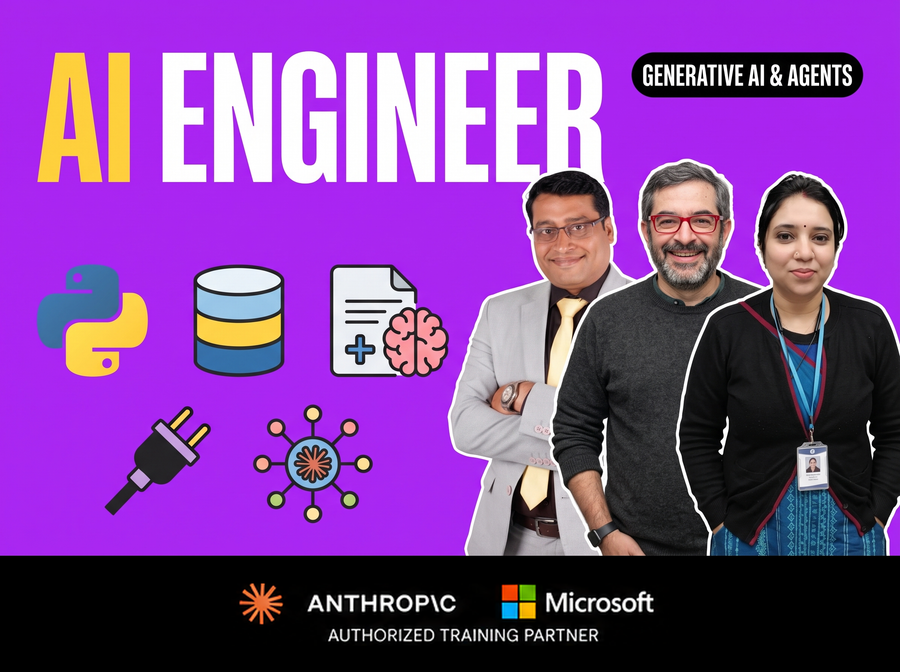
 Python
 Claude API
 FAISS
 ChromaDB
 LangChain
 LangGraph
 CrewAI
 AutoGen (AG2)