Home › Guides › FDE Skills 2026
Career Guide · 2026Forward Deployed Engineer Skills in 2026: 8 Employers Actually Want (and 3 That Don't Matter)
Forward deployed engineer skills in 2026 center on eight capabilities: production coding, API and systems integration, cloud deployment on AWS or Azure, agent and RAG engineering, data pipeline literacy, client-facing debugging, security awareness, and stakeholder communication. Most job postings screen hardest for the first five.
Your first week on an FDE desk looks nothing like the job posting. You are handed a client's half-documented API, a Slack channel with a name like #acme-prod-escalation, and a deadline that was set before anyone checked whether the data was clean. Nobody asks if you know the theory. They watch whether you can read a stack trace, patch it, and explain what happened to a VP who does not know what a vector database is, all inside one call.
That gap between what the job posting lists and what the desk actually tests is why strong engineers get filtered out at the first technical screen. Below is the list built from what enterprise AI deployment teams actually check for in 2026, not the generic "strong communication skills" line every posting repeats.
- Eight skills dominate almost every screen: production coding, integration, cloud deployment, agent/RAG engineering, data literacy, live debugging, security awareness, and stakeholder communication.
- Cloud deployment fluency on AWS or Azure is the single most consistent screen, ahead of raw AI skill.
- Deep ML research ability is not one of them. Most FDEs never train a model; they wire one into somebody else's mess.
- A 12-week plan from a working backend developer to a credible FDE candidate is realistic.
- Certifications clear the resume filter, but a real integration demo beats a badge in the technical round.
- The role rewards people who can debug out loud in front of a client without going quiet.
What a Forward Deployed Engineer Actually Does
Strip away the Palantir mythology and the role is simpler than it sounds: you sit between a vendor's AI product and a client's actual, messy systems, and make the product work inside their environment, not a demo sandbox. Forward deployed engineer skills matter because the job is graded on outcomes inside somebody else's infrastructure, under their security rules, on their timeline. For a broader walkthrough of the role itself, see our full FDE role explainer.
A useful way to picture it: a five-year Java developer at a mid-size Indian insurer who has shipped internal tools but never faced a client directly. Moving into an FDE seat does not mean learning a new language from scratch. It means adding a layer on top of solid engineering: reading someone else's schema fast, deploying into environments you do not control, and narrating your fix to people who are not engineers. That combination, not raw coding talent, is what the next section breaks down.
Forward Deployed Engineer Skills at a Glance
The shape of what gets screened for versus what most candidates over-prepare
Figures are editorial judgment based on 360DT's review of current forward deployed engineer postings, checked 23 September 2026.
The 8 Forward Deployed Engineer Skills Employers Actually Want
This is the list you can walk into a screen with. Each one below is something an interviewer can actually test in thirty minutes, not a soft trait you claim on a resume.
Production-grade coding
Python, TypeScript or Java written to ship inside a client's existing repo and pass their own code review, not a personal side project.
Core screenAPI and systems integration
Reading undocumented REST or SOAP endpoints, handling five-year-old OAuth flows, and working around rate limits nobody told you about. The single most repeated day-to-day task on the desk.
Daily taskCloud deployment fluency
Deploying into a client's AWS or Azure account: containers, IAM roles, networking, without breaking their setup. A live AWS Solutions Architect & DevOps program or its Azure equivalent builds this muscle.
Near-universal askAgent and RAG engineering
Wiring an LLM into retrieval, tool calls and a client's actual data, not chatting in a playground. 360DT's AI Engineer course spends most of its live hours here, since most 2026 briefs start with "connect this to our data."
Fastest-rising askData pipeline literacy
Client data never arrives clean. You read a schema, spot a broken join, and know when a null means "missing" versus "zero" before a model touches it.
UnderratedClient-facing debugging under pressure
Reading a stack trace out loud on a call while a stakeholder watches, and staying calm when the first fix does not work. The skill that most separates FDEs from backend engineers.
Hardest to fakeSecurity and access-control awareness
Least-privilege thinking, PII handling and knowing why a client's security team just blocked your deployment. Enterprises rolling out Copilot or agents increasingly ask for this by name.
Growing askStakeholder communication
Translating "the vector index is stale" into "results will be outdated until tomorrow's refresh," without sounding like you are hiding something.
Non-negotiableTools of the trade
Job postings now name specific tools often enough to recognise cold: Docker, Postman for integration testing, a cloud CLI (aws or az), a vector store such as pgvector or Pinecone, and an incident tool like Jira or PagerDuty. If you cannot describe what each does in one sentence, that is your gap list.
Which of These Skills Actually Gets You Screened In
Not all eight carry equal weight at the resume stage. Cloud deployment and integration experience clear the first filter more often than raw AI knowledge, because a client's platform team can teach you their AI stack faster than they can teach you not to break production.
How Often Each Skill Shows Up as a Hard Screen
Editorial ranking based on 360DT's review of current FDE and enterprise AI deployment postings
Editorial assessment, not a survey result. Checked 23 September 2026.
Here is how each skill maps to what employers check, and where to practise it live rather than in a self-paced video:
| Skill | Why employers screen for it | Where you build it live |
|---|---|---|
| Cloud deployment (AWS or Azure) | Client environments already run one of the two; you deploy inside their account from week one | AWS Solutions Architect & DevOps course or Azure equivalent |
| Agent & RAG engineering | Most 2026 briefs are "connect this model to our data," not "build a chatbot" | AI Engineer Course: Generative AI, RAG & AI Agents |
| Claude agent architecture & tool design | Anthropic-partner clients expect designed agent boundaries, not just prompts | Claude Certified Architect Foundations (CCAR-F) prep |
| Production coding on LLM APIs | You ship inside the client's repository and their review process | Claude Certified Developer Foundations (CCDV-F) prep |
| Data pipeline literacy | Client data arrives messy; you triage schemas and joins before a model sees it | Microsoft Fabric Data Engineer course |
| Enterprise governance & admin | Regulated clients want an audit trail before an agent touches a live workflow | Microsoft 365 Copilot & Agent Administrator course |
| Production monitoring & ops | A deployment outlives the demo call; someone has to keep it alive at 2am | MLOps Engineer course |
The 3 Skills Job Postings Oversell
Here is the caveat most guides skip: a chunk of what these postings list is copy-pasted from a machine learning research job description, and chasing it wastes your prep time.
Deep ML research or model training expertise. Almost no FDE trains a model from scratch. You call an API, fine-tune at most with a managed service, and spend your hours on integration, not backpropagation. A posting that leads with "PhD preferred" is not describing this role accurately.
Full DevOps or SRE ownership. Most client organisations already have a platform team. You need to deploy without breaking things, not own their entire infrastructure lifecycle. Over-indexing on Kubernetes internals when you have never integrated an API is a common, avoidable mistake.
Fluency across every major cloud. "AWS and Azure and GCP" on a posting is usually a wish list. One cloud, deep enough to deploy and debug independently, clears almost every real screen. Depth on one platform beats a shallow tour of three.
Candidates spend eight weeks on model theory and two days on integration practice, then freeze when asked to debug a broken webhook live. Flip that ratio: theory questions are rare, "here's an API that returns garbage, find out why" is not.
How These Skills Show Up in a Real FDE Week
Picture that same Java developer, three months into an FDE seat. Tuesday morning starts with a client's payments dashboard throwing intermittent errors after last night's deployment, and nobody on the client side can say why. This is where the eight skills stop being a checklist and become one continuous afternoon.
A Real Escalation, Start to Finish
How a single incident pulls on most of the eight skills in sequence
Illustrative sequence based on how enterprise AI deployment escalations typically run, checked 23 September 2026.
Notice what the sequence draws on: integration skill to isolate the bug, cloud fluency to ship the fix safely, and stakeholder communication to keep the client calm through steps two and six. Nowhere in that afternoon does anyone ask about transformer architecture.
Forward Deployed Engineer vs Solutions Architect vs AI Engineer
These three titles get confused constantly because they overlap on paper. The skill bar is where they diverge. Our detailed FDE vs Solutions Architect vs AI Engineer comparison goes deeper on career paths; here is the skill-level cut.
| Dimension | Forward Deployed Engineer | Solutions Architect | AI Engineer |
|---|---|---|---|
| Primary skill emphasis | Live integration and debugging inside a client's stack | System design and technical pre-sales | Model, RAG and agent engineering |
| Client exposure | Daily, often under live pressure | Frequent, mostly pre-deal | Occasional, mostly post-deal |
| Typical background | Backend or full-stack engineer | Senior engineer or ex-consultant | ML or backend engineer |
| Where you write code | Inside the client's own repository | Rarely; mostly diagrams and specs | Inside your own product's codebase |
How to Become a Forward Deployed Engineer: A 12-Week Plan
If you already ship production code, twelve weeks is a realistic runway to a credible FDE application, not a fantasy timeline. Here is the sequence that maps back to the eight skills above.
Cloud deployment basics
Deploy a containerised API on one AWS or Azure account and configure IAM roles yourself. Deliverable: an app you can redeploy from memory.
API and systems integration
Integrate two unfamiliar third-party APIs, including one with OAuth. Deliverable: a working integration handling at least three failure modes.
Agent and RAG engineering
Build a retrieval pipeline over a real, messy dataset with tool calling. Deliverable: an agent that answers questions from your own documents with citations.
Data pipeline literacy
Clean, join and validate a deliberately dirty CSV or database export. Deliverable: a data-quality checklist you can reuse on the job.
Security and governance basics
Set up least-privilege access on your cloud project with a basic audit trail. Deliverable: an access-control writeup you can explain in an interview.
Practice live debugging out loud
Break your own deployment on purpose and fix it while narrating, recorded. Deliverable: two recordings you would not be embarrassed to send a hiring manager.
Package and apply
Turn weeks 1 to 11 into a portfolio, framed around client impact rather than tech stack. Deliverable: applications out to five target roles.
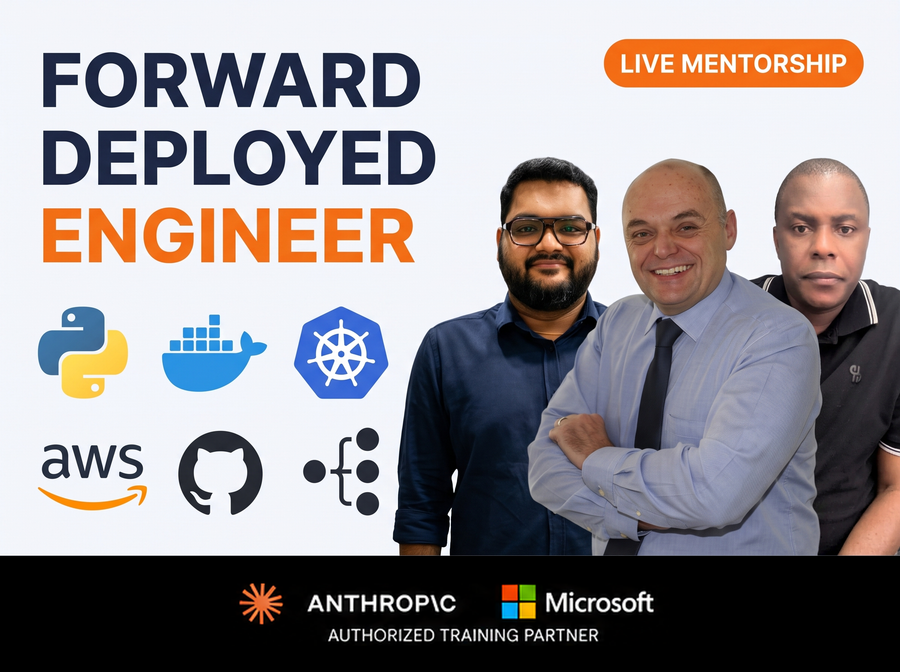
Running that plan alone works, but it is slower without feedback on your mistakes. 360DT's Forward Deployed Engineer course compresses this into a live, mentor-reviewed cohort built around eight real deployment scenarios rather than slides, and if interview prep is your gap rather than the skills themselves, our FDE interview questions guide covers what you will actually be asked.
Certifications and Proof Points That Actually Help
A certificate does not get you the job. It gets your resume past the first filter and gives an interviewer a reason to believe your claimed skills without testing all eight from scratch. The ones that carry weight here are narrow: an AWS or Azure associate-level credential for the cloud deployment claim, and a Claude Certified Architect Foundations (CCAR-F) credential for the agent-engineering claim if the client runs on Claude. Go cloud-first if your resume is thin on deployment; go agent-first if it is thin on AI. See the 360DT certifications overview for a full comparison of every current credential.
Is This a Career Switch Worth Making in 2026?
Honestly: only if you like being interrupted. The role pays well because it sits at the uncomfortable intersection of engineering and client management, and that discomfort is the actual job, not a side effect of it. If you want to write code all day with no stakeholder calls, this is the wrong seat, and no amount of skill-building fixes that mismatch. If live debugging in front of a client sounds interesting rather than dreadful, the eight skills above are learnable on evenings and weekends, and the market is short of people who have all eight rather than three or four.
Build all eight forward deployed engineer skills in one live cohort
360DT's Forward Deployed Engineer course runs eight real deployment scenarios across 18 weeks: cloud deployment, integration, agent engineering and live debugging, with Microsoft and Anthropic certification prep built in.
Explore the course
Related guides
- What Is an AI Agent Harness in 2026? for the agent-engineering skill, in depth.
- CCAR-F vs CCAR-P, which Claude architect credential to sit first.
- Microsoft Fabric vs Databricks, if data pipeline literacy is your weakest link.
- SAA-C03 vs DOP-C02, which AWS certification backs your cloud claim.
- What Is a Microsoft 365 Copilot Administrator?, the governance angle on security awareness.
Frequently asked questions
What skills do you need to become a forward deployed engineer?
The core forward deployed engineer skills are production-grade coding, API and systems integration, cloud deployment on AWS or Azure, agent and RAG engineering, data pipeline literacy, client-facing debugging, security awareness, and stakeholder communication. Employers screen hardest for cloud deployment and integration before testing AI-specific knowledge.
Is coding required for a forward deployed engineer role?
Yes. You need production-grade code that passes a client's own review process, typically in Python, TypeScript or Java. The bar is close to a mid-level backend engineer's, with integration work layered on top.
Do forward deployed engineers need a cloud certification?
A certification is not mandatory, but an AWS or Azure associate-level credential is one of the fastest ways to clear the resume filter, since cloud deployment fluency is the most consistently screened skill in current postings. An AWS Solutions Architect & DevOps course or its Azure equivalent covers this directly.
What is the difference between a forward deployed engineer and a solutions architect?
A solutions architect mostly designs systems and supports pre-sales conversations, with limited hands-on coding. A forward deployed engineer writes production code inside the client's own repository and handles live debugging under pressure, often daily rather than occasionally.
How long does it take to become job-ready as a forward deployed engineer?
If you already ship production code professionally, a focused 12-week plan covering cloud deployment, integration, agent engineering and live debugging practice is realistic. Starting from a non-technical background takes closer to 9 to 12 months.
What tools do forward deployed engineers use daily?
Common tools include Docker and a container registry, a cloud provider's CLI for AWS or Azure, API testing tools like Postman, a vector store such as pgvector or Pinecone for RAG work, and an incident or ticketing tool like Jira or PagerDuty for client escalations.
Is forward deployed engineering a good career in India in 2026?
It suits engineers who already enjoy client interaction and live troubleshooting, since that discomfort is central to the role, not incidental to it. Industry postings typically advertise this as a premium track over generic backend roles, reflecting the skill bar covered above.
About this guide. 360 Digital Transformation is an Authorized Training Partner of Anthropic and Microsoft. Other certification bodies, vendors and employers named here are not affiliated with us. Figures cited were checked on 23 September 2026.
 Python
 Claude API
 OpenAI API
 FAISS
FAISS ChromaDB
 LangChain
 LangGraph
 CrewAI