Data Engineer Jobs in Amsterdam 2026: 362 Openings, Pay Bands and Visa Rules
Data engineer jobs in Amsterdam pay roughly €53,000 to €97,000 depending on experience, with Glassdoor listing 362 openings in September 2026. The biggest hirers are Booking.com, Adyen, ING and Optiver. The catch for non-EU candidates is the IND salary threshold of €5,942 a month, which rules out most junior roles.
- 362 data engineer openings were listed for Amsterdam on Glassdoor in September 2026, clustered in payments, banking, travel marketplace and trading rather than consumer social.
- Pay runs roughly €53,000 to €97,000 gross across the middle of the market, with senior and lead roles reported above €118,000.
- The IND threshold is the real filter. A highly skilled migrant aged 30 or over needs €5,942 a month gross in 2026, which is higher than the average advertised data engineer salary in the city.
- Being under 30 changes the maths. The threshold drops to €4,357 a month, which mid level roles clear comfortably.
- The 30% ruling still applies in 2026 but new rulings are capped at 27% from 1 January 2027, so do not price an offer on today's number.
- Azure and Fabric skills travel unusually well here because so much Dutch enterprise data sits in Microsoft estates, while Databricks and Snowflake dominate the scale ups.
You have four years on Azure Data Factory, a certification Microsoft retired underneath you, and a LinkedIn feed full of Amsterdam recruiters who stop replying the moment you mention sponsorship. That gap between the job ad and the actual offer is almost never about your pipelines. It is about a number the Dutch immigration service publishes every January, and almost nobody explains it before you have spent three months applying to the wrong roles.
Why data engineer jobs in Amsterdam look different in 2026
Amsterdam is not a startup city that happens to have banks. It is a regional headquarters city that happens to have startups. Booking.com runs a global campus that employs more than 6,000 engineers and product managers. Adyen has grown to around 1,800 people in Amsterdam and processed over €1.2 trillion in payment volume in 2024. ING sits in Zuidas on the southern ring. Optiver trades from the city and was listing senior data engineer roles when we checked job boards on 22 September 2026.
That mix decides what your job actually is. In a payments company, a broken pipeline is a regulatory incident. In a trading firm, a late feed is money. In a bank, every table you build has to survive an auditor asking where the number came from. So Amsterdam interviews lean hard on lineage, data contracts, idempotent reprocessing and reporting correctness, and much less on whether you have used the newest lakehouse format.
This is the part I would argue with most online advice about. The standard data engineer roadmap tells you to collect tools. Amsterdam pays for the opposite: one cloud you know deeply, SQL you can defend under questioning, and a story about a time your pipeline produced a wrong number and what you changed so it could not happen again. Bring three half-learned platforms and you will lose to a candidate with one and a clean incident write-up.
Also read: Data Engineer Jobs in Hyderabad 2026 for how the same role is priced and interviewed in an Indian GCC market.
Which companies hire data engineers in Amsterdam
Job board roundups checked on 22 September 2026 put Booking.com at roughly 215 open roles and Adyen at about 134 across all functions, which gives you a sense of who is moving volume. Beyond the household names, a large share of Dutch data engineering work sits inside consultancies staffing bank, retail, telco and government projects, and those postings are where Microsoft Fabric, Snowflake and Databricks all show up in the same paragraph.
| Employer type | Examples seen hiring | What the data work is | Typical advertised band |
|---|---|---|---|
| Payments and fintech | Adyen | Settlement and regulatory reporting pipelines, high volume event data, strict correctness | €70,000 to €110,000 |
| Travel marketplace | Booking.com | Very large scale batch and streaming, experimentation platforms, internal data products | €65,000 to €105,000 |
| Banking and insurance | ING, Nationale-Nederlanden | Risk and regulatory data, lineage, migration off legacy warehouses | €60,000 to €95,000 |
| Trading | Optiver | Low latency market data, time series storage, reliability engineering | €85,000 to €130,000 |
| Telco and retail | VodafoneZiggo | Cloud data platforms, streaming, early generative AI products on top of warehouses | €60,000 to €95,000 |
| IT consultancies | Dutch consultancies staffing enterprise clients | Azure, Fabric, Snowflake and Databricks builds for finance, retail and government | €55,000 to €85,000 |
Bands above are advertised market ranges assembled from listings and salary aggregators checked on 22 September 2026, not offers and not guarantees.
A worked example: what Adyen's growth actually creates
Adyen is useful precisely because the numbers are public. Roughly 1,800 people in Amsterdam, over €1.2 trillion processed in 2024, and a published careers page that was advertising engineering management roles in data and regulatory reporting when we looked today. Scale like that does not mainly create glamorous machine learning jobs. It creates reconciliation, reporting, retention policy, and schema evolution work, because every extra billion in volume is another billion that has to tie out to the cent across dozens of jurisdictions. If you want to know which skills a payments company will test, read that sentence again. It is why interviews there dwell on exactly-once semantics and late arriving data instead of model architectures.
The three numbers that decide your Amsterdam move
Market size, the visa floor, and the tax break that is shrinking.
Sources: Glassdoor listings and published 2026 IND threshold figures, checked 22 September 2026.
Netherlands relocation facts at a glance
The four figures worth writing down before you negotiate.
Published threshold and ruling figures plus Amsterdam Science Park's own company count, checked 22 September 2026.
Data engineer salary in Amsterdam 2026
Advertised pay varies more than any single source admits, so here is the honest version. Glassdoor puts the Amsterdam average around €67,000 with a middle range of €53,000 at the 25th percentile to €85,000 at the 75th, and €97,000 at the 90th. Levels.fyi reports about €79,700. SalaryExpert, which surveys differently, reports about €104,900. Junior roles average around €49,000 and senior profiles with eight or more years average around €118,700. All figures checked on 22 September 2026.
Advertised data engineer pay in Amsterdam by stage
Gross annual euros. The jump between mid and senior is where the visa problem disappears.
Ranges compiled from Glassdoor, levels.fyi and salary aggregator figures for Amsterdam, checked 22 September 2026. Advertised market ranges, not guarantees.
One warning before you convert any of this into rupees and get excited. Dutch gross is not Indian gross. Income tax, the mandatory health insurance premium you pay yourself, pension contributions and Amsterdam rent will take a much larger bite than the equivalent deductions at home. A €67,000 offer is a comfortable life in Amsterdam, not a fortune, and the honest comparison is lifestyle to lifestyle rather than number to number.
The visa maths behind data engineer jobs in Amsterdam
Here is the thing that reorganises everything else in this guide.
The highly skilled migrant visa Netherlands threshold for 2026
To sponsor you as a highly skilled migrant, a Dutch employer has to pay at least the IND minimum for your age group. For 2026 that is €5,942 a month gross if you are 30 or over, and €4,357 a month if you are under 30. Both rose by roughly 4.5% in the annual indexation. The IND assesses your gross salary before the 30% ruling is applied, so you cannot use the tax break to bridge a gap.
Multiply it out. €5,942 a month is about €71,300 a year before holiday allowance. That is above the Glassdoor Amsterdam average of €67,000 and comfortably above the €49,000 junior average. Which means a junior or even average mid level data engineer role in Amsterdam mathematically cannot sponsor a candidate aged 30 or over. The recruiter who stopped replying was not being rude. They ran the same arithmetic in four seconds.
If you are under 30, the picture inverts. The €4,357 monthly threshold is about €52,300 a year, which sits just under the 25th percentile. Plenty of ordinary mid level roles clear it. Same skills, same CV, completely different odds, decided by your date of birth.
The 30% ruling in the Netherlands, 2026 and what changes next year
The 30% ruling lets a qualifying incoming employee receive up to 30% of salary as a tax free allowance. In 2026 the maximum is still 30%. From 1 January 2027 the maximum for new rulings drops to 27%, with transitional rules protecting employees who were already applying the ruling in the final payroll period of 2023.
The practical consequence is a negotiation trap. If you are offered a role starting in late 2026 and you model your take home on 30%, and your ruling is granted in the new year, your net is lower than the spreadsheet you built. Ask the employer in writing which allowance percentage they have assumed, and whether they will top up salary if the cap moves.
- Applying to roles that cannot sponsor. If the advertised band tops out below €71,300 and you are over 30, that job is closed to you regardless of fit.
- Assuming any employer can sponsor. Only IND recognised sponsors can hire highly skilled migrants. Check the public register before you invest in a process.
- Counting the 30% ruling as pay. It is a tax treatment with conditions and an expiry, and the cap is already scheduled to fall.
- Ignoring the EU Blue Card. It has its own salary threshold and different rules, and for some profiles it is the easier route. Worth an hour of research before you conclude the door is shut.
The honest caveat
Amsterdam is oversold to non-EU candidates. English is genuinely the working language in most tech teams, the city is pleasant, and the tax break is real while it lasts. But the housing market is brutal, the visa floor excludes exactly the entry level roles that people usually use to get a foot in a new country, and Dutch employers overwhelmingly prefer candidates who already hold the right to work. If you are 32, have three years of experience, and no EU passport, Amsterdam is probably not your first move. Build to five or six years somewhere that pays for the same skills, then come back to this page when your market value clears €71,300. That is not defeatism. It is the sequence that works.
Where the work actually sits in the city
Three clusters matter, and knowing them changes how you read a job ad.
Zuidas, along the southern ring, is the financial district and where ING and the banking and professional services world concentrate. Its Kenniskwartier area is designated as an innovation district. Expect regulated data work, structured career ladders and collective labour agreements that make pay more predictable and less negotiable than at a scale up.
Amsterdam Science Park is a 70 hectare site in the east with around 170 companies alongside University of Amsterdam research institutes, and it is where digital innovation and AI research concentrate. If your interest is research adjacent data infrastructure rather than enterprise reporting, this is your cluster.
The centre and eastern waterfront hold the marketplace and payments employers, including Booking.com's global campus. Roles here are the largest scale and usually the most competitive.
The practical local detail nobody puts in a job ad: almost nobody lives where they work. Rent inside the ring is the constraint that shapes everything, so people commonly settle in Amstelveen, Diemen, Haarlem or Almere and commute in by train or bike. Factor a realistic commute and a realistic rent into any offer before you compare it to a package somewhere else.
Skills and certifications Amsterdam employers ask for
Dutch enterprise data estates are unusually Microsoft heavy, which is why Azure Data Factory, Synapse and now Microsoft Fabric appear so often in bank, telco and government postings, while the scale ups and consultancies lean on Databricks, Snowflake and dbt. Netherlands based Azure data engineer postings reviewed on 22 September 2026 asked for Python, PySpark, dbt and SQL across Snowflake, Databricks and Fabric in the same job description, which tells you the market expects you to be platform literate rather than platform loyal.
| Skill or credential | Why Amsterdam employers ask for it | Where it shows up |
|---|---|---|
| SQL, deeply | Every regulated reporting conversation ends in a query someone has to defend | Every posting, every interview |
| Python and PySpark | The transformation layer in both Databricks and Fabric estates | Consultancy and scale up roles |
| dbt | Transformation, testing and documentation standard for the modern warehouse | Snowflake and BigQuery shops |
| DP-700 and Fabric | Microsoft estates in banking, telco, retail and government | Enterprise and consultancy roles |
| Streaming: Kafka or Event Hubs | Payments and trading run on events, not nightly batches | Adyen, Optiver and similar profiles |
| Power BI and PL-300 | The reporting layer your pipelines feed, especially in Microsoft shops | Analytics engineering hybrid roles |
| AZ-305 or AZ-400 | Platform and DevOps ownership is increasingly bundled into data roles | Senior and lead postings |
| AWS SAA-C03 | Marketplace and product companies that never went Microsoft | Booking.com style environments |
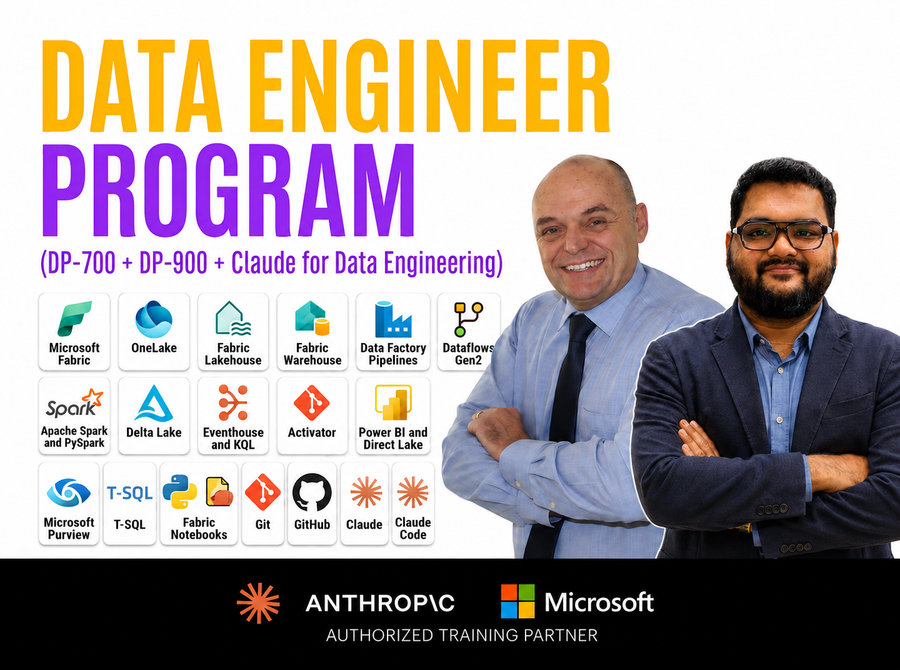
If you are picking one credential to sit before you start applying, I would take the Microsoft Fabric route over a Databricks certification for this city specifically, because the Dutch enterprise and consultancy market that sponsors most visas runs on Microsoft. 360DT teaches that path live in a Microsoft Fabric data engineering program that covers DP-700 with DP-900 fundamentals included. If your target is a scale up instead, invert that advice without guilt.
What I would not spend money on yet: a generative AI certification bought purely to decorate a data engineering CV. Amsterdam postings that mention generative AI want someone who can serve a warehouse to a retrieval pipeline reliably, or keep a model in production without drift going unnoticed, which is closer to MLOps work than prompt craft. Get hired on data engineering first, add that second. You can see how the credentials stack up in the full certifications overview, including the CCDV-F developer track if agent tooling is where you eventually want to land.
Also read: Microsoft Fabric vs Databricks in 2026 for a full cost and certification comparison of the two platforms.
How to break into Amsterdam tech jobs in 2026 from outside the EU
Take an illustrative case, not a real person: a 28 year old data engineer in Pune with four years on Azure Data Factory and SQL Server, currently earning in the low teens in lakhs, who wants Amsterdam. Being 28 is the single most valuable thing on that CV, because the €4,357 threshold applies rather than €5,942, and mid level Amsterdam roles clear it.
The sequence that works for that profile: get to genuine Fabric or Databricks fluency rather than Data Factory alone, publish one pipeline project with tests and documented lineage, target IND recognised sponsors only, and apply to consultancies as well as product companies because consultancies sponsor more routinely and place you into exactly the bank and telco projects that build Dutch enterprise experience. Two years in a Dutch consultancy makes the next move inside the country far easier than two more years of applying from abroad.
Here is what usually goes wrong, in the order it goes wrong.
You apply to roles that cannot sponsor you
Junior and average mid level bands sit below the over-30 threshold. Check the advertised band against your age bracket before you write a cover letter. This single filter saves most people three months.
Filter firstYou lead with tools, not with correctness
A CV listing nine technologies reads as shallow to a payments or banking interviewer. Lead with one incident you owned, what broke, what you changed, and how you proved it was fixed.
Reframe the CVYou treat the 30% ruling as salary
It is conditional, time limited, and capped at 27% for new rulings from January 2027. Negotiate the gross number. Treat the ruling as upside you might lose.
Negotiate grossYou skip the recognised sponsor check
Only IND recognised sponsors can hire highly skilled migrants. The register is public. Ten minutes with it will change which hundred companies you apply to.
Check the registerAlso read: AI Engineer Jobs in Berlin 2026 if you are comparing EU destinations, since Germany's Blue Card thresholds work quite differently.
Build the Microsoft Fabric skills Amsterdam's banks, telcos and consultancies actually hire for
Fifty plus live hours over eight weeks covering Microsoft Fabric data engineering for DP-700, with DP-900 fundamentals included, hands on projects and mentor support. Classes run Saturday and Sunday, 8 to 11 PM IST, which is 4:30 to 7:30 PM in Amsterdam, and pricing is in Indian rupees.
Explore the course
Your next 90 days, if Amsterdam is the goal
This assumes you already work in data and are aiming at a sponsored mid level role rather than a first job.
Run the arithmetic on yourself
Find your age bracket threshold, convert it to an annual figure, and compare it against the advertised bands in the table above. Deliverable: a written yes or no on whether Amsterdam is viable for you this year.
Build the sponsor shortlist
Work through the IND recognised sponsor register and cross reference it with Amsterdam data postings. Deliverable: 40 named companies that can legally hire you, split into product, consultancy and enterprise.
Close the platform gap
Pick Fabric or Databricks based on whether your shortlist skews enterprise or scale up, and go deep on one. Deliverable: a medallion architecture pipeline you built yourself, with tests and documented lineage.
Add the streaming piece
Amsterdam's payments and trading employers assume events, not nightly batches. Deliverable: the same project extended with a Kafka or Event Hubs feed and a documented late arriving data strategy.
Rewrite the CV around correctness
Replace the tool list with two incident stories and one lineage story. Deliverable: a one page CV where the first bullet under each role is an outcome a Dutch auditor would recognise.
Apply in volume, to the right list
Consultancies first, product companies alongside. Deliverable: 40 applications sent to recognised sponsors only, and the free webinars or a demo class booked if you need to sanity check the platform choice with someone.
What I would actually do in your position
If you are under 30 with three or more years in data, Amsterdam is one of the best value moves in Europe right now: real openings, English speaking teams, a threshold you can clear, and a tax break that is still 30% this year. Go, and go before the 2027 cap lands.
If you are over 30 and your market value does not yet clear roughly €71,300, do not spend this year on Dutch applications. Spend it becoming the senior engineer that number describes, in Fabric or Databricks plus streaming, with incidents you can talk about. The trade-off I am accepting in that advice is a slower start, and I think it is clearly worth it, because the alternative is a year of silent rejections that teach you nothing.
Either way the skill gap is the same one, and it is closeable in a quarter of focused work. If Fabric is your route, the live Microsoft Fabric Data Engineer course is where to start.
Related guides
- PL-300 vs DP-700 in 2026 decide which Microsoft data certification to sit first before you spend a euro on an exam.
- Data Analyst to Data Engineer in 2026 the switch plan if you are coming at Amsterdam from an analytics job rather than an engineering one.
- dbt Tutorial for Beginners 2026 hands on with the transformation tool that appears in most Dutch Snowflake postings.
- What Is Apache Iceberg in 2026 the table format question that comes up in lakehouse interviews at scale ups.
- Cloud Engineer Jobs in Dublin 2026 the closest European comparison, with a permit system that works very differently.
- Data Engineer Roadmap 2026 the full seven step path if you are earlier in the journey than this guide assumes.
Frequently asked questions
Are data engineer jobs in Amsterdam open to candidates from India?
Yes, but only through employers that are IND recognised sponsors and only at salaries clearing the 2026 threshold: €5,942 a month gross if you are 30 or over, €4,357 if you are under 30. That is the binding constraint, not your skills. Consultancies sponsor more routinely than product companies.
What does a data engineer earn in Amsterdam in 2026?
Advertised ranges checked in September 2026 put the middle of the market between roughly €53,000 and €85,000, with a city average near €67,000, the 90th percentile around €97,000 and senior profiles with eight or more years averaging around €118,700. These are market ranges, not guarantees.
Do I need to speak Dutch for a data engineering job in Amsterdam?
For most international product companies and scale ups, no. English is the working language and Dutch proficiency in English is near universal. Some government, insurance and public sector consultancy projects do require Dutch, so read those postings carefully rather than assuming.
Is the 30% ruling still worth it in 2026?
In 2026 the maximum tax free allowance is still 30%, so yes. From 1 January 2027 new rulings are capped at 27%, with transitional protection for employees who were applying the ruling in the last payroll period of 2023. Model your take home on the percentage that will apply when your ruling starts.
Which certification helps most for a data engineering job in Amsterdam?
For the enterprise, banking and consultancy roles that sponsor most visas, a Microsoft Fabric credential such as DP-700 maps closest to the local stack. If you are targeting scale ups and marketplaces, a Databricks or AWS credential is the better fit. Pick based on your shortlist, not on general popularity.
Can I get a junior data engineer job in Amsterdam on a sponsored visa?
If you are 30 or over, almost certainly not. Junior bands average around €49,000, well below the €71,300 annual equivalent of the threshold. Under 30 it is possible but still difficult, because junior pay sits below the €52,300 annual equivalent too. Target mid level roles instead.
How does Amsterdam compare with Berlin or Dublin for a data career?
Amsterdam pays more than Berlin and has a stronger payments and marketplace concentration. Dublin's permit system is more forgiving at lower salary levels. Amsterdam's advantage is the density of EMEA headquarters and the tax ruling; its disadvantage is the housing market and a visa floor that excludes junior roles.
How long does the highly skilled migrant process take?
Recognised sponsors use an accelerated route, and in practice employers typically plan for a matter of weeks rather than months once the offer and documents are complete. Timelines vary with your own paperwork, so ask your prospective employer's mobility team for their current experience rather than relying on published maximums.
About this guide. 360 Digital Transformation is an Authorized Training Partner of Anthropic and Microsoft. Other certification bodies, vendors and employers named here are not affiliated with us. Salary and hiring figures are advertised market ranges, not guarantees. Figures cited were checked on 22 September 2026.
 Microsoft Fabric
 Python