Home › Guides › Small Language Models
Tech Explained · 2026What Are Small Language Models in 2026? How SLMs Work, SLM vs LLM Costs and 6 Steps to Get Started
A small language model (SLM) is a compact AI model, typically under 15 billion parameters, built to run one job cheaply and fast instead of handling everything a chatbot might ask. Industry estimates put SLM inference costs at 10 to 30 times lower than large language models, which is why Indian teams are routing routine work to them in 2026.
- SLMs cost 10 to 30 times less to run than frontier large language models for the same volume, by widely cited hosting-cost estimates.
- Most production tasks do not need a frontier model. A well-tuned 7B model reaches 80 to 95% of frontier accuracy on narrow jobs like extraction and classification.
- The router pattern is the 2026 default: route easy, high-volume requests to an SLM and escalate only hard cases to a large model.
- Phi-4, Gemma 3 and Mistral Small 3.1 are the three SLM families Indian teams reach for first, each under 25 billion parameters.
- Self-hosting only pays off past a volume threshold: below roughly 2 million tokens a day, a pay-per-token API is usually still cheaper.
- SLMs are not a drop-in replacement for a frontier model on multi-step reasoning or broad world knowledge. Know where that line sits before you commit.
A two-person data team at a mid-size Indian insurer gets told to cut its GenAI bill by 60% this quarter. Their claims pipeline calls a frontier model for every PDF in the queue, even the boring ones: policy number, claim amount, date of loss. The bill is the problem, not the model's intelligence. That is almost always a small language model problem wearing a large language model's price tag.
What Are Small Language Models?
A small language model is a transformer shipped at a scale you can run on a single GPU, sometimes a laptop, usually under 15 billion parameters against the 70 to 400 billion plus that frontier labs ship for do-everything chat models. The size is a design choice: a smaller model trains faster, serves faster, and fails in ways that are easier to audit, because it was never trying to know everything in the first place.
Three families dominate the India conversation: Microsoft's Phi-4 line (3.8B, 5.6B, 14B, built for Azure AI Foundry), Google's Gemma 3 line (1B, 4B, 12B, open-weight), and Mistral Small 3.1 (24B, the upper edge of "small"). None need a data centre; all run on one GPU once quantized.
Why "small" means under 15B, not under 1B
There is no official cutoff. Industry usage in 2026 treats anything under roughly 15 to 25 billion parameters, designed for a narrow set of tasks, as an SLM, while anything built to converse about any topic sits in the LLM bucket regardless of size. A 24B Mistral Small model doing one job well is still called small.
How Small Language Models Actually Get Built
Nobody trains a useful SLM from a blank slate on a laptop budget. Three practical routes cover most shipped models.
Knowledge distillation
A large "teacher" model generates training examples, and a smaller "student" model learns to match the teacher's outputs on the task that matters. This is broadly how Phi-4 was built: synthetic data from larger models, filtered hard, used to train the small one. The student never needs the teacher's breadth, only its competence on the target task.
Quantization and pruning
A trained model's weights, normally 16-bit floats, get compressed to 8-bit or 4-bit integers (the GGUF or AWQ files on Hugging Face), cutting memory footprint by half to three-quarters for a small accuracy hit. Pruning removes weights or attention heads that contribute little. Our guide to running an LLM locally walks through pulling one of these into Ollama.
Mixture-of-experts at small scale
Some 2026 SLM releases use a sparse mixture-of-experts design even at small total size, activating only a fraction of parameters per token. It is why model cards list a confusing "31B-A4B" number: 31 billion total parameters, about 4 billion active per token.
Small Language Models vs Large Language Models: Cost, Latency and Accuracy
SLM vs LLM is a cost-and-capability trade you make per task, and the numbers are not subtle.
Cost to process 1 million tokens, by model class
Directional figures from publicly advertised API and hosting price ranges, not a specific vendor's exact rate card.
Checked 13 October 2026 against publicly advertised pricing ranges. Treat the exact multiplier as directional, not a quote.
| Dimension | Small language model (SLM) | Large language model (LLM) |
|---|---|---|
| Typical parameter count | 1B to 25B | 70B to 400B+ |
| Typical cost per million tokens | $0.05 to $0.50, API or self-hosted | $2 to $30, API-dominated |
| Typical latency | Tens of milliseconds, often on-device | Hundreds of milliseconds to seconds |
| Where it runs | Single GPU, edge device, sometimes a phone | Data centre GPU clusters |
| Best at | One well-defined, repeated task | Open-ended reasoning, broad world knowledge |
| Weak at | Novel tasks outside its training, multi-step reasoning | Nothing specific, but costs scale with every query |
| Typical 360DT-relevant use | Document extraction, intent classification, on-device assistants | Agent planning, complex RAG, open conversation |
Our RAG vs fine-tuning breakdown is the natural companion decision to this one.
The Best Small Language Models in 2026: A Quick Field Guide
Ask five AI engineers which are the best small language models in 2026 and you will get five different shortlists, but these names come up most often in production conversations. Treat exact benchmark scores as moving targets and verify the current model card first.
| Model | Maker | Size | Best for | License |
|---|---|---|---|---|
| Phi-4 | Microsoft | 3.8B / 5.6B / 14B | Reasoning-heavy narrow tasks, Azure AI Foundry deployment | MIT (open weights) |
| Gemma 3 | 1B / 4B / 12B | Multilingual tasks, on-device and edge deployment | Open, custom terms | |
| Mistral Small 3.1 | Mistral AI | 24B | The upper edge of "small," general-purpose narrow tasks | Apache 2.0 |
| Llama 3.2 (1B/3B) | Meta | 1B / 3B | On-device assistants, strict latency budgets | Llama community license |
| Qwen2.5 | Alibaba | 0.5B to 14B range | Code and structured-data extraction tasks | Apache 2.0 (most sizes) |
Azure's AI-200 syllabus now treats small-model deployment on AI Foundry as examinable content; see 360DT's Azure AI Developer course for the full syllabus.
Small Language Models in India: Where Enterprises Are Actually Using Them
Small language models in India are showing up less in pilot decks and more in production budgets. Back to that insurer: their claims-extraction job is the textbook SLM case: high volume, narrow scope, a document format that barely changes. Swapping the extraction step to a fine-tuned 7B model, and keeping the frontier model only for genuinely messy scans, cut per-document cost by roughly 90% in the scenario most vendors describe. Getting those PDFs into a clean queue is a data engineering problem first; teams running a Microsoft Fabric pipeline usually bolt the SLM step onto the end of it.
Call centre intent classification
Before any agent responds to a support chat, something has to work out what the customer wants. That first-pass classification is high volume and repetitive, and does not need frontier reasoning. Several Indian BPOs and telecom back offices run it on an SLM and escalate only ambiguous messages.
On-device AI models for regional languages
On-device AI models matter in India because connectivity is not guaranteed, and health, agriculture-advisory and retail point-of-sale use cases need to work offline in Tier 2 and 3 towns. A 1B to 4B Gemma or Llama variant, fine-tuned on a regional language and quantized onto a mid-range phone, is a 2026 pattern a 70B model cannot match on 4GB of RAM.
Data sovereignty in regulated sectors
Banking, insurance and healthcare data in India increasingly cannot leave the organisation's own infrastructure. An SLM small enough to run inside your own VPC removes the "whose cloud is my data sitting in" question entirely. Deciding which workload needs this constraint is the kind of agentic-architecture call 360DT's CCAR-F prep course puts on its exam, not in a footnote.
The Router Pattern: Building a Hybrid SLM + LLM Pipeline
Here is what the vendor slide decks gloss over: you rarely pick one model class and stop. The 2026 default is a router sitting in front of both, classifying each request and sending it to whichever model can actually handle it for the least money.
Monolithic pipeline
Every request pays frontier-model price, no matter how simple it is.
Simple to build, expensive to run at volume. Checked 13 October 2026.
Hybrid router pipeline
Most requests get the cheap path. Only hard cases escalate.
The 2026 enterprise default. Checked 13 October 2026.
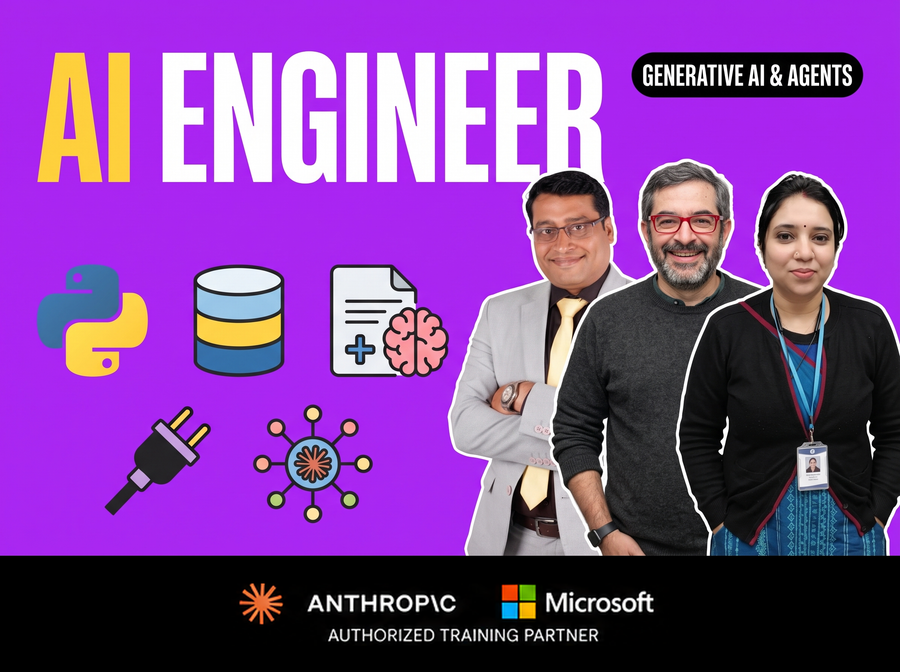
Building that routing logic well is an agent-design problem, not just a model-selection one: the router needs to classify intent reliably and know when to escalate. 360DT's AI Engineer course spends a full module on this kind of routing, the skill that separates a router that saves money from one that adds a confusing hop.
One caveat: a badly tuned router is worse than none. Misroute 15% of hard cases and you have shipped wrong answers faster, not saved money.
How to Get Started With Small Language Models: 6 Steps
You do not need a research team. You need one well-chosen task and a week of focused work.
Pick one narrow, high-volume task to offload
Not your hardest problem. Document extraction, ticket tagging or FAQ deflection are safer first targets. Deliverable: a one-page spec of inputs and expected outputs.
Baseline your current cost and latency
Pull last month's API logs for that task: token volume, average latency, the dollar figure you are trying to beat. Deliverable: one spreadsheet row to compare every candidate against.
Shortlist 2 to 3 candidate SLMs, benchmark on your own data
Public leaderboards do not know your document format. Run Phi-4, Gemma 3 and one more against 100 real examples and score accuracy yourself.
Quantize and serve
Pull the winning model into Ollama or vLLM, or onto a managed endpoint such as Azure AI Foundry, behind an internal API shaped like whatever it replaces.
Build the router and escalation rule
Write down exactly what triggers escalation to the large model. Deliverable: a router that fails safe, sending uncertain cases up rather than guessing down.
Monitor drift and re-benchmark
Re-run your 100-example test set whenever the input format changes, say a partner updates its claim form. A live MLOps Engineer program covering this monitoring pipeline beats another model comparison.
Limitations and Pricing Caveats Nobody Puts in the Slide Deck
SLMs are good at narrow, repeated tasks and bad at what most people want from an AI model: flexible reasoning across topics it was never trained on. Push one fine-tuned on insurance claims to read a legal contract clause, and it answers confidently and wrongly, because it cannot generalise past its training distribution. Confidence without competence is the dangerous failure mode, not an obvious refusal.
- The demo works, production does not. Teams fine-tune on 200 clean examples, see 95% accuracy, ship it, then watch it fall apart on messy real inputs: smudged scans, mixed languages, odd formatting.
- Nobody budgets for retraining. A partner updates its claim form template, and accuracy quietly drops for weeks because nobody set up the drift monitoring from step 6.
- The "cheaper" self-hosted model is not actually cheaper. Below roughly 2 million tokens a day, GPU hosting and on-call burden usually cost more than the managed API bill.
Every cost figure here is a per-token estimate. It leaves out the engineering time to fine-tune and monitor the model, which for a first project usually dwarfs year-one token savings. The payoff shows up in year two. This kind of model-selection call sits inside the AI-103 syllabus that 360DT's Generative AI Developer course is built around; the Claude API side of a router's escalation path sits inside the CCDV-F prep course.
Learn to build the router, not just call an API
360DT's AI Engineer course teaches you to build agents that plan, use tools and route between models, certified on both Microsoft Copilot Studio and Claude Code. Model selection and cost-aware routing are taught as a real module, not a footnote.
Explore the course
Related guides
- What Is Context Engineering in 2026? covers the other half of cutting token costs, inside one agent's context window.
- What Is an AI Agent Harness in 2026? for how an orchestration layer decides which tool, and which model, to call next.
- LLM Evaluation in 2026 for the benchmarking pipeline step 3 of this guide assumes you already have.
- MLOps Engineer Salary in India 2026 for what the step 6 monitoring skills are worth on the job market.
- pgvector vs Pinecone in 2026 if your SLM pipeline also needs retrieval.
Frequently asked questions
What is a small language model in simple terms?
An AI model, usually under 15 billion parameters, built to do one kind of task well, such as extraction or classification, rather than handle any topic a user throws at it. It runs cheaper and faster, often on far smaller hardware, than a frontier large language model.
What is the difference between SLM and LLM?
Scope and scale. An SLM is tuned for a narrow set of tasks, typically under 25 billion parameters; an LLM handles broad reasoning at 70 billion and up. The SLM is cheaper per request; the LLM generalises better.
Which is the best small language model in 2026?
There is no single best one; it depends on the task. Phi-4 suits reasoning-heavy narrow tasks on Azure, Gemma 3 leads on multilingual and on-device use, and Mistral Small 3.1 sits at the upper edge of "small" for general-purpose jobs. Benchmark two or three on your own data first.
Can a small language model run on a laptop or phone?
Yes, once quantized. A 1B to 4B model such as Gemma 3 1B, compressed to 4-bit or 8-bit weights, runs on a mid-range laptop and sometimes a modern phone. Larger SLMs in the 14B to 24B range need at least one GPU.
Are small language models cheaper than using the ChatGPT or Claude API?
For high-volume, narrow tasks, usually yes, often by a wide margin; hosting-cost estimates put the gap around 10 to 30 times. For low-volume or open-ended tasks, a pay-per-token frontier API is often still cheaper once you count engineering time.
Do small language models support Indian languages well?
Coverage varies by model and language. Multilingual SLMs like Gemma 3 handle several major Indian languages reasonably well out of the box, but production-grade accuracy for one language and domain usually still needs fine-tuning on your own examples.
Is learning to work with small language models useful for a career in India?
Yes. The scarce skill, as enterprises move routine work to SLMs, is knowing when to use one and how to build the router in front of it, not just how to call a frontier model's API. That sits squarely inside AI engineering and MLOps roles.
How do you fine-tune a small language model?
Most teams use parameter-efficient fine-tuning (LoRA or QLoRA), training a small set of adapter weights on a few hundred to a few thousand labelled examples. This takes hours on a single GPU rather than the days or weeks full fine-tuning needs.
About this guide. 360 Digital Transformation is an Anthropic Partner and a Microsoft Authorized Training Partner. Other certification bodies, vendors and employers named here are not affiliated with us. Figures cited were checked on 13 October 2026.
 Python
 Claude API
 FAISS
 ChromaDB
 LangChain
 LangGraph
 CrewAI
 AutoGen (AG2)