Home › Guides › CCAR-P Interview Questions
Career Guide · 2026CCAR-P Interview Questions 2026: 20 Real Questions With Model Answers
CCAR-P interview questions center on seven domains: solution design, RAG architecture, integration, security, evaluation, governance and stakeholder communication. Panels typically run 45 to 60 minutes per round and expect you to defend a specific design choice out loud under follow-up pressure, not recite a definition from the exam blueprint.
- CCAR-P interviews test judgment, not recall. Every question below expects you to defend a trade-off, not repeat an exam objective.
- The panel maps almost exactly to the exam's 7 domains, from RAG architecture to GDPR/HIPAA/FedRAMP governance.
- The two areas most candidates fumble are cost-of-evaluation and stakeholder communication, not the technical architecture itself.
- A live mock panel matters more than another practice test. Reading about trade-offs and defending one out loud under time pressure are different skills.
- Industry postings typically advertise 18 to 30 LPA for architect-level agentic AI roles in India, with wide variance by city and employer.
- CCAR-F is a real prerequisite in practice, even though Anthropic does not enforce it as a gate.
Ananya has spent six years designing integration layers for a Pune-based insurance software vendor. She can draw a message queue architecture on a whiteboard without thinking. Then a recruiter asks her to walk through how she would evaluate a RAG pipeline's hallucination rate before it ships to an underwriting team, and she goes quiet. That gap between "I can build the system" and "I can defend the system to a panel that has read the CCAR-P blueprint" is exactly what this guide closes.
Why a CCAR-P Interview Looks Nothing Like a Certification Quiz
Anthropic's Claude Certified Architect Professional (CCAR-P) exam is multiple choice and scenario based. The interview that follows it, at a product company, a systems integrator or a GCC building internal AI tooling, is not. Interviewers who've seen the CCAR-P syllabus stop asking "what does RAG stand for" and start asking "your retrieval layer just returned stale embeddings after a vector store failover, walk me through your first three actions." The certification proves you know the vocabulary. The interview checks whether you can use it under pressure, in front of people who'll hold you to the design a year later.
That distinction matters because CCAR-P sits above the associate and developer tiers. A CCAO-F holder gets asked about prompt structure. A CCAR-P candidate gets asked to own the failure mode of a system that three teams depend on.
How a CCAR-P Panel Actually Flows
Five stages, each testing a different exam domain, from screen to offer.
Stage order and focus vary by employer; checked against candidate reports and the CCAR-P blueprint on 30 September 2026.
What the CCAR-P Credential Signals, and Who Should Wait
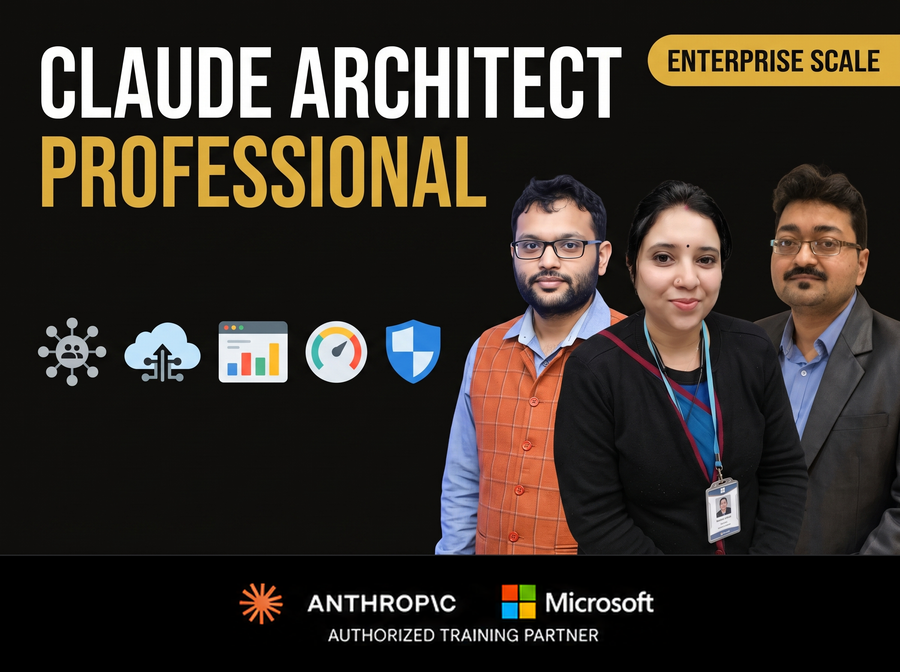
CCAR-P is Anthropic's enterprise-level architect credential. It assumes you already own the seven domains its exam covers: solution design, RAG architecture, integration and security, evaluation and observability, governance and compliance (including GDPR, HIPAA and FedRAMP patterns), and stakeholder communication with team enablement. A live cohort like 360DT's CCAR-P prep course runs candidates through all seven across an 8-week weekend schedule, ending in a capstone architecture defense that is closer to a real panel than any practice test.
If you've never shipped a RAG pipeline to production, CCAR-P interviews will be a rough ride regardless of how well you know the syllabus. The exam doesn't require production experience; the interview assumes it. Most people are better served spending three to six months building one real agentic system first, or starting at CCDV-F, before booking a CCAR-P panel.
The 7 Domains Every CCAR-P Interviewer Draws From
Every question in the next section maps back to one of these. Knowing the domain an interviewer is probing tells you what "good" looks like before you open your mouth.
| Domain | What it covers | What the interviewer is really probing |
|---|---|---|
| Solution design | Choosing an architecture pattern for a business problem | Can you justify why you rejected the two obvious alternatives |
| RAG architecture | Chunking, embedding, retrieval and re-ranking choices | Do you know where a RAG system silently degrades |
| Integration architecture | Wiring agents into existing enterprise systems | Have you actually touched a legacy system that fights back |
| Security | Prompt injection, data exfiltration, tool permission scoping | Do you treat the model as a trusted or untrusted component |
| Evaluation & observability | Offline evals, drift detection, cost and latency monitoring | Can you catch a regression before a user does |
| Governance & compliance | GDPR, HIPAA and FedRAMP-style controls on AI systems | Do you know which control lives in policy versus in code |
| Stakeholder communication | Explaining architecture trade-offs to non-technical leaders | Can a VP understand your risk without a whiteboard |
CCAR-P Interview Questions 2026: The 20 Questions, With Model Answers
These are grouped by domain because that is how most panels structure a 45 to 60 minute round: two domains covered deeply rather than seven covered shallow. Treat the model answers as a shape for your own answer, not a script to memorize. A memorized answer is the fastest way to sound like you read a blog post instead of shipped a system.
Solution design and RAG architecture
- "Design a RAG system for a 40,000-document policy library." Good answers name a chunking strategy tied to document structure and justify hybrid search over pure vector search.
- "Retrieval quality dropped after a vector store failover. What do you check first?" Strong answers check index freshness and embedding version consistency before touching retrieval logic.
- "When would you pick an agentic architecture over a single RAG pipeline?" The honest answer names the added latency and debugging cost, and defaults to RAG unless the task genuinely needs multi-step reasoning.
- "How do you decide chunk size for a manual versus a contract?" Ties chunk size to how self-contained a unit of meaning is in that document type, not a fixed number.
- "What breaks first scaling a RAG system from 10 users to 10,000?" Look for vector database query latency and embedding throughput, not "the model gets slower."
Integration, security and governance
- "Scope tool permissions for an agent that can read and write to a CRM." Expect least-privilege scoping per tool call, not a blanket API key.
- "A user tries a prompt injection against your support agent. What stops it?" Good answers separate system instructions from retrieved content structurally, not with a warning in the prompt.
- "How does GDPR change a RAG design for a European customer base?" Look for a data residency and right-to-erasure answer that names the vector store specifically, since deleting a source document doesn't always delete its embedding.
- "Integrate an agent into a 15-year-old core banking system with no modern API." Tests whether you've dealt with a legacy wrapper layer or batch interfaces instead of assuming a clean REST endpoint.
- "What FedRAMP-style control blocks a third-party embedding API for a government client?" Expect data residency and vendor certification requirements, not just "encryption."
Evaluation, observability and cost
- "How do you catch a hallucination rate increase before a user complains?" Look for a scheduled offline eval set with a defined pass threshold, not "we monitor user feedback."
- "Token cost tripled overnight with no traffic increase. Where do you look?" Check tool-calling loops or context window bloat before assuming a pricing change.
- "Design an eval set for a legal document summarizer." Panels want domain-specific accuracy criteria, not a generic BLEU or ROUGE score.
- "What's the difference between model drift and data drift in a production RAG system?" Separates changes in the model's outputs from changes in the document corpus.
- "Justify two full evaluation passes a week to a finance stakeholder." A communication question wearing a technical costume; the panel is watching for domain seven as much as domain four.
Stakeholder communication and team enablement
- "Explain your RAG architecture to a VP who has never heard of embeddings." Graded on whether you drop jargon entirely, not simplify it slightly.
- "A junior engineer keeps shipping agents without evals. How do you fix that?" Look for a process fix, like a mandatory eval gate in the deployment pipeline, over a motivational one.
- "Push back when leadership wants a launch date your architecture can't safely hit." Strong answers offer a scoped-down alternative rather than a flat no.
- "Train five developers who have never built with Claude before." A structured enablement plan, not just "pair programming," separates a CCAR-P-level answer from a mid-level one.
- "Tell me about a time you were wrong about an architecture decision." Panels listen for what changed in how you design afterward, not for the mistake itself.
Walk Into the CCAR-P Panel Having Already Defended a Design
360DT's CCAR-P prep course covers all 7 exam domains across an 8-week live cohort, closing with a capstone architecture defense and two full-length timed mocks scored domain by domain. It's the closest rehearsal you'll get to a real panel before you sit one.
Explore the course
How to Prepare for a CCAR-P Interview in 4 Weeks
This is interview prep, not exam prep. If you have not sat the CCAR-P exam yet, read the 8-week CCAR-P exam study plan first. What follows assumes you already hold or are about to hold the credential, and now need to survive a panel.
Rebuild one real system from memory
Pick the most complex RAG or agent system you've actually built and redraw its architecture on paper, no notes. Ananya used her insurance vendor's document search tool.
List every trade-off you made and why
For each decision in that system, write one sentence on what you rejected and why. This becomes your answer bank for solution design questions.
Drill the failure-mode questions out loud
Practice the retrieval-failure and cost-spike questions above, speaking not typing. Panels notice hesitation on operational questions more than design ones.
Write a one-paragraph GDPR and FedRAMP cheat sheet
Most candidates lose the governance domain not from ignorance but from freezing when a compliance acronym lands mid-interview.
Run a live mock panel
A structured mock, like the capstone defense in 360DT's CCAR-P cohort, with unpredictable follow-ups, is the single highest-impact hour of this month.
Rehearse the VP-explanation question specifically
Record yourself explaining your architecture in under two minutes, zero jargon. Listen back. Most technically strong candidates fail this one.
Review, don't cram
Reread your trade-off list and cheat sheets once. New material this week crowds out the specifics you already own.
Bring one system, not seven
Anchor every answer back to the one real system from week 1. Panels trust depth on one example over breadth across many.
What a Claude Certified Architect Professional Actually Earns in India
Treat every figure here as a hedge, not a promise: industry job postings for agentic AI and enterprise AI architecture roles typically advertise wide bands that depend heavily on city, employer size and whether the role is client-facing.
Typical Advertised Pay Progression for CCAR-P-Level Architects
Illustrative bands drawn from general job-posting patterns, not a guarantee for any individual.
Entry architect
Mid-level
Senior architect
Principal / lead
Typically advertised ranges based on general job-market patterns, checked 30 September 2026. Actual offers vary by city, employer and negotiation.
The honest caveat: CCAR-P alone doesn't move you between these bands. The certification opens the interview; production experience closes the offer. If you're targeting the top of a band, pair the credential with at least one system you can defend end to end, exactly what the question list above is built to surface.
Common Mistakes Candidates Make in CCAR-P Interviews
The single most common failure is not technical. It's candidates who know all seven domains cold, then freeze the moment a question mixes two together, like the cost question above that's secretly a communication question. The second is over-indexing on one impressive project and refusing to admit where it fell short when a panelist pushes back, which reads as inexperience dressed up as confidence. The third is treating governance as a footnote: interviewers who've shipped AI into a regulated Indian enterprise, banking, insurance or healthcare, spend real time on GDPR, HIPAA or FedRAMP-style controls, and a shallow answer there sinks an otherwise strong round faster than a shaky RAG answer does.
Ananya's mock panel exposed exactly this: asked to explain a six-week delay to a business head, she reached for technical justifications instead of a plain-language trade-off. A rehearsal gap, not a knowledge gap.
CCAR-P Interviews vs Generic AI or Cloud Architect Interviews
If you have interviewed for an AWS or Azure solutions architect role before, some of this will feel familiar. Some of it will not.
| Dimension | Generic cloud architect interview | CCAR-P interview |
|---|---|---|
| Core artifact discussed | Infrastructure diagram, scaling plan | Agent or RAG pipeline behavior under failure |
| Security focus | Network and IAM boundaries | Prompt injection and tool-permission scoping |
| Compliance depth | Usually a checklist question | A scenario question tied to a named regulation |
| Non-technical round | Often a separate HR round | Folded into the technical panel as domain 7 |
| What "wrong answer" looks like | Missing a scaling bottleneck | Missing a silent quality regression |
If you're coming from a Microsoft Fabric data engineering background instead of a pure cloud architecture one, your evaluation and observability answers will likely be stronger than average, and your governance answers will need the most extra work.
Also read: our comparison of CCAR-F vs CCAR-P if you have not decided which exam to sit first, and our breakdown of AI engineer interview questions if you are weighing an individual-contributor AI role against an architect track. For governance and administration adjacent to Claude and Copilot rollouts, 360DT's Microsoft 365 Copilot administrator course and the full certifications overview are worth a look, and candidates starting from scratch usually begin at CCAO-F before working up to CCAR-P.
Our Call: Should You Book the Interview Yet?
If you can't yet draw one production RAG or agent system from memory, wait. Panels smell an unrehearsed answer within two questions. If you can draw that system, stop re-reading the blueprint. Candidates who clear these panels are the ones who've said their answers out loud under time pressure, not the ones who read the most, and that's the one gap self-study structurally can't close. It's exactly what 360DT's CCAR-P prep course and its capstone defense are built to close instead.
Related guides
- Forward Deployed Engineer Interview Questions if you're weighing a client-facing deployment role against a pure architect track.
- SQL Interview Questions for Data Analyst Roles for the data-side equivalent of this question bank.
- What Is an MLOps Engineer in 2026? for the operations side of the systems a CCAR-P architect designs.
- AZ-305 vs AZ-400 if you're deciding between an Azure architecture path and the Claude architect path.
- Data Engineer Roadmap 2026 for the pipeline skills that feed the RAG systems discussed above.
- What Is a Microsoft 365 Copilot Administrator? for the governance-heavy adjacent role.
Frequently asked questions
What kind of questions are asked in a CCAR-P interview?
CCAR-P interview questions map to the exam's seven domains: solution design, RAG architecture, integration, security, evaluation, governance and stakeholder communication. Expect scenarios like a retrieval failure or explaining an architecture to a non-technical leader, not definition recall.
Is CCAR-P harder to interview for than CCAR-F?
Yes. Panels expect production-level judgment and stakeholder communication on top of the technical depth CCAR-F candidates are tested on, which stays closer to implementation questions.
Do I need coding experience to clear a CCAR-P interview?
You need enough hands-on experience to defend architecture decisions credibly, usually meaning you've built or maintained a RAG or agent system yourself. Heavy daily coding isn't required at architect level, but you can't fake having built something.
How long does a typical CCAR-P panel round last?
Most reported panels run 45 to 60 minutes, often split across two or three rounds that each cover two or three of the seven domains in depth.
What salary can a Claude Certified Architect Professional expect in India?
Industry postings for agentic AI architecture roles in India typically advertise bands from roughly 18 to 32+ LPA depending on seniority, city and whether the role is client-facing. These are general patterns, not guaranteed outcomes.
Can I prepare for CCAR-P interviews without the live cohort?
You can study the domains and rehearse alone, but a structured mock panel with live follow-ups, like the capstone defense in a live cohort, is hard to replicate solo and is where most gaps surface.
What is the difference between CCAR-P and a generic AI or cloud architect interview?
CCAR-P interviews fold compliance and stakeholder communication into the technical panel rather than a separate HR round, and focus on agent or RAG failure modes rather than infrastructure scaling.
How many mock interviews should I do before a real CCAR-P panel?
One structured mock with a reviewer who asks unpredictable follow-ups beats several solo run-throughs. Two mocks, spaced a week apart so you can act on feedback, is a reasonable target.
About this guide. 360 Digital Transformation is an Anthropic Partner. Other certification bodies, vendors and employers named here are not affiliated with us. The Ananya example is an illustrative scenario used for teaching purposes, not a real 360DT student or outcome claim. Figures cited were checked on 30 September 2026.
 Claude API + SDKs
 RAG Stacks (Embeddings · Vector Stores)
 MCP
MCP Evals & Observability
 AWS Bedrock
 GCP Vertex AI
 HITL Frameworks