Home › Guides › MLOps Engineer
Career Guide · 2026What Is an MLOps Engineer in 2026? Role, Skills, AI-300 Certification and Career Path in India
An MLOps engineer is the person who takes a trained machine learning model out of a notebook and keeps it running reliably in production, owning deployment pipelines, monitoring, retraining and cost control. In India the role blends data science, DevOps and cloud ML skills, and most 2026 job postings now pair it with Microsoft's AI-300 certification.
- MLOps engineers own the last mile of machine learning: deployment, monitoring and retraining, not just model building.
- The role sits between three teams: data science, DevOps and cloud infrastructure, so hybrid skills matter more than deep specialisation in any one.
- Microsoft's AI-300 certification is becoming the entry credential of choice for MLOps roles advertised by GCCs and product companies in India.
- Containers and CI/CD are non-negotiable: Docker, Kubernetes and GitHub Actions or Azure DevOps pipelines show up in almost every MLOps job description.
- GenAIOps is the fastest-growing sub-skill as companies move from managing single models to managing fleets of LLM-based agents in production.
- A working pipeline in your portfolio beats a certificate alone: hiring managers want to see a model you actually shipped, not just an exam score.
- A realistic switch timeline runs 6 to 9 months for someone already comfortable with Python and basic cloud concepts.
Picture a data analyst in Pune, three years into SQL and Python work, who just finished a churn-prediction notebook that hits 91% accuracy on the test set. It gets a round of applause in the sprint review, then sits in a shared drive for six months because nobody on the team knows how to get it running against live data without babysitting it by hand. That gap between "the model works" and "the model runs" is not a tooling footnote. It is a full job now, and in 2026 it has a name: MLOps engineer.
What Does an MLOps Engineer Actually Do?
Strip away the job-title inflation and an MLOps engineer does three things on repeat: ship a model safely, watch it while it runs, and catch it before it quietly gets worse. A typical week looks like packaging a scikit-learn or PyTorch model into a Docker image, wiring a CI/CD pipeline that runs tests before anything touches production, registering the approved version in a model registry such as MLflow or the Azure Machine Learning registry, and setting up a dashboard that flags drift, the specific problem where a model's real-world accuracy erodes because the data it now sees no longer looks like the data it was trained on. Precision can slide from 0.91 to 0.77 over eight weeks without a single error in the logs, and the only way anyone notices is a monitoring rule tripping or a support queue quietly filling up.
The work sits closer to platform engineering than to data science. You are not tuning hyperparameters most days; you are answering questions like "why did the staging deployment roll back at 2 a.m." A live MLOps Engineer program spends real class time on exactly this kind of production debugging rather than notebook experiments, because that is what the job actually rewards.
The MLOps Pipeline, End to End
A model rarely dies from bad accuracy. It dies from having no path back into the loop when it starts to drift.
Simplified for one common pattern; real pipelines add feature stores and shadow-deploy steps. Checked 20 September 2026.
MLOps Engineer vs DevOps Engineer vs Data Engineer: What Actually Separates Them
These three titles get used almost interchangeably in Indian job postings, and that is a mistake that costs candidates interviews. A hiring manager asking an MLOps question in a DevOps interview is testing something different from one asking a data engineer about a Microsoft Fabric pipeline. Here is where the actual boundaries sit.
| Dimension | MLOps Engineer | DevOps Engineer | Data Engineer |
|---|---|---|---|
| Core focus | Model deployment, monitoring, retraining | App deployment, infrastructure, uptime | Data pipelines, storage, transformation |
| What breaks on a bad day | Silent accuracy drift | A failed release or an outage | A broken ETL job or stale table |
| Signature tools | MLflow, Azure ML, Kubeflow | Terraform, Jenkins, Kubernetes | Microsoft Fabric, Spark, dbt |
| Typical prior role | Data scientist or backend engineer | Sysadmin or backend engineer | Data analyst or backend engineer |
| Closest 360DT course | MLOps Engineer Course (AI-300) | Azure Solutions Architect & DevOps | Data Engineer Course (Fabric) |
If your instinct in a production incident is to ask "did the input distribution change," you are thinking like an MLOps engineer. If it is "did the deployment config change," that is DevOps. Both instincts are teachable, but most people are naturally stronger in one, and it is worth figuring out which before you commit six months of study to a certification.
Skills You Need to Become an MLOps Engineer in 2026
Nobody hires an MLOps engineer for knowing one tool. Recruiters at Bengaluru and Hyderabad GCCs, going by the roles posted this year, want a specific stack of six things working together.
Python & ML fundamentals
scikit-learn, pandas and enough statistics to sanity-check a model's evaluation metrics before you ship it.
FoundationContainers & orchestration
Docker images that reproduce the training environment exactly, plus enough Kubernetes to read a pod's logs when a deploy fails.
CoreCI/CD pipelines
A GitHub Actions or Azure DevOps YAML pipeline that tests, builds and ships a model without a human clicking deploy.
CoreCloud ML platforms
Azure Machine Learning workspaces, endpoints and model registries; AWS SageMaker as the equivalent stack on the other cloud.
PlatformMonitoring & observability
Drift dashboards, latency and cost alerts, and a runbook for what to do the moment one fires, before users notice.
OpsGenAIOps
Evaluating and monitoring LLM-based agents in production, a discipline covered in depth in 360DT's AI Engineer course on RAG and agents, and one worth reading up on in our guide to LLM evaluation.
2026 skillHere is the honest caveat, because course marketing tends to skip it: none of this is fast to fake. A resume that lists "MLOps" with no pipeline to show for it gets filtered out at screening in most GCCs now, since the term got popular enough that everyone claims it. If you cannot walk an interviewer through a model you personally containerised and monitored, even a small one on a free-tier account, a certificate alone will not carry the conversation.
Is the Microsoft AI-300 Certification Worth It for MLOps Engineers?
AI-300, officially Microsoft Certified: Machine Learning Operations Engineer Associate, is the certification most Indian MLOps job postings now name directly, alongside general cloud credentials from the AWS certification track. It tests operationalising both classical ML and generative AI solutions on Azure, which is exactly the split GenAIOps roles need in 2026.
AI-300 at a Glance
Four numbers worth knowing before you book the exam.
Sourced from Microsoft Learn's AI-300 certification and study guide pages, checked 20 September 2026.
The exam splits across five domains, and the weighting tells you where to actually spend study time.
| Domain | Weight | What it covers |
|---|---|---|
| ML model lifecycle and operations | 25-30% | Training, versioning, deployment and retraining of classical ML models |
| GenAIOps infrastructure | 20-25% | Deploying and scaling generative AI apps and agents on Microsoft Foundry |
| MLOps infrastructure | 15-20% | Environments, compute and pipelines in Azure Machine Learning |
| GenAI quality assurance & observability | 10-15% | Evaluation, monitoring and safety checks for LLM outputs |
| GenAI optimisation | 10-15% | Cost, latency and prompt or context tuning for production agents |
Two domains, model lifecycle and GenAIOps infrastructure, cover roughly half the exam between them. If you only have time to go deep on two things, those are the two. A structured cohort such as 360DT's MLOps Engineer Course, which pairs AI-300 preparation with a Claude Certified Architect Foundations (CCAR-F) track for the agent-design side, maps its weekly modules against exactly this weighting rather than teaching Azure ML and GenAIOps as separate afterthoughts. If you already hold CCAR-F and are wondering what comes next on the Claude side, our CCAR-F vs CCAR-P comparison covers that separately.
Is it worth the $165 and the study hours? If you are breaking in from data analysis or backend development with no MLOps title yet, yes, since it is one line item a recruiter's applicant tracking system will actually flag. With two years of hands-on Azure ML or SageMaker experience already, it adds less; your pipeline history speaks for itself.
MLOps Engineer Roadmap 2026: A Realistic Path From Zero to Job Ready
Back to that Pune data analyst. Here is roughly what closing the gap between "the model works" and "the model runs" looks like over ten weeks, assuming five to seven hours a week outside a day job.
Python and Docker refresher
Rebuild one existing notebook model as a script with a Dockerfile. Deliverable: a container that runs the model with a single command on any machine.
CI/CD basics
Write a GitHub Actions workflow that builds the container and runs a test on every push. Deliverable: a green pipeline badge on the repo.
Cloud ML platform
Register the model in an Azure Machine Learning workspace and deploy it to a managed online endpoint. Deliverable: a live, callable API endpoint.
Monitoring
Add a drift check comparing incoming data to the training set, alerting on a threshold breach. Deliverable: one working dashboard, even a basic one.
GenAIOps basics
Wrap one LLM API call in a simple evaluation harness that logs latency, token cost and a pass or fail quality check. Deliverable: a cost and quality log for 100 calls.
Exam and interview prep
Sit two AI-300 practice tests and rehearse walking an interviewer through the pipeline you just built end to end. Deliverable: a practice score above 80% and a five-minute pipeline walkthrough you can give cold.
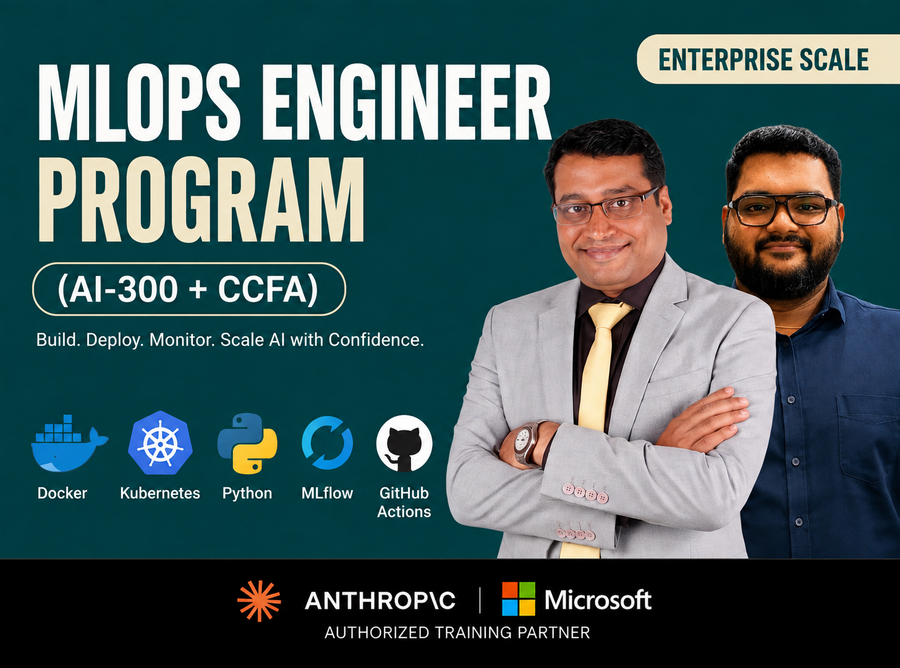
Ten weeks is tight but doable if those deliverables already exist somewhere in your work history and just need consolidating. Starting from zero Python, add eight to ten weeks first. A live weekend cohort compresses the guesswork: 360DT runs its MLOps Engineer Course as 50+ hours over 8 weeks, Saturday and Sunday from 8 to 11 PM IST, with mentor review on each deliverable rather than leaving you to debug a broken Kubernetes deploy alone at midnight.
MLOps Engineer Salary in India 2026: What Actually Moves the Number
Pay for this role varies more by what you can demonstrate than by your job title. Industry job boards typically advertise MLOps roles somewhere in the 8 to 18 LPA band for two to five years of experience, with GCCs and product companies at the upper end for candidates who can show a real production deployment, not just certificates. Company type moves the number more than years of experience do at the mid-level. For the full breakdown by band, see our MLOps Engineer Salary in India 2026 guide.
The Mistakes That Sink Most MLOps Career Switches
The pattern repeats often enough to be predictable: someone spends three weekends on an AI-300 practice test bank, passes on the second attempt, and still gets rejected at the first technical screen. They studied the exam, not the job. Interviewers almost always ask you to walk through a real deployment, drift and all, and a candidate who can only recite exam objectives stalls within two questions. The fix is not more exam prep. It is building one pipeline, badly if necessary, before you sit the exam at all.
A second, quieter mistake: treating monitoring as optional because it is the least glamorous part of the stack. Teams that skip it find out their model degraded not from a dashboard but from a customer complaint three months later, which is the exact failure mode the whole discipline exists to prevent. If you are choosing what to learn first between deployment and monitoring, monitoring is the one that actually differentiates an MLOps engineer from someone who can just run docker build.
If you are the Pune analyst in this piece, or anyone else weighing this move, here is the call: skip the AI-300 practice tests until you have shipped one pipeline end to end, even a small one, because that pipeline is what actually gets you past a technical screen. The certificate is worth taking after that, not instead of it. A structured live cohort just removes the trial and error from figuring out what "end to end" means on your own; that is the trade you are making by paying for one instead of self-teaching. Either way, the next step is the same: build something that runs, then go prove it. 360DT's MLOps Engineer Course is built around exactly that sequence.
Build the pipeline before you sit AI-300, not after
360DT's MLOps Engineer Course covers Azure AI-300 and Claude CCAR-F together over 8 weeks, with hands-on projects and mentor review on every deployment you ship, not just exam drills.
Explore the course
Related guides
- What Is Kubernetes? the orchestration layer under most MLOps deployments, explained from zero.
- Data Engineer Roadmap 2026 for the pipeline discipline that feeds every model you will ever deploy.
- AZ-305 vs AZ-400 if you are weighing a broader Azure architecture path alongside AI-300.
- AI Engineer vs Machine Learning Engineer to see how MLOps compares with the two roles it most often gets confused with.
- What Is Context Engineering? a GenAIOps-adjacent skill worth knowing once you are deploying agents, not just models.
Frequently asked questions
What does an MLOps engineer do on a daily basis?
An MLOps engineer spends most days on deployment pipelines, monitoring dashboards and incident response for models already in production, rather than building new models from scratch. Typical tasks include containerising a model, wiring a CI/CD pipeline, registering versions in a model registry, and checking drift alerts before they turn into customer-facing problems.
Is MLOps engineer a good career in India in 2026?
It is a strong option for people who already have some Python and cloud exposure, since GCCs and product companies are actively hiring for it and naming AI-300 directly in job postings. It suits people who enjoy production debugging and infrastructure more than pure model research.
What is the difference between an MLOps engineer and a machine learning engineer?
A machine learning engineer typically builds and trains models; an MLOps engineer takes those models and keeps them running reliably in production, including deployment, monitoring and retraining. In smaller teams one person often does both, but larger companies are increasingly hiring them as separate roles.
How long does it take to become an MLOps engineer from a data analyst background?
A realistic timeline is 6 to 9 months of consistent part-time study for someone already comfortable with Python and SQL, covering containers, CI/CD, a cloud ML platform, monitoring and enough GenAIOps to speak to LLM-based systems. A live cohort with mentor review, such as an 8-week MLOps Engineer course, can compress the guesswork if you are starting from zero cloud experience.
Is the Microsoft AI-300 certification enough to get an MLOps job on its own?
AI-300 helps you clear resume screening, especially at companies whose applicant tracking systems filter by certification name, but interviewers almost always ask you to walk through a real deployment. Pair the certification with at least one pipeline you built and can explain end to end.
What tools should an MLOps engineer learn first in 2026?
Start with Docker and basic Kubernetes, then a CI/CD tool such as GitHub Actions or Azure DevOps, then a cloud ML platform such as Azure Machine Learning or AWS SageMaker. Monitoring and GenAIOps basics come next once the core deployment loop is solid.
What is the salary range for MLOps engineers in India?
Industry job postings typically advertise MLOps roles in the 8 to 18 LPA range for two to five years of experience, with company type and demonstrated production experience moving the number more than years of experience alone. See our dedicated salary guide for the full breakdown by band.
About this guide. 360 Digital Transformation is an Authorized Training Partner of Anthropic and Microsoft. Other certification bodies, vendors and employers named here are not affiliated with us. Figures cited were checked on 20 September 2026.
 Azure Machine Learning
 Python