Home › Guides › AI Product Manager Salary
Career & Salary · 2026AI Product Manager Salary in India 2026: Pay Bands by Experience, Company Type and the AI Premium
AI product manager salary in India in 2026 is typically advertised between 16 and 28 LPA for first product roles, 30 to 55 LPA at four to eight years, and past 70 LPA at senior levels in big tech and funded startups. Listings show a 25 to 50 percent premium over generalist PM roles.
- The premium is conditional. Public salary guides put AI PM pay 25 to 50 percent above generalist PM pay at matched levels, but only once you have shipped something with a model in it.
- Company type moves pay more than years do. A four-year AI PM in a Bengaluru GCC and a four-year AI PM in an IT services firm can sit 15 LPA apart on advertised base alone.
- Evals and inference cost separate candidates, and they are the two skills most people skip in favour of model theory that never decides an offer.
- The title is cheap. Carrying "AI PM" where the AI work stays in a deck does not price like an AI PM anywhere else.
- Volume is concentrated. LinkedIn India listed over 7,000 matching roles in September 2026, clustered in Bengaluru, Hyderabad, Pune and Gurugram.
You have been a PM for three years at a Pune insurance SaaS company. Four items on your roadmap now start with the words "AI powered", the CTO wants a copilot in the claims module by March, and you are the one expected to scope it. You do not know what a hallucination rate is, and you are quietly aware that the person who does will get the next band.
What Changes When a PM Role Becomes an AI PM Role
The title moves less than the artefacts do. A generalist PM writes acceptance criteria that are either met or not. An AI PM writes criteria that live on a distribution: retrieval returns the right document in the top three at least 85 percent of the time, the summary passes a graded rubric at some agreed rate. Everything downstream changes with it. QA becomes an eval set. Rollback becomes a shadow deployment. The cost model grows a per-token line finance has never seen.
That is what the premium buys: not someone who has read about large language models, but someone who will not sign off a feature that demos beautifully and fails in production at a rate nobody measured. You do not need to train models. You do need to know what retrieval augmented generation and agent loops actually do, because you negotiate scope against those mechanics every sprint.
Also read: Retrieval Augmented Generation Explained in 2026: How RAG Actually Works, Step by Step.
AI Product Manager Salary in India 2026: Pay by Experience Band
These are advertised ranges, not offers. Indian listings are noisy here, because the same title covers an APM running a chatbot backlog at a 40-person startup and a principal PM owning a model platform at a GCC. Read it alongside the company table below; together they explain most of the spread.
| Experience | Advertised base (LPA) | What the listing asks for |
|---|---|---|
| 0 to 2 years | 8 to 18 | SQL, analytics fluency, one AI feature shipped or a serious side project |
| 2 to 4 years | 16 to 28 | Owned an AI surface end to end, comfortable with eval metrics |
| 4 to 8 years (senior PM) | 30 to 55 | Platform scope, model cost and latency tradeoffs, vendor selection |
| 8 to 12 years (lead or group PM) | 50 to 90 | Owning an AI portfolio, hiring PMs, defending spend to a CFO |
| 12+ years (director and above) | 90 to 150+, large equity component | Org level AI strategy, build versus buy at scale |
Collection basis: advertised bands compiled on 25 September 2026 from Indian AI PM listings and public salary guides including productleadership.com and upGrad, cross read against LinkedIn India. Advertised ranges, not guarantees of any individual offer. Equity excluded.
AI PM versus generalist PM, advertised midpoints
The gap is widest mid-career, where AI delivery evidence is scarcest.
Midpoints of advertised base ranges, checked 25 September 2026, scaled against a 100 LPA axis. Public guides put the premium at 25 to 50 percent at matched levels; these midpoints illustrate that shape and are not a survey result.
AI Product Manager Salary in India by Company Type
If you remember one thing from this guide, remember that employer tier is worth more than two years of experience. The same resume reads as 22 LPA in one building and 38 LPA across the road.
| Company type | Advertised, 3 to 6 yrs (LPA) | What the work is really like |
|---|---|---|
| IT services and consulting | 14 to 26 | Client-shaped scope, AI features sold before they are scoped, heavy documentation |
| Indian product SaaS (Series A to B) | 22 to 40 | Widest ownership, thinnest support, you will write your own SQL |
| Growth stage startup and unicorns | 30 to 60 | Real platform scope, aggressive timelines, constant model cost pressure |
| GCC (global capability centre) | 30 to 55 | Global product, decision rights split with an overseas counterpart, strong process |
| Big tech India | 40 to 80 base, higher total comp with RSUs | Narrow slice of a huge surface, very high evidence bar at interview |
Collection basis: advertised ranges and public India GCC and product compensation benchmarks read on 25 September 2026, including plugscale's GCC benchmark and productleadership's India PM guides. Equity excluded: grant value varies by date and liquidity.
An ANSR report carried in the trade press in September 2026 found that roughly 65 percent of new GCC roles created in India in 2026 require AI skills, with AI and data demand up about 45 percent year on year. That is the structural reason mid-career listings thickened this year. GCC loops reward written clarity over startup improvisation, and they will ask you to defend a decision you made two years ago in detail.
The AI Premium: What Moves You to the Top of the Band
BusinessToday reported on 23 September 2026 that Indian salary hikes are stabilising at 8 to 12 percent for 2026, averaging around 10.4 percent, while professionals with AI and ML mastery are seeing hikes of 21.1 percent against 9.8 percent for everyone else.
Average hike reported for professionals with AI and ML mastery in 2026, against 9.8 percent for other roles, per figures carried by BusinessToday on 23 September 2026. A reported average, not an outcome anyone can promise you.
That gap does not arrive because you edited your LinkedIn headline. Three things move an offer up its band. First, a shipped AI surface with a measured outcome: not a pilot, something users touched, with a before and after number attached, even a modest one such as deflecting 18 percent of tier-one tickets. Indian panels have been burned by pilots that never scaled, so the measurement counts as much as the ship. Second, eval literacy: why accuracy misleads on an imbalanced support classifier, what a golden set is, how you would catch a silent quality regression after a version bump. Third, domain depth, the one input no course sells, which is why a 2019-batch insurance PM often beats a generalist with a fresher certificate.
The honest caveat: the premium attaches to evidence, not to the role. Plenty of people carry this title at a services firm, spend the week writing decks about a copilot nobody has scoped, then discover at interview that they cannot say how the thing behaves under load. That title does not pay 40 LPA anywhere.
A negotiation script that actually moves the number
Anchor on the role, not your current CTC, because the CTC question exists to cap the conversation. Close to verbatim: "I'd rather anchor on the band for this role and level. Similar AI platform PM roles at GCCs are advertising 34 to 40 fixed. Where does this one sit in that range?" Then price the evidence: "The triage assistant took median handling from 38 minutes to 14 across two quarters, with an eval gate I designed." What usually goes wrong is that people rehearse the ask and fold at the first counter. Sometimes base really is capped. Level, joining bonus and the review date almost never are.
AI Product Manager Skills That Show Up in Indian Job Descriptions
Strip the marketing language out of Indian AI PM postings and the same four requirements survive.
SQL you actually use
Not "familiarity". You pull your own funnel and quality numbers because the data team is booked. Window functions and CTEs are the floor.
Weekly, not occasionalEval design
Building a golden set, choosing between an LLM judge and human graders, and knowing why precision and recall move apart when you tighten a threshold.
The real differentiatorUnit economics of inference
Cost per thousand requests, cache hit rate, and what happens to margin when usage triples. This decides whether a feature survives review.
Talk to finance in their unitsGovernance and data handling
What data may leave the VPC, what an audit trail for an agent action looks like, and how the DPDP Act shapes your consent flow. Enterprise buyers ask first.
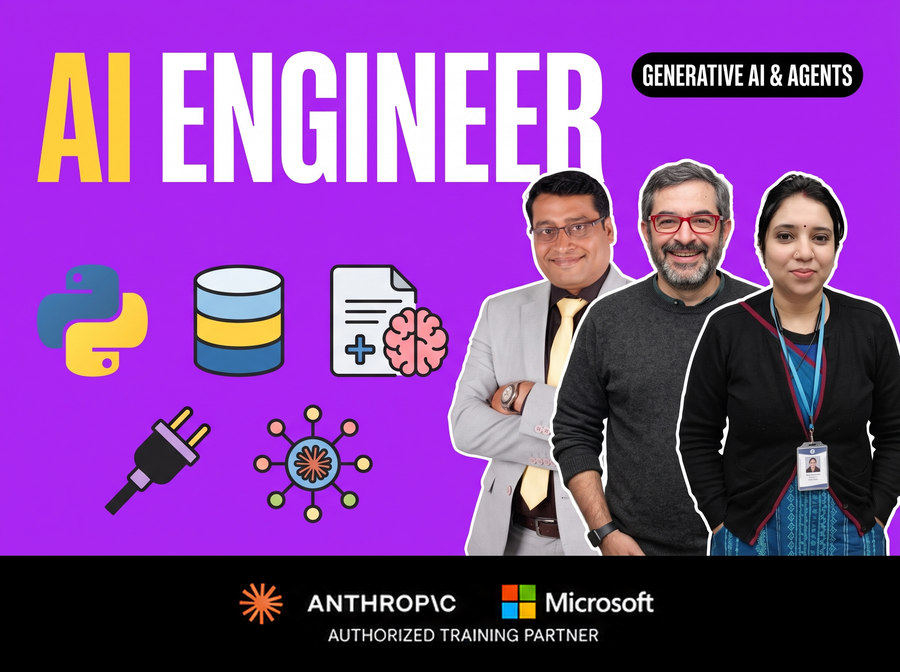
Deal blocker if missingEvals and inference cost are the two most people skip, and the two interviewers use to separate candidates. Spend limited study hours there rather than on another survey course about transformer internals. The internals are interesting. They have never once decided a PM offer. Both sit inside the build track of 360DT's live AI Engineer programme. If you have never touched a model API, the shorter Claude Certified Associate Foundations prep course at 30+ hours over four weeks is the cheaper start, and the metrics half goes easier with SQL and Power BI fundamentals behind you.
Which certifications are worth it, and which are not
A foundations-level AI credential is worth it mainly as a deadline. If your product runs on Azure, take the current Microsoft associate AI exam, but check the code before booking: AI-102 carried a USD 165 fee and retired on 30 June 2026, replaced by AI-103, with Indian role-based exam pricing generally near Rs 4,800. The AI-103 preparation track covers that syllabus; the certifications overview shows how the paths connect. Two to skip here: AZ-305 is excellent for architects and wasted on a product owner, and a Copilot administration credential pays off only if your product is literally Microsoft 365 Copilot rollout.
Where the AI Product Manager Jobs in India Actually Are
LinkedIn India listed more than 7,000 open roles matching "AI product manager" when we checked on 25 September 2026, Bayt showed roughly 4,560 for India the same week, and Naukri carried 12,204 product manager jobs of all kinds. Treat the big numbers as inflated: boards double count reposts, and many of those titles are generalist PM roles with an AI line bolted on. The narrow signal is more honest. The specialist board productmanagementjob.com listed 33 genuinely AI-specific PM openings in Bangalore, and LinkedIn showed 65 technical PM roles mentioning machine learning in Bengaluru.
Bengaluru carries the GCC and big tech volume, Hyderabad has grown fast behind Microsoft, Amazon and a thick GCC layer, and Pune and Gurugram split enterprise SaaS and fintech. Outside those, remote roles exist but skew to seed and Series A startups, with the pay and stability that implies.
Also read: Agentic AI Jobs in India 2026: How a 300% Hiring Surge Is Creating 6 New Tech Careers.
Where an AI PM loop spends its points
The direct technical probe is the smallest slice, and candidates over-prepare for it.
Illustrative weighting built from how Indian AI PM job descriptions and public interview write-ups describe their loops, read 25 September 2026. Not survey data and not any one company's rubric.
The market, in four numbers
Volume is real; the AI tilt in newly created GCC roles is the stronger signal.
Listing counts read on LinkedIn India and Naukri on 25 September 2026; GCC and increment figures from ANSR and BusinessToday coverage of September 2026. Board counts include duplicates and reposts.
How to Become an AI Product Manager in India: Three Entry Routes
There is no fourth route worth planning around.
Route 1: Sideways inside your current company
Highest success rate, and the one most people dismiss because it feels slow. You already hold domain context and internal credibility, the two hardest things to acquire. Own the AI feature nobody wants, ship it, measure it, then move externally with that on the resume. Six to twelve months, and the pay bump arrives at the external move, not the internal one.
Route 2: Engineer or analyst moving into product
The technical floor is cleared, so the work is product judgement: discovery, prioritisation under constraint, saying no in writing. Engineers underestimate how much of this job is written argument. From a data role the metrics half is free and the stakeholder half is the climb.
Route 3: Generalist PM adding AI depth
The most common path in 2026 and the one the premium was built for. The failure mode is stopping at vocabulary. A PM who says "we'll use RAG" but cannot state the retrieval quality target has not made the switch, and the interview finds that out in about four minutes. Whichever route you take, the study runs alongside a full-time job: 360DT's live cohorts sit on Saturday and Sunday, 8 to 11 PM IST.
Build the AI layer an AI PM interview actually probes
Sixteen weeks of live sessions on generative AI, RAG pipelines and agents that plan, use tools and act, certified on both Microsoft and Claude stacks. You work through the same mechanics you will be scoping, measuring and signing off as a product owner.
Explore the course
An Illustrative 11-Month Switch, With the Numbers
Back to the Pune insurance PM from the opening. What follows is an illustrative composite built from typical market paths, not a real named individual and not a 360DT student outcome.
Start. Three and a half years as a PM, 19 LPA fixed plus a small variable, owning the agent-facing claims module. No model experience beyond using a chatbot.
Months 1 to 3. Eight hours a week around the job on RAG mechanics and evaluation, properly rather than skimmed. Sat the CCAO-F exam as a forcing function, Rs 12,999 for prep plus the exam fee. No pay change, and this is where most people quit.
Months 4 to 7. Scoped an internal claims triage assistant. Built a 200-item golden eval set by hand with two senior claims agents over three weekends, the most valuable artefact of the year. Shipped behind a flag to 10 percent of traffic. The first rollout regressed on long claim narratives and the fix was chunking, not the model. That failure became the strongest interview story.
Months 8 to 11. Measured over two quarters: median triage time down from about 38 minutes to 14, with a documented quality gate. Rewrote the resume around that one line. Interviewed at four companies, rejected at two on depth of eval questioning, accepted at a Hyderabad GCC.
Destination. Senior product manager, AI platform, in the 34 to 38 LPA advertised band plus RSUs. Eleven months elapsed, under Rs 20,000 spent. The cost that was not money: most weekends for four months, and a promotion cycle skipped while the project ran.
- The pay cut on the way in. Moving from a senior engineering seat into a first product role often means a lateral or lower offer for one cycle. Engineers at 28 LPA have taken PM offers at 24 to 26 to get the title.
- Timelines slipping by six months. The internal project you need for evidence depends on someone else's roadmap. An eleven-month plan becomes eighteen when a reorg lands in month five, and that is the normal case rather than bad luck.
- Freshers and the closed door. Product management is still a hard first job in India at any level of AI knowledge. Most listings using this title want three or more years of delivery.
- Certification without a surface. A credential helps you pass a screen and helps you study. On its own it does not move a band. Choosing between one more exam and one shipped feature, ship the feature.
What We Would Do in Your Position
If you are already a PM with two or more years and a domain you know well, do not take a course first. Find the AI feature inside your current company, own it, measure it, and study the eval and cost layer in parallel so you can actually run it. That order produces both the resume line and the interview stories, and it is the version of this switch where the market pays you for the transition instead of the reverse.
If you are an engineer or analyst without a product seat, invert it: build technical credibility until you can be handed an AI surface, then push for ownership. The AI Engineer course is where we would send you, because it runs the same RAG pipelines, agents and evaluation loops an AI PM has to scope and sign off. Start there, and start with the thing you can ship.
Also read: AI Engineer Salary in India 2026: Pay by Experience, City and the Skills That Move It.
Related guides
- Enterprise AI Agents in 2026: Why Only 23% of Pilots Scale is the failure pattern you will be asked to prevent in every AI PM interview.
- Certification vs Projects in 2026: Which Gets You Hired Faster in India? settles the exact trade-off this guide resolves in favour of shipping.
- Highest Paying IT Certifications in India 2026 compares advertised bands across ten credentials if you are deciding where to spend exam money.
- AI Engineer Interview Questions 2026 shows the depth your engineering counterparts are held to, which is useful calibration before you scope with them.
- What Is Agentic Commerce in 2026? covers the product surface most Indian AI roadmaps touch next.
Frequently asked questions
What is the average AI product manager salary in India in 2026?
Advertised bands cluster around 16 to 28 LPA at two to four years, 30 to 55 LPA at four to eight years, and 50 to 90 LPA at lead level, with big tech total compensation higher once equity is counted. A single average misleads, because company type shifts the number more than experience does. These are advertised ranges from public listings, not guarantees.
Do I need to code to become an AI product manager?
Not production code. You do need working SQL, the ability to read a notebook without panic, and enough grasp of retrieval, prompting and evaluation to argue about scope with engineers. Indian listings describe this as technical fluency, and the interview tests reasoning rather than syntax.
Am I too old to move into AI product management at 35?
No, and at 35 with a domain behind you the odds are better than for a 24-year-old with none. Domain depth in BFSI, healthcare or enterprise support is the input hiring panels cannot train for. What gets harder with age is the flat pay year a route change often requires, so plan the finances before the study plan.
Which certification helps most for an AI product manager role?
A foundations-level AI credential that forces you through prompting, retrieval and evaluation, because it maps to what you will scope. If your product runs on Azure, take the current Microsoft associate AI exam, and confirm the live code first: AI-102 retired on 30 June 2026 and was replaced by AI-103. Deep architecture certifications are poor value here.
How long does it take to switch from engineering to AI product management?
Commonly nine to eighteen months when you already work in tech and can find an AI surface to own internally. The study takes three to four months at eight hours a week. The rest goes into shipping something measurable, which cannot be compressed and is what employers screen on.
Do AI product managers really earn more than generalist PMs?
Public salary guides put the gap at 25 to 50 percent at matched levels, and reported 2026 hike data associates AI and ML skills with roughly 21 percent increases against a 10 percent average. The premium attaches to demonstrated delivery, so an AI PM title with no shipped model-backed product typically prices like a generalist role.
Is an MBA required for AI product manager jobs in India?
It is not required and is rarely the deciding factor outside campus hiring at a few large firms, where a top-institute MBA still opens APM programmes that are otherwise closed. For lateral hiring at three or more years, a shipped AI product with a measured outcome outweighs the degree in almost every loop.
Which Indian cities have the most AI product manager jobs?
Bengaluru leads by a wide margin on GCC and big tech volume, followed by Hyderabad, then Pune and Gurugram for enterprise SaaS and fintech. Chennai and Ahmedabad have smaller markets weighted toward services and BFSI. Remote roles exist but skew heavily to early-stage startups.
About this guide. 360 Digital Transformation is an Authorized Training Partner of Anthropic and Microsoft, offering exam preparation and skills training. We do not offer placement or job guarantees. Other certification bodies and employers named here are not affiliated with us. Salary figures are advertised market ranges collected from public job listings, not guarantees of what any individual will earn. Figures cited were checked on 25 September 2026.
 Python
 Claude API
 FAISS
FAISS ChromaDB
 LangChain
 LangGraph
 CrewAI
 AutoGen (AG2)