Home › Guides › AI Engineer Interview Questions
Career Guide · 2026AI Engineer Interview Questions 2026: 20 Real Questions With Model Answers
AI engineer interview questions in 2026 split across four areas: LLM fundamentals, RAG engineering, agent orchestration with protocols like MCP, and deployment cost control. Indian GCCs and product companies now spend close to 40% of technical rounds on agentic AI and RAG design instead of plain prompting, with the rest split across system design and behavioral rounds.
- RAG and agent design now dominate the loop: close to 40% of technical rounds test retrieval debugging and orchestration, not plain prompting.
- MCP and A2A show up as named topics, not abstractions. Expect at least one question that asks you to compare them directly.
- Cost questions are standard from mid-level up: expect a "cut the token bill" scenario in at least one round.
- LLM-as-a-judge gets tested for its blind spots, not just its existence. Know what it misses before you praise it.
- Fresher pay typically starts near ₹8-14 LPA; clearing senior-round agent architecture questions is what moves offers into the ₹30 LPA+ band.
- One well-defended RAG project beats five shallow ones in every round covered below.
Six months ago an AI engineer interview opened with "what is a large language model." In 2026 it opens with: "your RAG pipeline is wrong on 1 in 5 queries, where do you look first." That shift is why engineers who prepped only prompt trivia keep losing offers to candidates who can debug a live retrieval pipeline on a shared screen.
Picture a Java developer who has shipped Spring Boot services since 2019 and spent six months bolting RAG onto a support chatbot on the side. That profile now clears more AI engineer interviews than a fresher who memorized LangChain's docs, because interviewers hire for production judgment, not API trivia. The 20 questions below span the four buckets real 2026 loops run: LLM fundamentals, RAG engineering, agent orchestration, and deployment economics, closing with the behavioral round almost every loop ends on.
How AI Engineer Interview Questions Are Weighted Across Rounds in 2026
Most loops run four to five rounds, each testing something different. Knowing the shape of the loop matters as much as knowing the answers, since a sharp technical answer in the wrong round reads as evasive rather than impressive.
| Round | What it actually tests | Typical duration | What clears it |
|---|---|---|---|
| Recruiter or HR screen | Role fit, notice period, CTC band | 20-30 min | Clear communication, realistic expectations |
| Technical Round 1 | LLM fundamentals, RAG basics | 45-60 min | Explains tradeoffs, not just definitions |
| Technical Round 2 | Agent architecture, live debugging or coding | 60-90 min | Designs and defends a system under follow-up questions |
| Take-home or pairing exercise | Real RAG or agent build, or a planted bug fix | 2-5 days, or 90 min live | Working code, sane evals, visible cost awareness |
| Behavioral + hiring manager | Ownership, failure handling, collaboration | 30-45 min | One specific story, not a generic answer |
Where AI Engineer Interview Time Actually Goes
Rough share of technical-round time spent per domain, based on candidate debriefs and posted interview guides
Approximate, pooled from candidate debriefs and public interview guides, checked 5 November 2026.
Cut DSA grinding first if time is short: it's 6% of round time and doesn't justify three weeks of LeetCode. Spend that time on one RAG project you can defend end to end instead, which is where programs like 360DT's AI Engineer course now put their live hours too.
LLM and Generative AI Fundamentals Questions
1. What's the real difference between a base model and an instruction-tuned model, and why does it matter for a RAG pipeline?
A base model predicts the next token on raw text and just continues a prompt. An instruction-tuned model, through SFT and RLHF-style alignment, follows instructions and knows when to stop or refuse, the state every deployable model, Claude Sonnet 5.5 and Haiku 5.5 included, ships in. This matters for RAG because a base model keeps "continuing" retrieved context instead of answering, with no sense of when the context lacks the answer, exactly what stops a bot from inventing a refund policy that doesn't exist.
2. How does a context window limit actually break a long-document summarization pipeline, and how do you fix it without just buying a bigger context model?
The failure isn't a hard error, it's silent quality loss. Models attend unevenly across long context, so facts buried mid-document summarize worse than facts at the start or end, the "lost in the middle" effect. A bigger window hides the symptom, not the cause. Fix it structurally: map-reduce summarization, or a retrieval-first pass pulling only relevant sections before summarizing. A 300-page compliance PDF can run past 150,000 tokens before you've even added the system prompt, so this is the default case, not an edge case.
3. When would you choose fine-tuning over RAG, concretely?
Fine-tune when the change belongs in generation behavior, not facts: a fixed output schema used thousands of times a day, a house tone that must survive even when retrieval returns nothing, or a classification task needing the model's weights to internalize patterns. Skip it when facts change weekly, you'll retrain constantly for something a retrieval index handles free. LoRA and QLoRA cut the training cost, but the decision is about where the knowledge should live, not the bill.
4. What is prompt caching and when does it actually save money?
Prompt caching reuses a repeated prefix, a system prompt, a long reference document, a tool schema, at a fraction of fresh-token cost on the cache hit. It pays off when the same large context gets reused across many calls; a support agent loading the same 20-page policy for every ticket is the textbook case. It does nothing if every call has a unique prompt with no shared prefix, a common mistake candidates make when they claim it as a blanket fix. Also read: What Is Prompt Caching in 2026?
RAG Engineering: The AI Engineer Interview Questions That Trip Up Experienced Developers
This is where the Java developer's chatbot experience matters more than reading ever will. RAG questions rarely test definitions, they test whether you've actually watched one fail.
5. Walk me through what happens when a RAG answer is wrong in production. Where do you look first?
Look at the retrieved chunks before blaming the model. A large share of "wrong answer" RAG bugs trace back to retrieval, not generation, so check first whether the right document even made the top-k results. Second, check for an embedding-model mismatch between ingestion and query time, common after someone swaps models and forgets to re-index. Third, check chunk boundaries; a chunk cutting a clause mid-sentence retrieves cleanly and still hands the model half a rule. Only then suspect generation itself.
6. What's the difference between exact nearest neighbor search and ANN, and why does every production vector database use ANN?
Exact nearest neighbor compares your query against every stored vector, correct but linear, and it stops scaling past a few hundred thousand vectors. ANN methods, HNSW and IVF being the two you'll be asked about, trade a little recall for a lot of speed. A typical HNSW setup holds roughly 95 to 98% recall at a fraction of brute-force latency once you're past that scale, which is why pgvector and Pinecone default to it. Treating recall as a tunable dial, not a fixed guarantee, is what separates candidates who've read about vector databases from candidates who've run one. Also read: What Is a Vector Database?
7. How do you evaluate a RAG pipeline beyond "it looks right"?
Two separate measurements. Retrieval quality uses recall@k and mean reciprocal rank against a golden question set you curate yourself. Generation quality needs a faithfulness score checking whether the answer is actually supported by the retrieved chunks, not just plausible-sounding. Tools like Ragas or DeepEval automate most of this. Running both checks on every chunking or prompt change, not once at launch, is exactly the eval harness 360DT's AI Engineer course builds as a graded project.
8. When does agentic RAG actually beat a single-shot retrieval call?
Agentic RAG, where the system rewrites the query, retrieves multiple times and critiques its own draft, wins on genuinely multi-hop questions: "compare the refund policy before and after the March price change" needs two retrievals and a comparison a single call can't supply. It loses on simple lookups, where the extra loop adds latency and cost for no gain. The honest answer is "better for this shape of question," not "better."
9. What does chunking strategy have to do with recall, and what's a realistic chunk size for a 50-page policy PDF?
Start around 300 to 500 tokens per chunk with 10 to 15% overlap, then adjust after looking at real failures. Chunks too large hurt precision; too small hurt recall. The Java developer's chatbot failed exactly here: fixed 1,000-token chunks split refund-policy clauses across boundaries, so retrieval returned half a rule and the model answered confidently with the wrong half.
AI Agents, MCP and Orchestration Questions
10. Explain MCP in one sentence to a hiring manager, then explain it properly to me.
One sentence: MCP lets an AI model discover and call external tools and data without custom glue code for each one. Properly: it's a client-server protocol over JSON-RPC with three primitives, tools, resources and prompts, letting any MCP client talk to any MCP server with no bespoke integration. Before MCP, every tool integration meant its own function-calling wrapper; now it's a one-time server any agent can reuse. 360DT's CCDV-F prep course spends a full module building MCP servers from scratch for exactly this reason.
11. LangGraph vs CrewAI vs a plain function-calling loop. When do you actually reach for an orchestration framework?
| Approach | State management | Debugging | Best fit |
|---|---|---|---|
| Plain function-calling loop | Manual, your own object or dict | Easiest, step through real code | Single agent, one or two tools |
| LangGraph | Explicit graph of nodes and edges | Harder, usually needs visualization | Branching workflows, human-in-the-loop interrupts |
| CrewAI | Role-based, mostly implicit | Moderate | Multi-agent "team" patterns, fast prototyping |
My honest take: for a single agent calling one or two tools, skip the framework. A plain while loop with a tool registry is easier to debug at 2 a.m. than untangling a LangGraph state machine. Reach for LangGraph once you need real branching or a human approval step mid-task; reach for CrewAI only with genuinely distinct agent roles, not one agent wearing a framework for the resume line.
12. What's the difference between A2A and MCP, and why would a production system need both?
MCP connects a model to its own tools and data. A2A, the Agent2Agent protocol, connects one autonomous agent to another, often built by a different team or vendor, so they can discover capabilities and hand off work as peers. A production system can need both: a procurement agent might use MCP for its own ERP tools, then A2A to hand a shipment query to a logistics partner's agent it has no internal visibility into. Calling A2A "MCP for agents" is the tell that someone's only read the names. Also read: What Is the A2A Protocol in 2026?
13. How do you stop an agent from looping forever on a tool call?
Cap tool calls per task, around 8 to 12 is a sane default for most support and research agents; past that you're watching a stuck agent, not a thorough one. Add loop detection on identical repeated calls, a time or cost budget per task, and escalate to a human after a fixed number of failed attempts rather than retrying indefinitely.
14. What's your approach to giving an agent write access to a production system safely?
Scope credentials per agent, never a shared service account. Put a human-in-the-loop approval gate in front of destructive actions. Run a dry-run mode so the intended action is logged before it executes. Log every tool call's inputs and outputs for audit, not just the final answer. 360DT's CCAR-F architecture prep course walks through exactly this governance pattern for enterprise agent deployments.
Deployment, Cost and Evaluation Questions
15. Your RAG pipeline costs ₹40,000 a month in token spend and the CFO wants it under ₹15,000. Where do you cut?
Start with caching: enabling it on a repeated system prompt and reference context can cut 50 to 70% of spend on that portion alone, the cheapest win since it changes nothing about quality. Next, route by difficulty: send simple lookups to a smaller model like Claude Haiku 5.5, reserve Sonnet 5.5 for genuinely hard multi-hop questions, standard model-routing practice now. Then cut retrieved chunk count from eight to four with a reranker in front, usually holding quality while cutting processed tokens. Interviewers want the cheapest, lowest-risk changes first, not one silver bullet.
16. How would you deploy this agent on Azure versus AWS, and what actually changes?
On Azure you're typically on Azure AI Foundry with the Azure AI Agent Service handling orchestration and identity through Entra Agent ID. On AWS it's Bedrock Agents calling Lambda for tool execution, with IAM scoping what each agent can touch. The concepts transfer, tool definitions, state, guardrails, but pricing, network isolation and identity differ enough that teams go deep on one cloud. Azure-first teams get this from 360DT's Azure Solutions Architect and DevOps course; AWS-first teams from the AWS equivalent.
17. What's LLM-as-a-judge, and what's wrong with using it as your only eval signal?
LLM-as-a-judge scores one model's output against a rubric using another model, useful because it scales where human review can't. The catch: judge models favor longer, more confident-sounding answers regardless of correctness, and their correlation with human judgment varies, sometimes well below what you'd want to trust blindly. The fix isn't dropping it, it's pairing it with one deterministic check, exact-match on structured fields or a groundedness score against retrieved chunks.
18. Explain the difference between latency and throughput in LLM serving, and why continuous batching matters here.
Latency is how long one request takes, time to first token and to finish. Throughput is how many requests or tokens the system serves per second across everyone at once. Naive batching, waiting to fill a batch, helps throughput but hurts the latency of whoever arrived first. Continuous batching, what vLLM is built around, interleaves requests at the token level so new requests join an in-flight batch immediately, raising throughput without that latency penalty.
Behavioral and System-Design Questions
19. Tell me about a time an AI feature you shipped failed in production. What did you actually do?
Interviewers grade specificity, not drama. Name one concrete metric that moved, an error rate, a complaint count, a cost spike, describe the actual debugging steps you took, not the ones you wish you'd taken, and end with what changed afterward: a new eval gate, a different chunking strategy, a rollback process. A vague "learning from failure" answer with no number attached reads as a story you haven't lived.
20. Design a customer support agent for an Indian D2C brand that needs to handle Hindi and English, check order status, and escalate to a human.
Cover, in order: language detection before anything else runs; intent classification routing between order-status, general-query and complaint paths; a scoped tool call to the order API with just the order ID, never broad database access; a confidence threshold that triggers human handoff automatically rather than letting the agent guess; and a logging layer recording every tool call for the support team to audit. Candidates who skip the escalation threshold and let the agent "answer everything" haven't shipped a real support bot.
So why do strong backend engineers still fail the agent-design round? Usually not for lack of knowledge. What we've seen go wrong, watching from the sidelines: a candidate defines agentic RAG perfectly on a whiteboard, then freezes the moment you ask them to trace one real tool-call log and say what went wrong. Theory and a debugging session are different skills, and only one gets tested in round two.
A caveat worth sitting with: twenty questions are preparation, not proof. Memorizing the answers above gets you through the first follow-up in any domain and loses you the second, because every real interviewer pushes on the edge case you didn't rehearse. These questions also won't tell you the specific stack a given company runs, or the one legacy system your interviewer secretly wants to ask about. Treat this as the floor, not the ceiling.
What Clearing These Rounds Is Actually Worth: AI Engineer Pay by Seniority
None of this is academic. Job postings and salary-aggregator data suggest advertised pay for AI engineering roles in India moves in fairly distinct steps as these questions get harder to answer under pressure.
AI Engineer Pay Progression by Seniority in India
Typically advertised ranges, hedged against company type and city
Fresher / Associate (0-2 yrs)
Mid (3-5 yrs)
Senior (6-8 yrs)
Lead / Architect (9+ yrs)
Typically advertised ranges pooled from current job postings, not a guarantee for any individual offer, checked 5 November 2026.
The jump that matters most isn't fresher-to-mid, it's mid-to-senior, and it tracks closely to the agent-orchestration and cost-control questions above. Candidates who can only discuss RAG basics tend to plateau at the mid band; the ones who can defend an agent architecture and a cost decision under follow-up questions clear the senior band.
How to Prepare for AI Engineer Interview Questions With the Weeks You Have
What you prioritize depends on runway. The two paths below are genuinely different, not shorter and longer versions of the same list.
If You Have 2 Weeks
Triage mode: cover the gaps that fail interviews fastest
If You Have 8 Weeks
Depth mode: build the judgment, not just the vocabulary
If your RAG pipeline pulls from a lakehouse rather than a folder of PDFs, that's a data engineering problem before it's an AI engineering one; a live Microsoft Fabric data engineering program covers the DP-700 ingestion patterns these questions quietly assume. If the agent lives inside Microsoft 365 rather than a custom stack, the Microsoft 365 Copilot Administrator course covers the admin-side guardrails a custom-build question will skip entirely. Either way, the full certifications overview is worth a look before committing to one path.
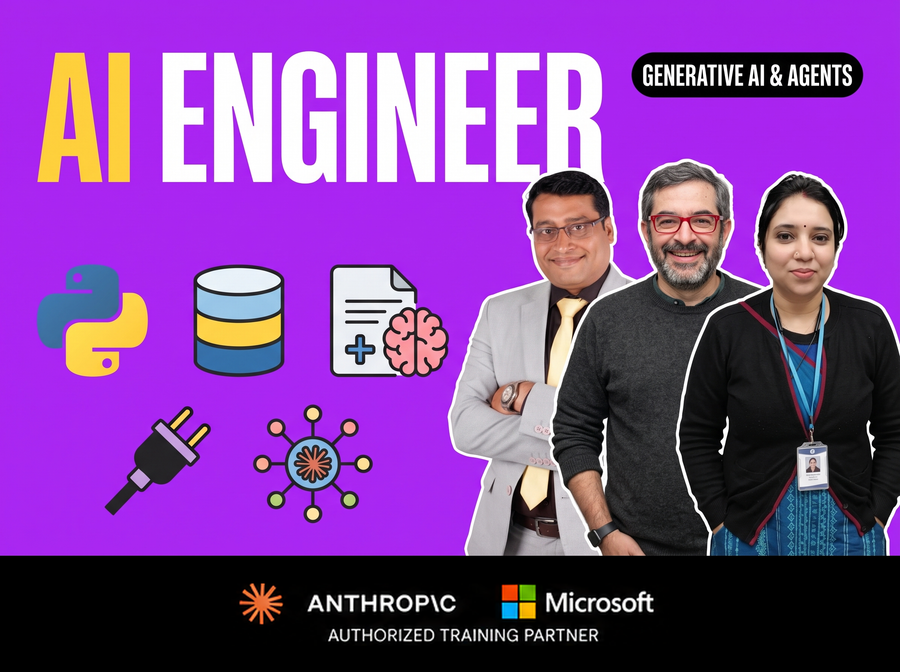
If you're the Java developer from earlier, here's what I'd do with your next six weeks: stop reading more lists like this one, pick one RAG project, break it on purpose, fix it, and write down exactly what you changed. That's the one thing every question above is testing for. If you'd rather have that structured than improvised solo, 360DT's AI Engineer course runs the same build-break-fix cycle live over 16 weekends, Microsoft and Claude certified at the end, the faster route in, though not the only one.
Stop guessing what AI engineer interviews test. Build the agents they ask about.
16 weeks of live sessions on RAG, agents and MCP, with Microsoft and Claude certification built into the syllabus, not bolted on at the end.
Explore the course
Related guides
- Power BI Interview Questions 2026 for a look at how interview prep differs when the role is reporting-led rather than agent-led.
- AWS Roadmap 2026 if the deployment questions above left you short on cloud fundamentals.
- Microsoft Fabric Tutorial for Beginners 2026 to build the data-ingestion layer most RAG pipelines actually sit on.
- CCAR-F Interview Questions 2026 for the architect-level version of the agent-governance questions above.
- Data Analyst Roadmap 2026 if you're weighing a data-first route into AI over the engineering-first one covered here.
Frequently asked questions
What are the most commonly asked AI engineer interview questions in 2026?
The most common AI engineer interview questions in 2026 cover RAG debugging, agent orchestration and MCP, model and context fundamentals, and at least one cost-optimization scenario. Pure algorithm questions make up a smaller share than these four areas in most loops.
Is RAG or fine-tuning asked more often in AI engineer interviews?
RAG comes up far more often, since most production use cases need current, changeable facts rather than behavior baked into model weights. Fine-tuning usually shows up as one "when would you choose this instead" comparison, not a deep-dive topic.
Do AI engineer interviews in India test LeetCode-style coding?
Some do, particularly at larger product companies, but it's usually a smaller share of the loop than RAG and agent-design rounds. Expect light-to-moderate coding in a pairing or take-home exercise rather than a dedicated algorithms round at most AI-first startups and GCCs.
What is the average AI engineer salary in India after clearing these interviews?
Industry job postings suggest fresher pay typically starts near ₹8-14 LPA, moving toward ₹14-28 LPA at mid level and ₹28-45 LPA at senior level, with lead and architect roles advertised higher. Actual offers vary by company type, city and interview performance.
How many weeks should I prepare for an AI engineer interview?
Two weeks is enough for triage prep focused on one solid RAG project and a few failure stories. Eight weeks gives room to build an eval harness, compare orchestration approaches hands-on, and audit your own token costs, the gap between mid and senior answers above.
Is a Claude or Microsoft certification enough to pass an AI engineer interview?
A certification alone rarely passes a technical round, since interviewers probe for hands-on judgment an exam can't fully test. It helps: a structured syllabus forces you through gaps, like MCP server-building or agent evals, self-study tends to skip, and gives you a credential behind the project work that actually carries the interview.
What's the difference between an AI engineer interview and a data scientist interview?
A data scientist interview leans toward statistics, model training and experiment design. An AI engineer interview leans toward systems: retrieval, orchestration, deployment and cost, with far less model-training depth and far more emphasis on operating one reliably in production.
About this guide. 360 Digital Transformation is an Anthropic Partner and a Microsoft Authorized Training Partner. Other certification bodies, vendors and employers named here are not affiliated with us. Figures cited were checked on 5 November 2026.
 Python
 Claude API
 FAISS
 ChromaDB
 LangChain
 LangGraph
 CrewAI
 AutoGen (AG2)