Career Roadmap · 2026
Forward Deployed Engineer Roadmap 2026: Step-by-Step Path to Becoming an FDE
Short answer
The Forward Deployed Engineer roadmap is: get solid at production software engineering, add data and integration skills, layer on applied AI, learn to deploy and operate, build customer-facing judgment, then target FDE roles or transfer in from an adjacent one.
There is no mandatory certificate. What gets people hired is evidence of shipped, deployed work — systems running in a real environment that you can explain, defend and account for when they broke.
The Forward Deployed Engineer roadmap
Work down the spine. The branches on either side are what you pick up at that stage. Solid coral means learn it, grey means recommended, dashed means it depends on the role you are targeting.
Stage 1: Understand the FDE seat
Before writing any code toward this transition, get clear on what the job actually is, because a lot of people spend months building the wrong evidence. An FDE is not a consultant who advises and not a solutions engineer who configures. They write and own the production code that goes live inside a customer's environment, and they stay through adoption.
Learn why AI projects fail. They almost never fail in the demo. They fail afterwards, on integration, reliability, security review and adoption. Everything else on this roadmap exists to close one of those four gaps. If you understand that, the rest of the map stops looking like a random list of technologies.
Stage 2: Core software engineering
This layer is non-negotiable and no amount of AI knowledge substitutes for it. Job descriptions from Palantir, OpenAI and Anthropic all assume you can already ship software before you add customer ownership on top.
Python is the primary language across almost every FDE posting. Add TypeScript or JavaScript, because an FDE builds the whole user workflow rather than an isolated backend component — you will often be the one putting an interface on the thing. Palantir also lists Java and C++ as examples. SQL and data modelling matter more here than in most engineering roles.
The practical test for this stage: can you build and ship a small service, integrate two APIs, handle real data, and have someone else run it? Aim for a track record of things you built, not coursework you finished.
Stage 3: Data and systems integration
This is the stage most self-taught learners skip and most FDE work actually consists of. Enterprise data is undocumented, inconsistent and frequently wrong. Getting it into a usable shape is routinely the majority of an engagement.
Build ETL pipelines. Design schemas for data you did not create. Practise on genuinely messy data rather than clean tutorial datasets — download something public and awkward and make it work. Learn how systems talk: REST, webhooks, event flows, and gRPC if your target roles mention it.
Stage 4: Applied AI and LLM engineering
You do not need research-level machine learning. You need applied capability, and postings are increasingly explicit about what that means. Databricks lists RAG, multi-agent systems, Text2SQL, fine-tuning and production-grade evaluation. Anthropic lists prompt engineering, agent development, evaluation frameworks and deployment at scale.
Build a retrieval pipeline end to end so you can explain chunking, embeddings, hybrid retrieval and re-ranking without hand-waving — interviewers push exactly here. Then move to agents and orchestration with LangChain and LangGraph, and to MCP for connecting models to a customer's tools and data.
The habit that matters most in this stage is evaluation. Build eval harnesses so prompt changes are measured rather than guessed. “It seems to work” does not survive a client review, and being able to prove grounding is what separates an FDE from someone who has built a demo.
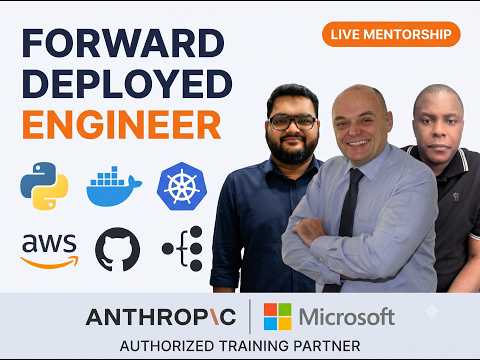
Stages 4 to 7 are where most self-taught engineers stall, because they are hard to practise alone. The 360DT Forward Deployed Engineer Program runs this whole map live over 16–18 weeks, with eight real deployments, a panel-evaluated capstone and dual certification prep.
Stage 5: Deployment, cloud and operations
A working notebook is not a deployment. This stage is what turns your portfolio from a tutorial folder into something you can defend in an interview.
Take one build all the way. Serve it with FastAPI including streaming and authentication. Containerise it. Deploy to a real cloud — Azure, AWS or GCP, with Azure common in enterprise contexts. Set up IAM properly, manage secrets, add tracing with OpenTelemetry, instrument evaluation, and watch the cost.
Then red-team it yourself. Prompt injection, the OWASP LLM Top 10, and the failure modes you would rather find before the customer does. Being able to hand someone a report of how your own system breaks is an unusually strong interview signal.
Stage 6: Customer delivery craft
This is the layer you cannot learn from documentation, and it is the one that separates an FDE from every other kind of AI engineer. Salesforce's FDE leadership has named problem-solving, technical breadth, communication, business acumen and a learning mindset as their five screening criteria — only one of which is purely technical.
The skills: running discovery sessions that surface the real problem rather than the requested feature, decomposing ambiguity into a scoped plan, communicating trade-offs to audiences from engineers to executives, handling security and procurement conversations, running a clean POC-to-production handoff, and driving adoption after go-live.
How to get reps if your current job is not customer-facing: join customer calls, volunteer for implementation work and production rollouts, write customer-facing documentation, and take the ambiguous project nobody wants. Practise decomposing a vague brief out loud, because that is precisely what the interview tests.
Stage 7: Portfolio and landing the role
Aim for three or more deployed systems you can walk someone through: what the problem was, what you shipped, what it cost, what broke and what you did about it. That narrative is worth more than any certificate.
Search under every title variant, because the same job carries different names: FDE, FDSE, Forward Deployed Software Engineer, Applied AI Engineer, Deployment Strategist, Customer-Facing AI Engineer. Consider the internal transfer route — moving into an FDE seat from an adjacent role at your current employer is often the fastest path in.
Credentials such as Anthropic's Claude Certified Architect and Microsoft's AI-103 map well onto what postings ask for and are useful signals, but they are supporting evidence rather than the thing that gets you hired.
How long the transition takes from where you are
| Starting point | Realistic runway | What to focus on |
|---|---|---|
| Backend / full-stack engineer | 4–8 months | Strongest foundation. Skip most of stages 2–3; go hard on stages 4–6. Internal transfer is often fastest. |
| Data engineer | 5–9 months | Stage 3 is already yours. Add applied AI and deployment, and get deliberate reps on customer-facing work. |
| ML engineer / data scientist | 5–9 months | Shift from model accuracy to whole workflows. Production engineering and deployment are usually the gap. |
| DevOps / cloud engineer | 6–10 months | Stage 5 is already yours. Build application-level depth and applied AI. |
| Solutions architect / SE | 6–10 months | Stage 6 is already yours. The gap is hands-on build depth — you must implement, not just specify. |
| Career switcher | 12–18 months | Build genuine production coding ability first. FDE is rarely a first job. |
For the role itself, see what a Forward Deployed Engineer is. When you reach stage 7, the FDE interview questions guide covers the loop in detail, and FDE jobs in India covers who is hiring.
Frequently asked questions
How long does it take to become a Forward Deployed Engineer?
It depends on your starting point. A backend or full-stack engineer can move in roughly four to eight months, often fastest through an internal transfer. Data, ML and DevOps engineers typically need five to ten months. From a non-engineering start, plan twelve to eighteen months, because production coding ability has to come first.
Do I need a certification to become an FDE?
No. There is no single industry-standard FDE certification. Credentials such as Anthropic's Claude Certified Architect and Microsoft's AI-103 map well onto what postings ask for and are useful supporting signals, but a portfolio of deployed systems is what actually gets you hired.
What should I learn first on the FDE roadmap?
Production Python, Git, SQL and REST APIs, in that order. This layer is non-negotiable and no amount of AI knowledge substitutes for it. Every FDE job description assumes you can already ship software before you add customer ownership on top.
Can I become a Forward Deployed Engineer without an AI background?
Yes. You need applied AI capability rather than research-level machine learning: LLM APIs, prompt engineering, RAG pipelines, agents, evaluation frameworks and deployment. Strong software engineering plus applied AI beats deep theory with no shipping record.
Which stage do most people get stuck on?
Stages four through seven, and especially six. Applied AI and deployment are hard to practise alone without a real environment, and customer delivery craft cannot be learned from documentation at all. Most self-taught candidates arrive able to build but with nothing deployed and no customer-facing evidence.
Is the FDE roadmap different from an AI engineer roadmap?
They overlap heavily through the applied AI and deployment stages. The difference is stage six: an FDE roadmap adds customer discovery, scoping, stakeholder communication, security reviews and adoption ownership, which a standard AI engineer path does not cover.
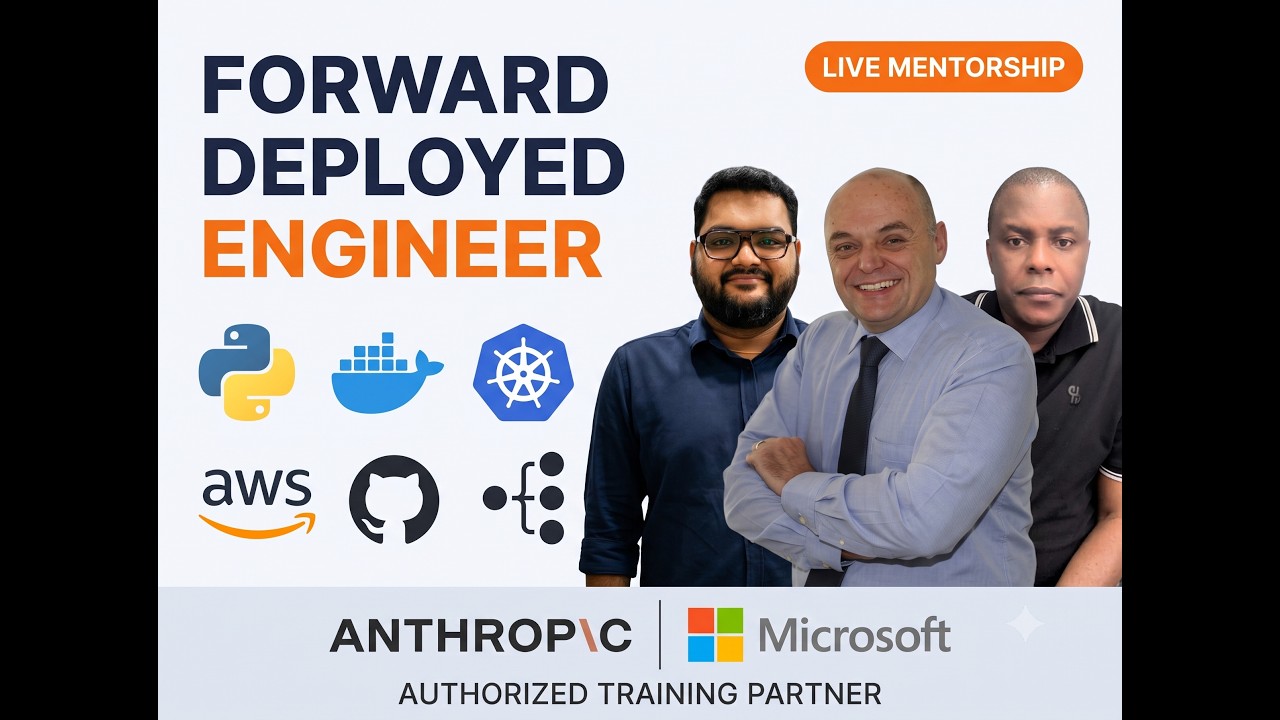
Run the whole roadmap in 16 weeks
Every stage on this map, taught live with mentor review, eight real deployments and a portfolio you can defend in an FDE interview.
- 16–18 weeks, live and mentor-led, 300+ hours of active learning
- Production RAG, agents, LangGraph, MCP, deployment and observability
- Client discovery, scoping, security reviews and POC-to-production handoff
- Eight real deployments plus a panel-evaluated capstone portfolio
- Dual certification prep: Claude CCA-F and Microsoft AI-103
Last updated August 2026. Salary and hiring figures cited on this page come from publicly reported third-party sources including Indeed, Glassdoor, SalaryExpert, TeamLease Digital and published job listings, and are provided for role context rather than as a guarantee of compensation or employment outcomes.
 Python
 Claude API
 OpenAI API
 FAISS
FAISS ChromaDB
 LangChain
 LangGraph
 CrewAI